Alongside many fellow quants, I love education and research. Positing structure that may exist, rigorously testing it, attempting to defend it until your house of cards falls down 95% of the time and you have to light the paper you've been working on for the past few months (or years) on fire whilst remaining ever the optimist moving forward because you want to know, you have to know.
Not because you want the recognition, wealth, prestige, but because you have to know. Motivation is flash paper, but curiosity? That drives discipline. Fall in love with the process and you'll want to improve every day. Pretty sure that's a James Clear thing, but I digress.
Regardless of the motivation, I've heard, time and time again, that quants are bad traders.
Why? (see, I have to know ;p)
They're some of the smartest people in the industry, but just because the analytics guy in the booth tells you that the stats say to throw the ball it doesn't mean that's what needs to happen, right now.
It's about risk, and what risk you can tolerate right now to achieve the desired outcome.
Let's use an example: variance risk premia. On average, if you go long convexity on the downside you are overpaying in the implied volatility sense for that protection. Insurance sellers demand a premium for offering that dollar in the economic state of the world that makes that dollar more valuable. If it wasn't a profitable business, nobody would sell insurance; effectively ensuring markets clear, we observe this premium.
It shouldn't be too much of a shock (ha, get it?). Volatility has to be a mean reverting process, by definition it is the expected surprise, and expectations adjust. If a unicorn jumped through your window this morning you'd be surprised...until it happened every day for a month, hence: volatility must be mean reverting. Therefore, forward variance tends to be in a state of contango, ETF proxies for volatility like VIXY experience severe NAV decay as they are constantly overpaying for derivatives to emulate that mean reverting volatility exposure.
You can't just hold a mean reverting process for free, it doesn't work like that.
Ok, it seems like we're pretty far in the weeds. What's my point? I've gotten into several academic debates where I suggest it makes a tremendous amount of sense to use the (what I call in my research) the Name Your Price Tool of Downside Protection. Based on my research, not all long convexity is priced equally, even though their downside protection remains roughly the same in certain crisis events.
I am immediately met with different flavors of "you're overpaying for downside protection, think VRP", "you're just going to bleed slower at best", "you're capping your upside by overpaying for premium on the downside".
But this analysis is fundamentally flawed, it's all ex-post. You should have folded the flop Roman. Ok, but what about when I river the card that gives me the nuts (poker term, please), then I'm a genius, right?
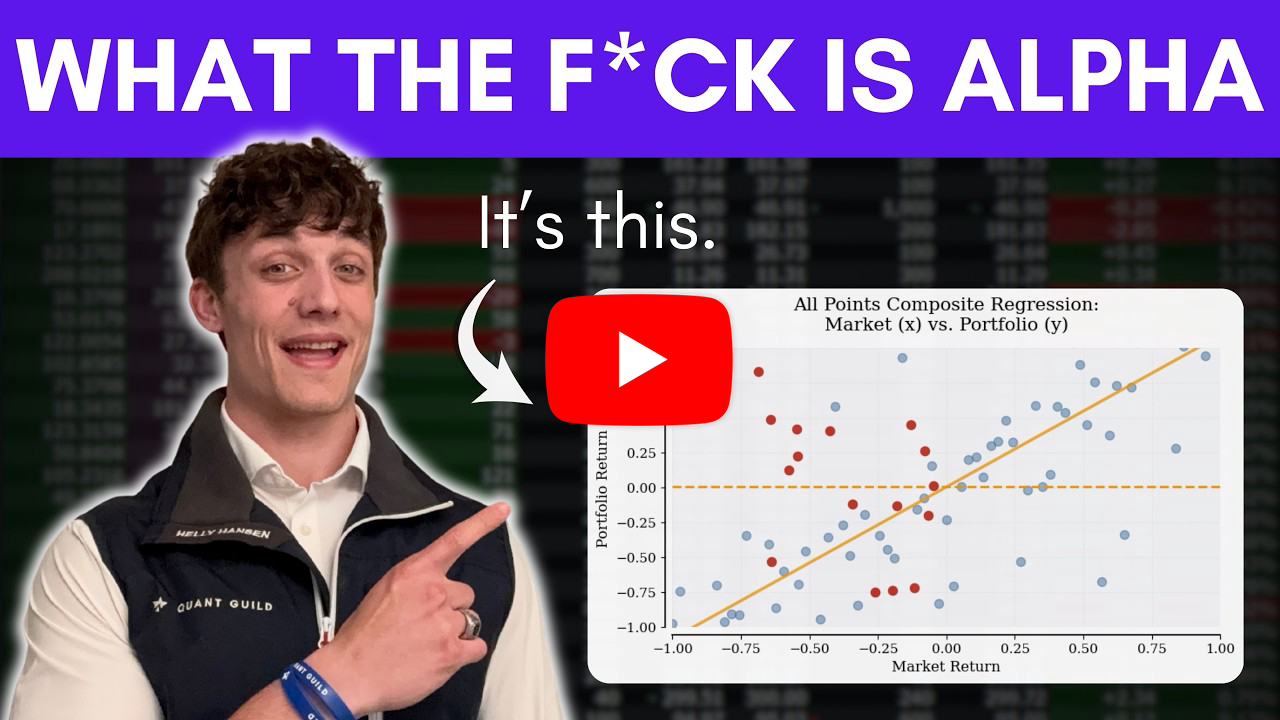
This is why quants are bad traders. Our equity curves are entirely path dependent, and manager discretion generates alpha by definition. If on average your manager outperforms there is reasonable evidence that, at least backward looking, they have an edge in their decision making process. Their discretion is a model like anything else, it just happens to exist in their mind. A tremendous tennis player has a model in their mind for how to win a game, it just happens to work more often than not, that's called an edge.
But how do you KNOW they have an edge?
You wouldn't know their name if they didn't have an edge.
That doesn't mean they are going to win every match, that doesn't mean you are going to win every trade, it doesn't mean it will persist going forward. It means over a long enough time horizon, if you survive, you will achieve a positive geometric trajectory.
Experience, like wealth, compounds. But only if you continue to update that model. If that model starts to fail and you roll over, you start losing, opponents get privy to what you are trying to do, you must change the model. You must update it.
That is the difficult part of every performance driven industry: there is no clear rule when to update, when we are experiencing a local drawdown and have to stay the course, when if we stay the course we are destined for our own destruction.
It's fundamentally about unknowing, accepting that we are dealing with incomplete information, and updating anyway.
It just so happens that this analysis is roughly impossible to do ex-post because you weren't there. Your biological agent was not capable of experiencing all the information each step of the way, even in a Markovian sense, to be able to discern what you would have done beyond a basic static ruleset.
If I decide to put on an overhedge for my portfolio right before a massive drawdown then I'm a hero. We can discuss the how, the why, the academic implications all we like but it's all performance driven. I still put on the hedge.
Too confusing, let's use Poker as an example.
If our hole cards are 2 and 7 why would we choose to play them? Ex-post we perform simulations and understand these cards do not offer favorable odds to win the hand.
But why might someone choose to play them? Do they think they have an edge against other players? Can they play looser and get them to fold? What if they hit the cards they need on the flop. Something that had an arbitrarily bad P-measure for success is actually substantially higher than the raw measure made it out to be in the simulations due to the risk premia available to the player that made that decision to see the flop.
This is largely my point, investment management, trading, is performance driven. If you have long volatility in your portfolio, a 2 and a 7, the ex-post academics, quants, whoever are going to be eager to tell you what you already know: the odds are not in your favor. But you're the one at the plate, and it's a bad idea to hit the ball until you knock it out of the park. You just have to survive long enough to be capable of doing so.
There is a difference between operating on vibes and genuine manager discretion. The difference is knowledge and experience. Extrapolation capacity demands both, performance driven outcomes always have. Think poker, think tennis, trading is no different. What has happened can be useful to understand our positioning, but doesn't actually govern our edge. That concept in all reality is amorphous, we can't measure it ex-ante, only ex-post in the context of extreme lossy compression.
This is why I find backtesting a violent crime (Kanye, nice), especially for students and new researchers getting involved in the space. I don't need a backtest to tell you what happens to your exposures in different states of the world, a backtest may be useful to discern the appropriate amount of leverage to target, and your VaR/C-VaR levels until, guess what, they aren't. Look at 2008, if you used historic returns as a proxy for those levels you would've gotten killed.
Model risk, performance, all comes down to the amorphous expectation function. Every manager has one, it's time varying, and that's the key to the managers that survive and the managers that die. It's what makes it an art. I can't describe what I did, I know what happened, was it the intended or unintended outcome? Did I survive? Can I iterate? It's literally how we learn everything, it's how we train machines, the only thing that separates the best in the world from those that never got there is quitting.
A close friend and retired Army drill sergeant told me breaking is the weather, quitting is a choice. Breaking makes people quit. Some quit before breaking.
This is why I love performance based outcomes. There's no discussion. Did you win or lose? Everything collapses to a binary outcome. We can debate and argue all we like. Did you submit or get submitted? Did you defeat or were you defeated? Did you make or lose money?
Does it make defeat painful? Sure, but it's literally the only way to win. The question isn't will you lose, it's will you survive? If you want to be a Super Bowl winning quarterback, you assume literally all the risk of losing, criticism, and the likes.
Afraid of performance?
Everyone is. Nobody wants to realize the state of the world where they lose, are you crazy? Position yourself for survival and you're ahead of most, put in more time and effort? Learn to iterate more efficiently? Play tight when you have to and loose when you need to? Not just for a day, a week, or a month, but all the time? There isn't going to be much keeping you from your objective.
It's as much an art as it is a science.
The mathematical structure of the world is on the side of those willing to stay the course. Progress compounds geometrically, iteration, even if slower than others, always wins. The literal quantitative manifestation of the tortoise and the hare.
Then when do we update and why?
If it was that easy, we'd all be super stars. Let me play my hand of poker and I'll let you play yours. You've heard of my name, at least for now, but if I'm right, if I have an edge, if I survive, this won't be the last time you'll be seeing it.
- Roman

 Roman Paolucci