 | | | 📜 A Note from the Guild Leader |
| Last week I worked on a series of interesting problems from the efficient simulation of fractional Brownian motion to the development of trading and hedging models for structured products, specifically the 🐦🔥 Autocallable Phoenix Note (sounds so sick, right?). What I've been calling "Quant Guild Season 2" is now in full swing! | | | To the former I proposed a modified implementation of the Davies-Harte scheme to save sample paths offline. To the latter, a local calibration of a stochastic model maintaining the covariance structure of the basket with the ability to include fundamental priors before deriving subsequent barrier probabilities and statistics. In tandem with this work, I hosted lecture and office hours for the current session of Financial Mathematics, posted the latest Quant Guild videos, and of course, continued developing material and recordings for the first offering in the Quant Bazaar and Quant Courses soon to be released to Quant Guild members. With that I will leave you to the Weekly Guild Letter. I hope you enjoy, and I hope you learn something! - Roman | | | 🧮 Quant Model of the Week |
| Autoregressive Conditionally Heteroscedastic (ARCH) Model |
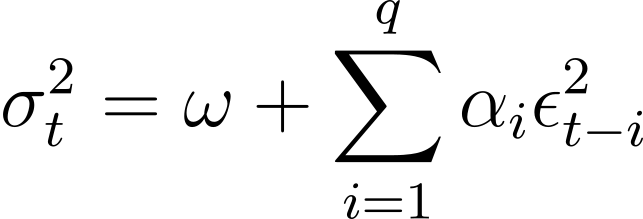
| By the early 1980s, quantitative finance had already embraced stochastic calculus, but markets were showing something models like Brownian Motion couldn’t explain — volatility came in clusters. Calm days followed calm days, and turbulence followed turbulence. Enter Robert Engle. In 1982, he introduced the Autoregressive Conditional Heteroskedasticity (ARCH) model — a way to let volatility evolve through time, responding to its own history. Instead of assuming constant variance, Engle’s idea was simple but profound: today’s risk depends on yesterday’s surprises. It was the first model to give volatility a memory. The model looks like this: | | | with ω setting the baseline variance and the α coefficients capturing how strongly volatility reacts to past shocks — a measure of how sensitive markets are to their own surprises. It’s volatility that learns. 📈 Model applications
You can use the ARCH model to capture time-varying volatility — the clustering of risk that real markets exhibit. When returns arrive in bursts of turbulence and calm, ARCH tracks it: today’s volatility depends on yesterday’s shocks. By specifying or calibrating model parameters of order p, you can model and forecast volatility paths that better reflect actual market behavior. This makes ARCH invaluable for risk management, Value-at-Risk estimation, and as a foundation for more sophisticated descendants like GARCH, EGARCH, and beyond. 🎓 A little story
Engle’s 1982 paper introducing ARCH was a quiet revolution. It gave volatility dynamics a voice — no longer just a constant “sigma,” but a living, breathing process. When he received the Nobel Prize in 2003, it wasn’t for complexity, but for capturing something markets had been showing all along: volatility has memory. Fast forward years later, I had the chance to see Engle speak about his latest research at the Bloomberg Quant Seminar Series (where I had also presented my work in generating volatility surfaces and approximating pricing functionals) — an absolutely wild experience. Listening to him discuss his current research efforts, surrounded by some of the sharpest minds in the industry, was electric — that was the kind of moment that reaffirms why we build models in the first place. 💡 Takeaway
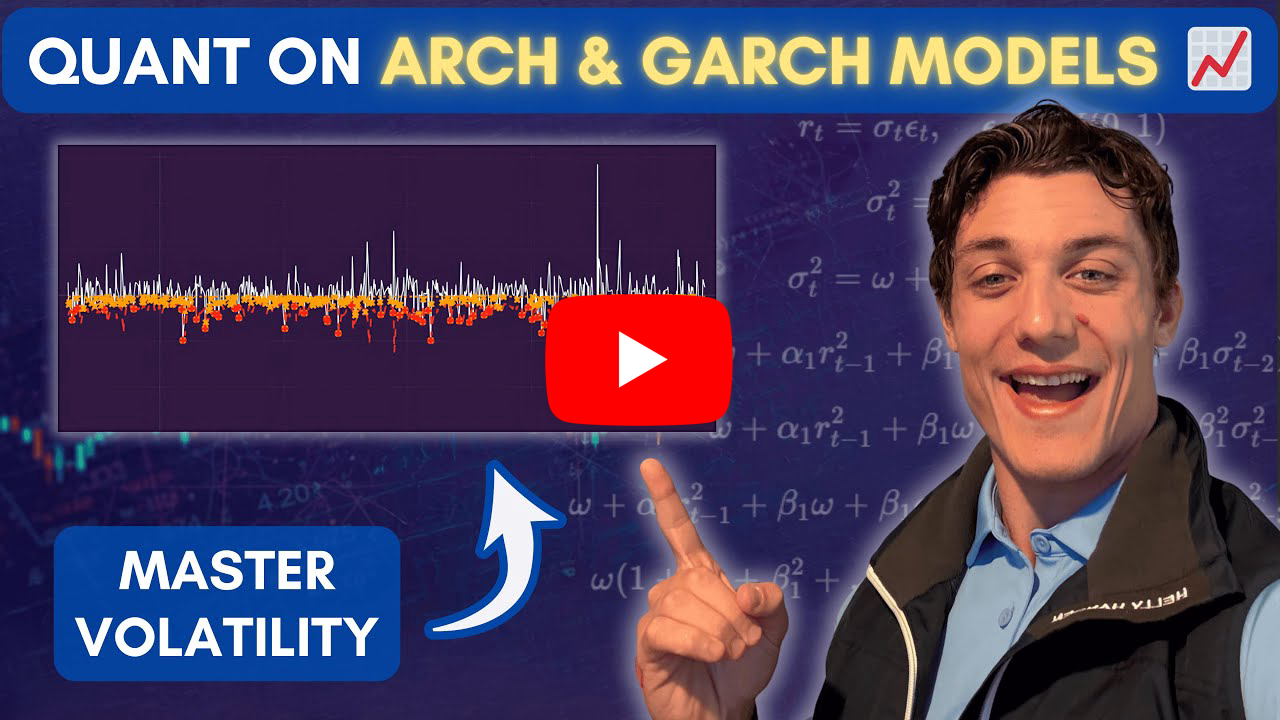
ARCH models brought realism to market risk. They remind us that uncertainty itself evolves — that volatility isn’t static noise, but structure. Every modern volatility model — from GARCH to stochastic volatility to realized variance — stands on the shoulders of Engle’s insight. Interested in learning more? I have a full video discussing the mathematics behind these models along with implementations for both calibration and risk management - check it out below! Quant Guild video on ARCH/GARCH Models 👇 | | | | | 🏆 Quant Question of the Week |
| Solution at the Bottom of this Email 👇 |
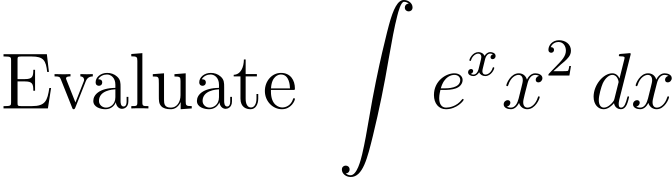
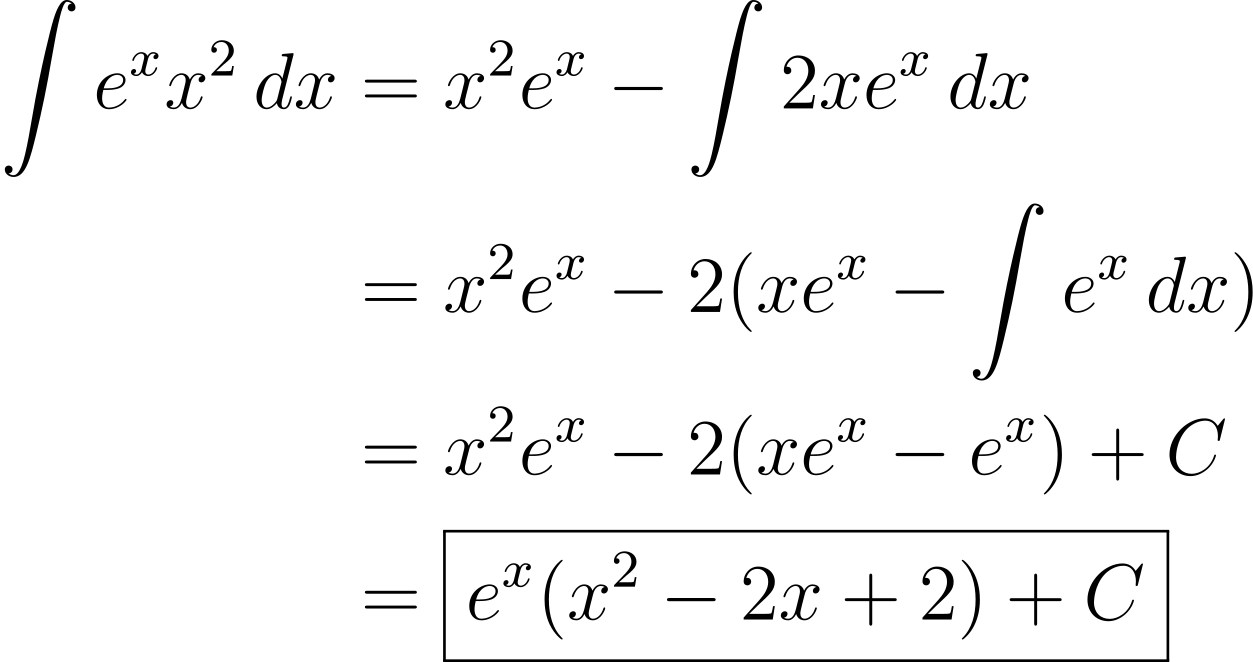
| | | Hint: The integrand can be decomposed into two functions. . . Need to study up on topics in math, probability, and finance? 👉 Learn to solve problems like this on Quant Guild — the platform I wish I had when I was studying to become a quant. | | | 📅 Quant Guild Week in Review |
| Central Limit Theorem, and My Life as a Quant |
|
|
|
|---|
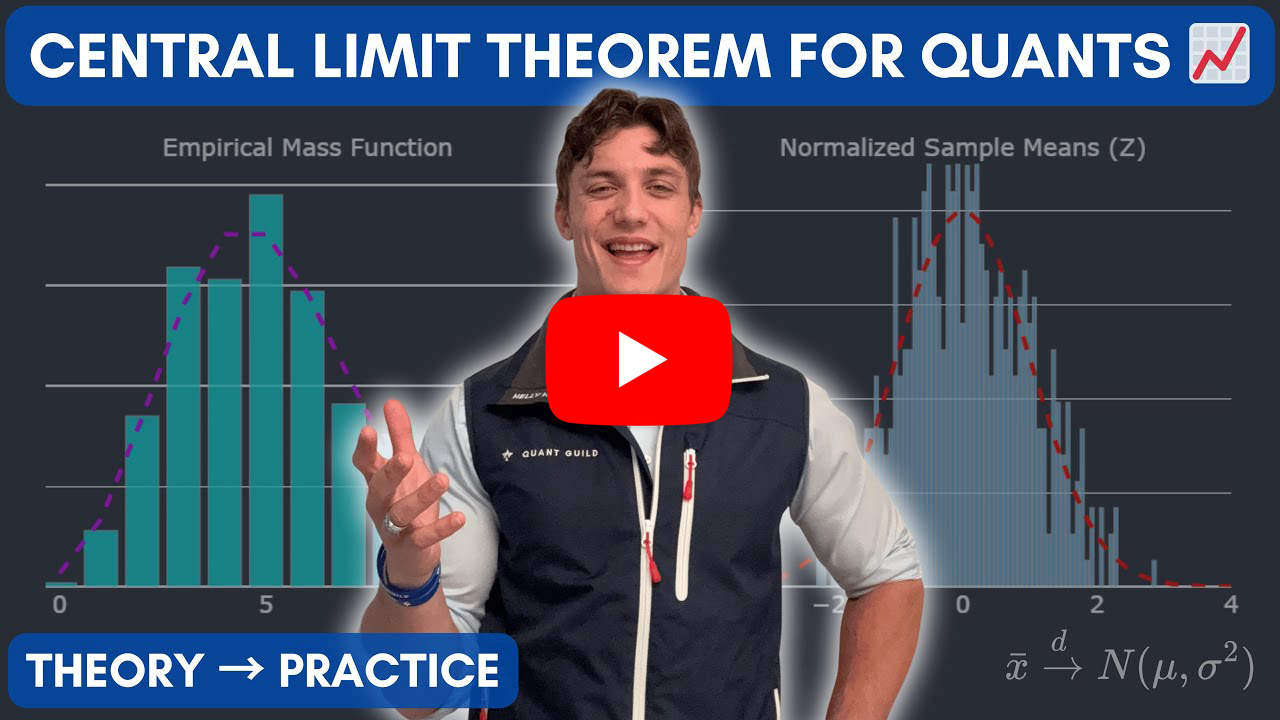
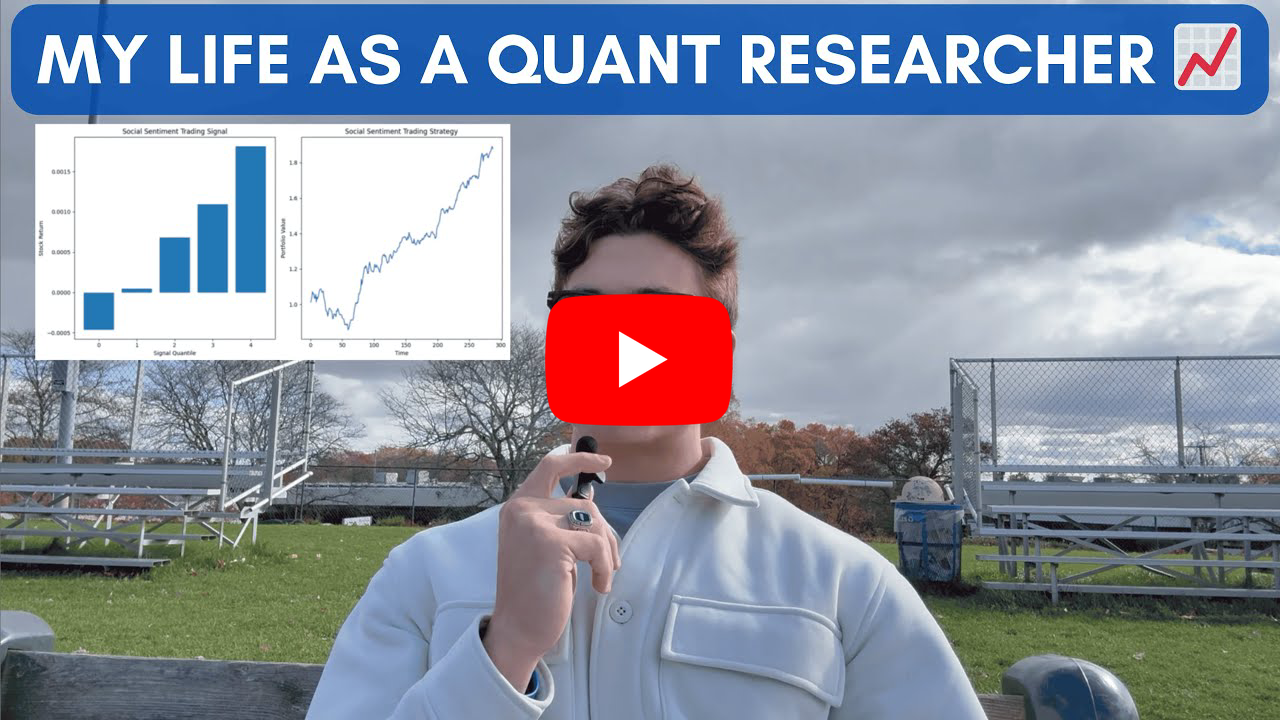
📊 Central Limit Theorem for Quant Finance | In this video, I break down one of the most important yet misunderstood ideas in all of quantitative finance — the Central Limit Theorem. We start from the basics of random variables and distributions, move through a rough proof using characteristic functions, and then bring it into practice with stock returns and trading signals. I show how the CLT bridges probability and statistics, letting us go from data to inference — from sample means to confidence intervals and hypothesis tests. But we also see where it breaks down in the real world: markets aren’t stationary, and distributions shift over time. So while the theorem gives us a powerful snapshot of uncertainty at a point in time, we still need to constantly recalibrate and update our models — which is, frankly, why we all still have jobs in quant finance. Here's a link to the full video 👇 | | | 🌱 My Life as a Quant | This one’s a little different — no script, no equations, just me talking about how I got into quantitative finance and what the journey’s really been like. I share how I went from building trading bots in high school with very little understanding of math, to studying both quantitative finance and math at James Madison University, to joining Bruno Dupire’s team at Bloomberg, where I learned more than I thought possible. I talk about what shaped my philosophy as a quant — rejecting gatekeeping, focusing on learning over prestige, and building Quant Guild to make that same opportunity accessible to anyone interested in the field. I still trade, research, and teach every day, and I wouldn’t trade it for anything. If you’ve ever wondered what a real path into quant finance looks like, this is my unfiltered version of it. Here's a link to the full video 👇 | | |
|
|
|---|
|
 | 📈 Why 10,000+ Quants Study on Quant Guild | Quant Guild is the one-stop platform for mastering the math that powers modern finance. With 90+ specialized lessons, adaptive practice with gamified progress that scales with your skill level, real interview questions, courses from A - Z in coding, math, probability & statistics, and exclusive live classes with me, it’s built to take you from fundamentals to the front-office. Everything’s designed for how real quants think and work — focused, practical, and deeply technical. That’s why over 10,000+ students and professionals study on Quant Guild to sharpen their edge and make smarter decisions in the face of uncertainty. |  |
|
|
|---|
| | I'm in QR preparing for technical interviews and your practice helped me brush up on probability, thanks | | |
| | |
|
| | | I learned more here in two days than an entire semester of college | | |
| - Guy on Discord Who DM'd Me |
|
|
|
|---|
|
| | ✅ Quant Question of the Week |
| | | | | | |
|
|
|---|
|

 Roman Paolucci