 | | | 📜 A Note from the Guild Leader |
| Last Thursday evening around 9pm I found time to resolve an issue in one of my systems. Nothing earth shattering, I estimated about 20 minutes to figure out what was going on and 5 minutes of actual coding. If you happened to be active in my Discord that evening between 11pm and 3am you will know this was not the case 😅 | | | An entirely different level of "but it works on my machine" is the fabled "but it works on my machine sometimes". I am happy to report that I was able to resolve the issue quite early Friday morning, but I missed my 6am workout with my buddy Frank (sorry Frank!). To my engineers out there: multithreading love gotta I, right am? | | | In other news, I put the next course to release on Quant Guild to a vote (on Discord) where Quant Stats beat out Quant Math by a narrow margin. This course has taken a significant amount of time to put together, it is effectively a college class with industry insights rolled into one. To those looking forward to Quant Math fear not, its release will follow shortly after Quant Stats! With that I will leave you to the Weekly Guild Letter. I hope you enjoy, and I hope you learn something! - Roman | | | | | Black Friday Contest: In the Weekly Guild Letter on November 24th a problem will appear in this part of the email. The first few to solve it will find a discount code for lifetime membership to Quant Guild (the discount code is the solution). The contest will end on Cyber Monday or when the quantity of codes run out. Good luck! | | | 🧮 Quant Model of the Week |
| Capital Asset Pricing Model (CAPM) |
| Long before factor models became an arms race, before machine learning pipelines and alt-data feeds took over the industry, finance was wrestling with a much simpler question: what should the expected return of a risky asset be, given its risk? In the 1960s, Sharpe, Lintner, and Mossin gave the field its first disciplined answer: the Capital Asset Pricing Model (CAPM). The model looks like this: | | | where beta reflects how strongly the asset moves with the market, and the spread between the market’s expected return and the risk-free rate defines the market’s risk premium — the basic risk–return tradeoff that continues to guide quantitative thinking decades later. 📈 Model applications
You can use the Capital Asset Pricing Model (CAPM) to link an asset’s expected return to its exposure to broader market risk. The model suggests you only get paid (in expectation) for bearing systematic risk — the risk you can’t diversify away. Intuitively, β measures how tightly an asset’s returns move with the market: If CAPM were literally correct, portfolio management would “just” be a game of competitively choosing which betas to hold at which times, trying to maximize returns per unit of market exposure. Idiosyncratic noise wouldn’t be rewarded, and once you’ve diversified it away, only systematic risk would matter. Of course, reality pushed back. CAPM’s clean one-factor story couldn’t explain all the cross-sectional patterns in returns — size, value, momentum, quality, low-vol, and so on. That gap between theory and data is exactly what gave rise to modern factor models: instead of a single market beta, assets load on multiple systematic sources of risk or mispricings (alpha), each with its own premium. 🎓 A little story
When I first learned CAPM and its extension to multi-factor models, they felt largely unsatisfying. On paper, you have a concise expectation, but in practice, you only see one realization of a sample path. Time variation, structural breaks, and rare but massive surprises all heavily distort both short- and long-horizon realized returns. Taken together with the Efficient Market Hypothesis, the whole picture initially felt like a closed system: investors as rational agents simply competing over which bundle of risk premia to hold, with “alpha” reduced to a measurement error around a fair game. But that’s not how the real world behaves, agents aren't rational, and equilibrium by supply and demand isn't sufficiently to command the fair price. The more time you spend in live markets, the more obvious it becomes that academic models break down quickly at the edges: frictions, constraints, flows, regulation, leverage cycles, behavioral quirks — all of these introduce structural alpha. It’s not magic; it’s an artifact of markets being complex, path-dependent, and far from perfectly efficient. The theory is still incredibly valuable — it gives you a language and a benchmark — but the world is messier than a single beta. 💡 Takeaway
CAPM doesn’t fully describe markets, but it gave us a powerful baseline: return as compensation for systematic risk. From there, the story naturally extended to multifactor models and beyond. Even when we “break” CAPM with anomalies and new factors, we’re still arguing in its shadow — about what risks matter, how they’re priced, and where genuine alpha can survive. | | | 🏆 Quant Question of the Week |
| Solution at the Bottom of this Email 👇 |
| | | Need to study up on topics in math, probability, and finance? 👉 Learn to solve problems like this on Quant Guild — the platform I wish I had when I was studying to become a quant. | | | 📅 Quant Guild Week in Review |
| Neural Networks and Quant Reading List |
|
|
|
|---|
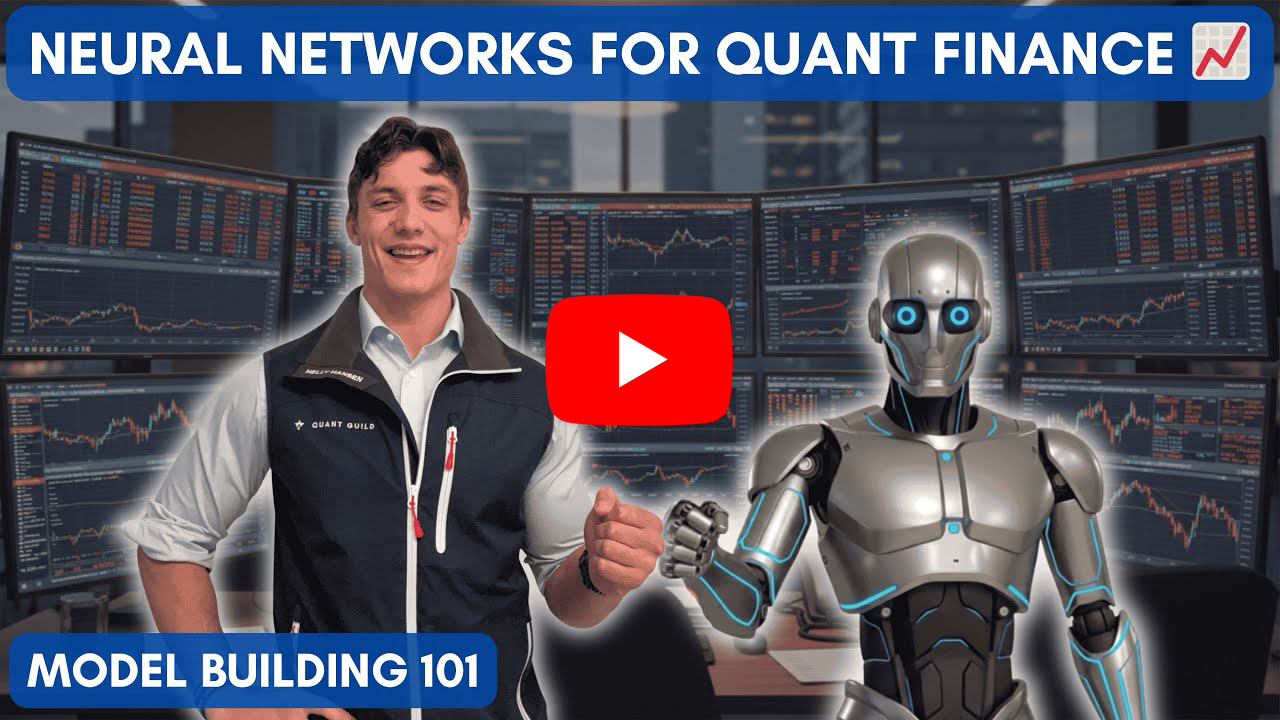
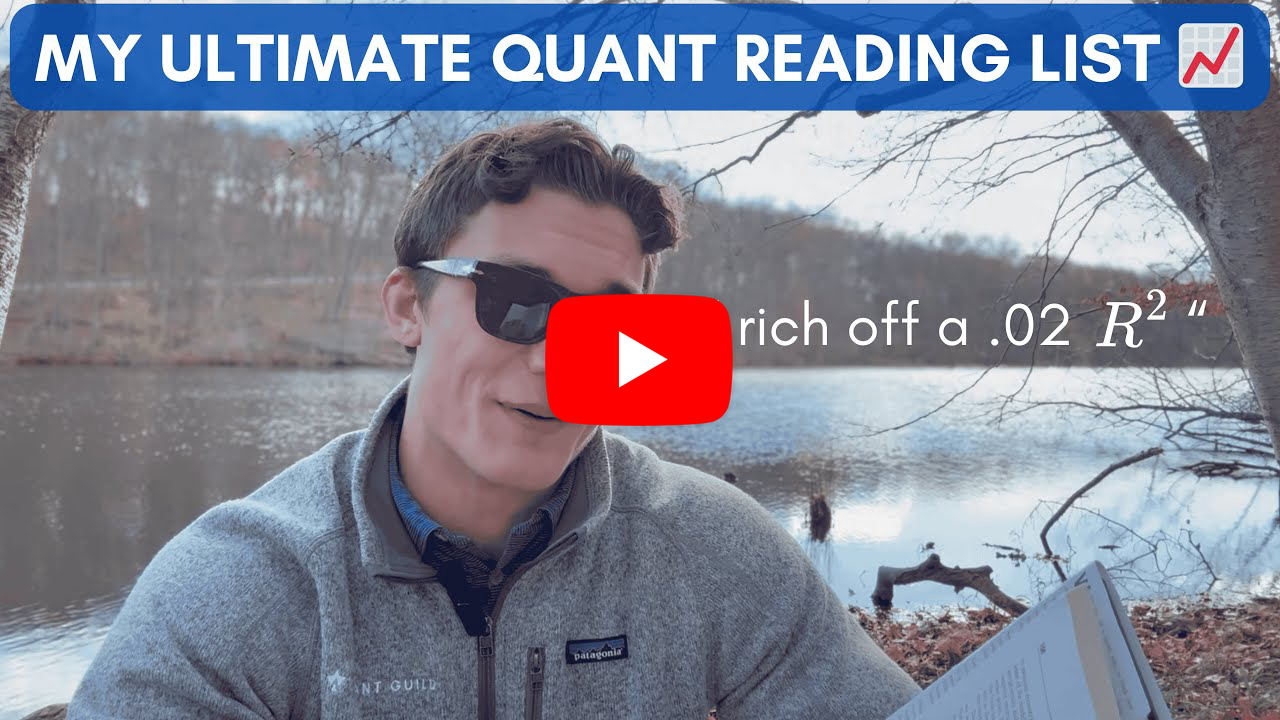
📈 Neural Networks for Quant Finance | In this video, I walk through a clean, generalized framework for how statistical learning models actually work — what they learn, how they learn, and why they’re never actually “predicting” anything. I show that every model in quant data science is really just trying to learn an expectation by minimizing error, and that robustness matters far more than chasing a perfect in-sample fit. From there, I introduce neural networks as universal function approximators — composite functions made of weight and bias matrices — and explain why they’re so powerful: they can learn virtually any continuous expectation function. I use simple examples like dice rolls and football-throwing distance to build intuition, and then highlight why these models fail on raw stock prices or returns: the underlying distributions shift too violently over time. Finally, I demo how we can train a neural network to learn the Black-Scholes pricing functional, and talk about real quant applications like signal generation, exotic option pricing, dimensionality reduction, and risk modeling. It’s a full walkthrough of how these models fit into the quant toolkit — and how to actually use them responsibly in a non-stationary world. Here's a link to the full video 👇 | | | 🎲 Books that Made Me a Quant | In this video, I walk through the books that have shaped me as a quant and a person — not as décor on a bookshelf, but as tools I’ve repeatedly gone back to as my “classroom” before stepping into the real world to test ideas. I split them into three categories: books that shaped the way I think about trading, books that shaped the way I think about modeling, and books that have grounded me throughout my entire journey. These are the titles that influenced my approach to strategy design, model development, alt-data research, and even how I think about my career and personal growth as a quant. 📈 Trading Books Option Volatility & Pricing — Sheldon Natenberg Advances in Financial Machine Learning — Marcos López de Prado Inside the Black Box — Rishi Narang
📊 Modeling Books 📜 Honorable Mentions (Pricing Derivatives) 🌊 Grounding Books Ego Is the Enemy — Ryan Holiday Meditations — Marcus Aurelius Discourses and Selected Writings — Epictetus
Here's a link to the full video 👇 | | |
|
|
|---|
|
 | 📈 Why 10,000+ Quants Study on Quant Guild | Quant Guild is the one-stop platform for mastering the math that powers modern finance. With 90+ specialized lessons, adaptive practice with gamified progress that scales with your skill level, real interview questions, courses from A - Z in coding, math, probability & statistics, and exclusive live classes with me, it’s built to take you from fundamentals to the front-office. Everything’s designed for how real quants think and work — focused, practical, and deeply technical. That’s why over 10,000+ students and professionals study on Quant Guild to sharpen their edge and make smarter decisions in the face of uncertainty. |  |
|
|
|---|
| | I'm in QR preparing for technical interviews and your practice helped me brush up on probability, thanks | | |
| | |
|
| | | I learned more here in two days than an entire semester of college | | |
| - Guy on Discord Who DM'd Me |
|
|
|
|---|
|
| | ✅ Quant Question of the Week |
| | | | | | |
|
|
|---|
|

 Roman Paolucci