 | | | 📜 A Note from the Guild Leader |
| You might remember how during the Q/A at my seminar with UCSD's Triton Quantitative Trading I mentioned that my computer needed an upgrade. Well, when I sat down at my desktop the other day I saw a beautiful rainbow, but not outside, it was a pixelated mess on my monitor instead of my code. | | | There's nothing quite like hedging open positions from the Interactive Broker's app on your phone 😅. My system image is backed up on the cloud so data is never a concern but I was still in dire need of a new build. Gotta give huge props to my buddy Stan who helped me turn around a brand new fine-tuned machine same week (you're the man Stan!). In other news, I met with a few institutional clients last week and aided in trading signal optimization. At this point, I'm not easily impressed by cursory performance metrics but some of the signals I observed were quite impressive in terms of sheer stability and OOS performance. Good for them, and great for their investors! | With that I will leave you to the Weekly Guild Letter. I hope you enjoy, and I hope you learn something! - Roman | | | | | | | | | Black Friday Contest: In the Weekly Guild Letter on November 24th a problem will appear in this part of the email. The first few to solve it will find a 20% discount code for lifetime membership to Quant Guild (the discount code is the solution). The contest will end on Cyber Monday or when the quantity of codes run out. Good luck! | | | 🧮 Quant Model of the Week |
| Ornstein-Uhlenbeck (OU) Process |
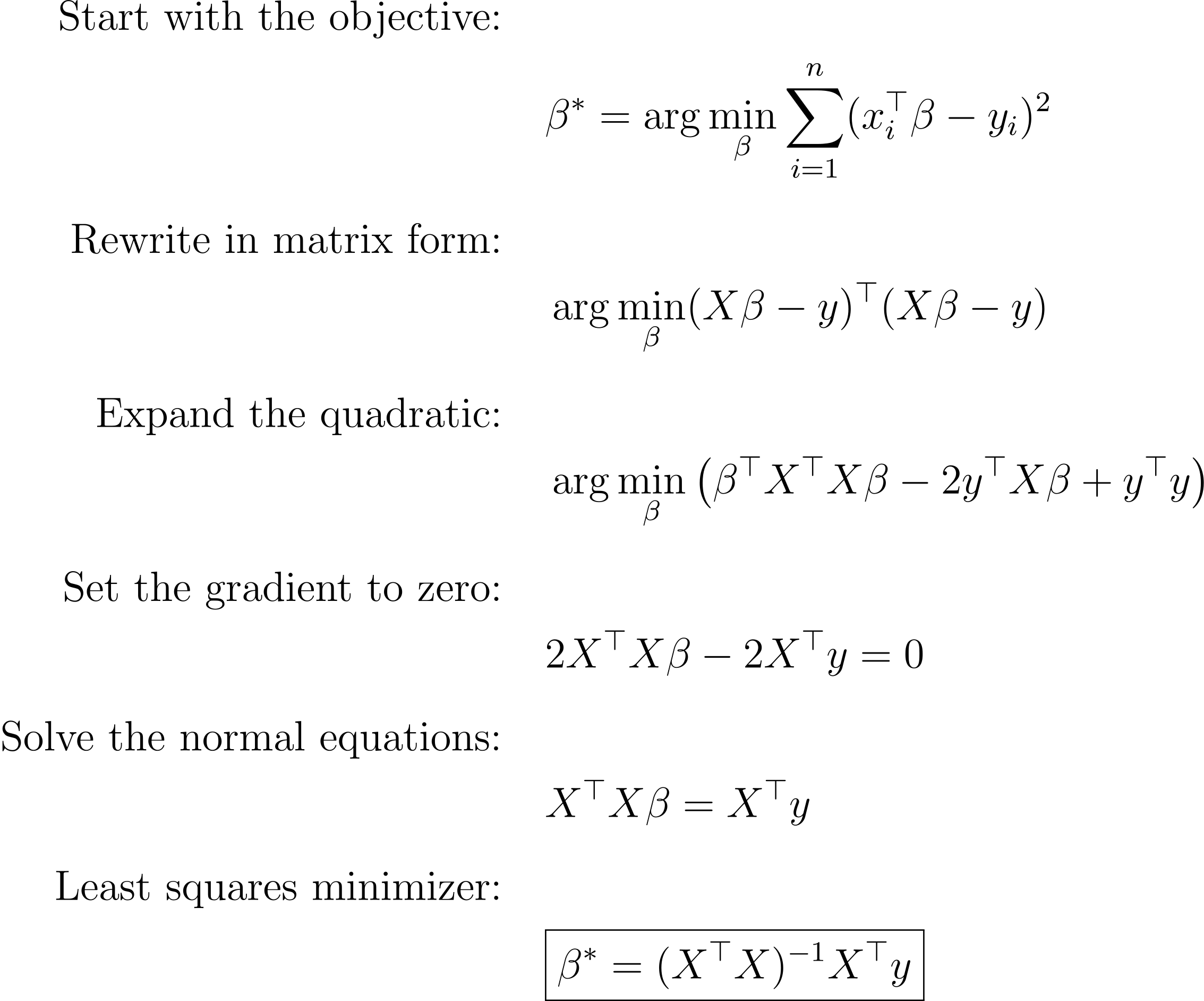
| Some behaviors in markets are too stubborn to ignore. Spreads that widen only to snap shut. Signals that surge, fade, then drift back toward their usual level. Interest rates that wander but refuse to escape gravity. Not everything in finance drifts freely, some things want to return to some level, fixed or otherwise. Mean reversion shows up everywhere: rates, commodities, pairs trades, factor signals, volatility dynamics, the list goes on. When you need a model that captures both noise and a process' natural tendency to revert to a mean level the Ornstein–Uhlenbeck (OU) process is usually the first stop. The model looks like this: | | | where theta reflects the speed of reversion, how aggressively the process is pulled back toward its anchor, and mu represents the long-run level the system gravitates toward. Add in sigma, the volatility that keeps the path wandering, and you get a model that captures one of the most intuitive behaviors in markets: drifting, but not drifting forever. 📈 Model applications
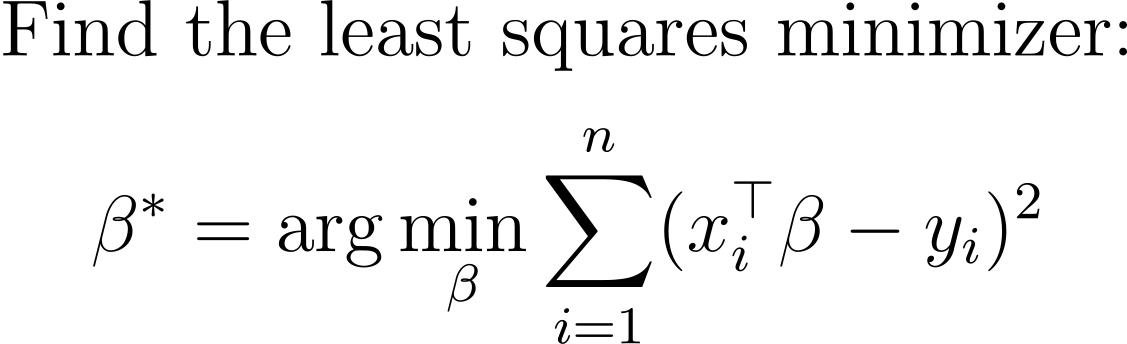
The Ornstein–Uhlenbeck process shines anywhere you see movement that wants to return to a level. In rates, it expresses the gravitational pull toward policy and macro equilibrium. In commodities, it captures inventory dynamics and storage pressures. In spreads and statistical arbitrage, it models the ebb and flow of convergence trades. And in signals with decaying predictive power, it mirrors the slow bleed back toward noise. In volatility modeling, mean reversion lets us treat market fear as something that spikes but doesn’t stay high forever. An OU-style process gives volatility a natural heartbeat: it jumps when the world acts irrationally, then gradually calms as the shock fades. This simple idea powers many volatility models because it reflects how emotions in markets—panic, uncertainty, relief—tend to wash through and settle rather than drift indefinitely. For option markets, the same mean-reverting logic keeps the entire volatility surface from wandering off into unrealistic territory. Implied volatility can wiggle, twist, and shift shape, but it does not drift endlessly upward or downward. OU-type dynamics act like a quiet stabilizing force, pulling the surface back toward a reasonable state so it behaves more like a living system and less like a runaway forecast. Beyond volatility, mean reversion helps explain subtle patterns that don’t look like prices at all. It can model how trading edges decay as more people discover them, how supply–demand imbalances in commodities work themselves out, or how relative-value trades slowly converge when temporary distortions fade. In all these places, the OU process captures a simple truth: many things in markets get pushed around, but most of them eventually return to a time variant equilibrium. 🎓 A little story The first time I calibrated the process to historical data, fitting theta, mu, and sigma, and then pushed it forward in simulation, it was immediately obvious that the long-run mean wasn’t actually long-run at all. The calibrated mu held for a window…then shifted. The apparent equilibrium moved. The target drifted. That was a moment where things clicked for me: modeling isn’t necessarily hard because the math is complicated; it’s hard because the world doesn’t stay still. A process can look beautifully mean-reverting until it doesn’t. What seems stationary in one sample becomes unstable in the next. Volatility swells and contracts. Distributions reshape themselves. Suddenly your carefully chosen parameters are describing a regime that no longer exists. The OU process doesn’t hide this fact, it reveals it. And that realization sets the stage for the deeper lesson about non-stationarity and subsequent models to handle such empirical behavior. Once you notice this, you start to appreciate how much of the structure in markets is dynamic: supply and demand regimes, macro cycles, liquidity conditions, risk appetite. Even in mean-reverting systems, equilibrium isn’t a point, it’s a moving target, a time variant equilibrium. 💡 Takeaway The OU process doesn’t perfectly describe markets, but it gives us a disciplined way to model one of their most persistent behaviors: reversion with noise. It’s foundational and forces us to acknowledge how unstable real-world assumptions are. Every sophisticated model, from stochastic volatility to regime switching to nonlinear mean reversion, grows out of this simple insight. And even when those advanced models break, we’re still reasoning in the OU framework’s shadow: what pulls a process back, what pushes it away, how stable the mean really is, and how much of the movement is noise versus structure. | | | 🏆 Quant Question of the Week |
| Solution at the Bottom of this Email 👇 |
| | | Need to study up on topics in math, probability, and finance? 👉 Learn to solve problems like this on Quant Guild — the platform I wish I had when I was studying to become a quant. | | | 📅 Quant Guild Week in Review |
| Natural Language Processing and Cracking the Quant Interview |
|
|
|
|---|
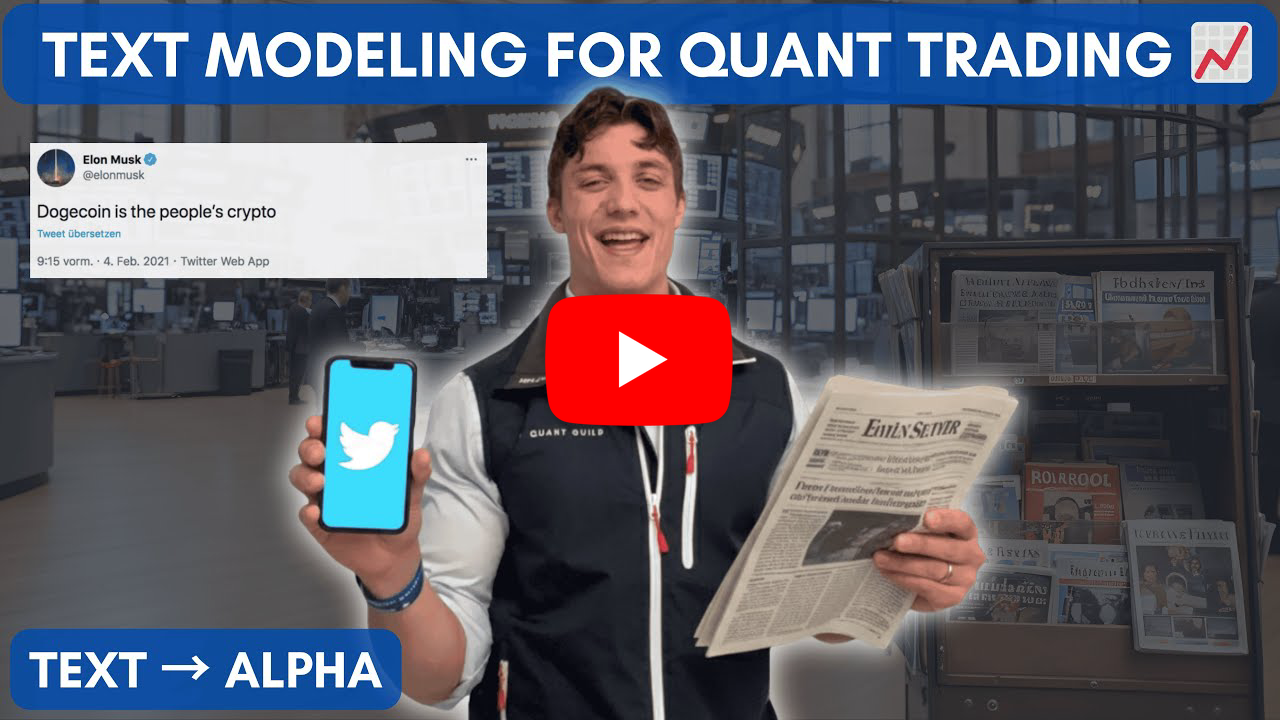
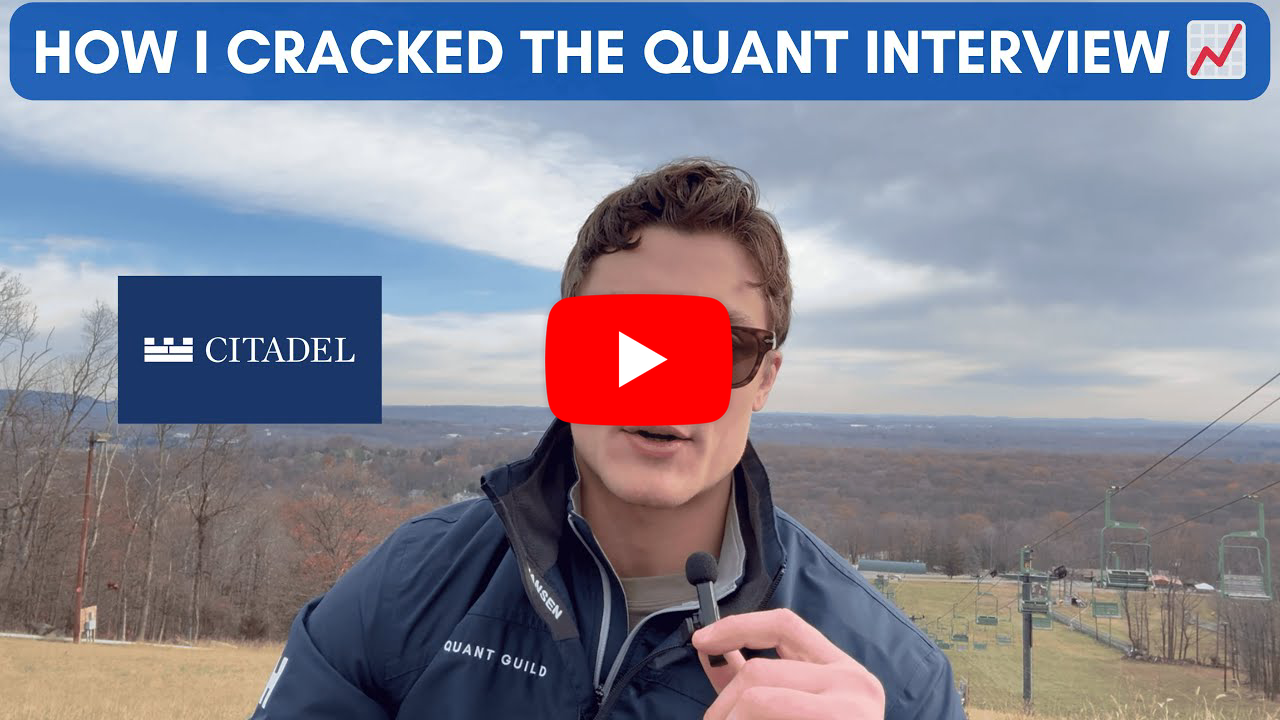
📈 Natural Language Processing (NLP) for Quant Trading | In this video, I walk through how to turn raw text — tweets, news, filings, anything — into real, quantitative trading signals. I start with the core idea that in quant trading there’s an inverse relationship between data accessibility and alpha: the harder the data is to acquire and interpret, the more opportunity it usually contains. That’s why we explore text as alternative data. I explain the full pipeline: building corpora, tokenizing documents, and converting qualitative text into quantitative structures like document-term matrices. From there, we look at similarity measures such as cosine similarity, dictionary-based sentiment scoring, and improvements using bigrams, trigrams, and more robust models like VADER. I show the practical challenges — noise, ambiguity, negations, and the importance of capturing financial lexicon — and why simple models often break in funny ways (like confusing Dogecoin with DOGE the government agency). We then move into the crucial step: linking extracted signals to tradable instruments using named entity recognition, and finally stitching everything together into a cross-sectional long–short strategy. I walk through how to aggregate signals across thousands of documents, rank securities by signal strength, and evaluate whether the structural inefficiency actually exists via backtesting. It's a full blueprint for how NLP sits inside a modern quant research pipeline — from raw text to market-neutral alpha. Here's a link to the full video 👇 | | | 🎲 How I Cracked the Quant Interview | In this video, I break down how my interview experiences with Citadel, Akuna, and AQR shaped the framework I still recommend to students today. I walk through what I did right, what I did wrong, and the three lessons that completely changed the way I approach the quant interview process. From Citadel, I learned the importance of not hedging — you have to interview for the roles you genuinely want, because the interviewer will immediately sense when you’re not excited about the work itself. From Akuna, I realized how much it matters to focus on what matters to your interviewer: people hire people, and when they see you light up talking about your own projects and trading experience, the whole conversation changes. And from AQR, I learned the power of immersion — when you truly love the field enough to study, build, trade, and research on your own, even the most esoteric technical questions stop feeling foreign. I close by talking about failure, persistence, and why I took the “burn the boats” approach — giving myself no fallback option, which forced me to push through every setback until I broke in. These three principles ultimately got me offers, and they’ve consistently worked for the students I mentor as well. Here's a link to the full video 👇 | | |
|
|
|---|
|
 | 📈 Why 10,000+ Quants Study on Quant Guild | Quant Guild is the one-stop platform for mastering the math that powers modern finance. With 90+ specialized lessons, adaptive practice with gamified progress that scales with your skill level, real interview questions, courses from A - Z in coding, math, probability & statistics, and exclusive live classes with me, it’s built to take you from fundamentals to the front-office. Everything’s designed for how real quants think and work — focused, practical, and deeply technical. That’s why over 10,000+ students and professionals study on Quant Guild to sharpen their edge and make smarter decisions in the face of uncertainty. |  |
|
|
|---|
| | I'm in QR preparing for technical interviews and your practice helped me brush up on probability, thanks | | |
| | |
|
| | | I learned more here in two days than an entire semester of college | | |
| - Guy on Discord Who DM'd Me |
|
|
|
|---|
|
| | ✅ Quant Question of the Week |
| | | | | | |
|
|
|---|
|

 Roman Paolucci