 | | | 📜 A Note from the Guild Leader |
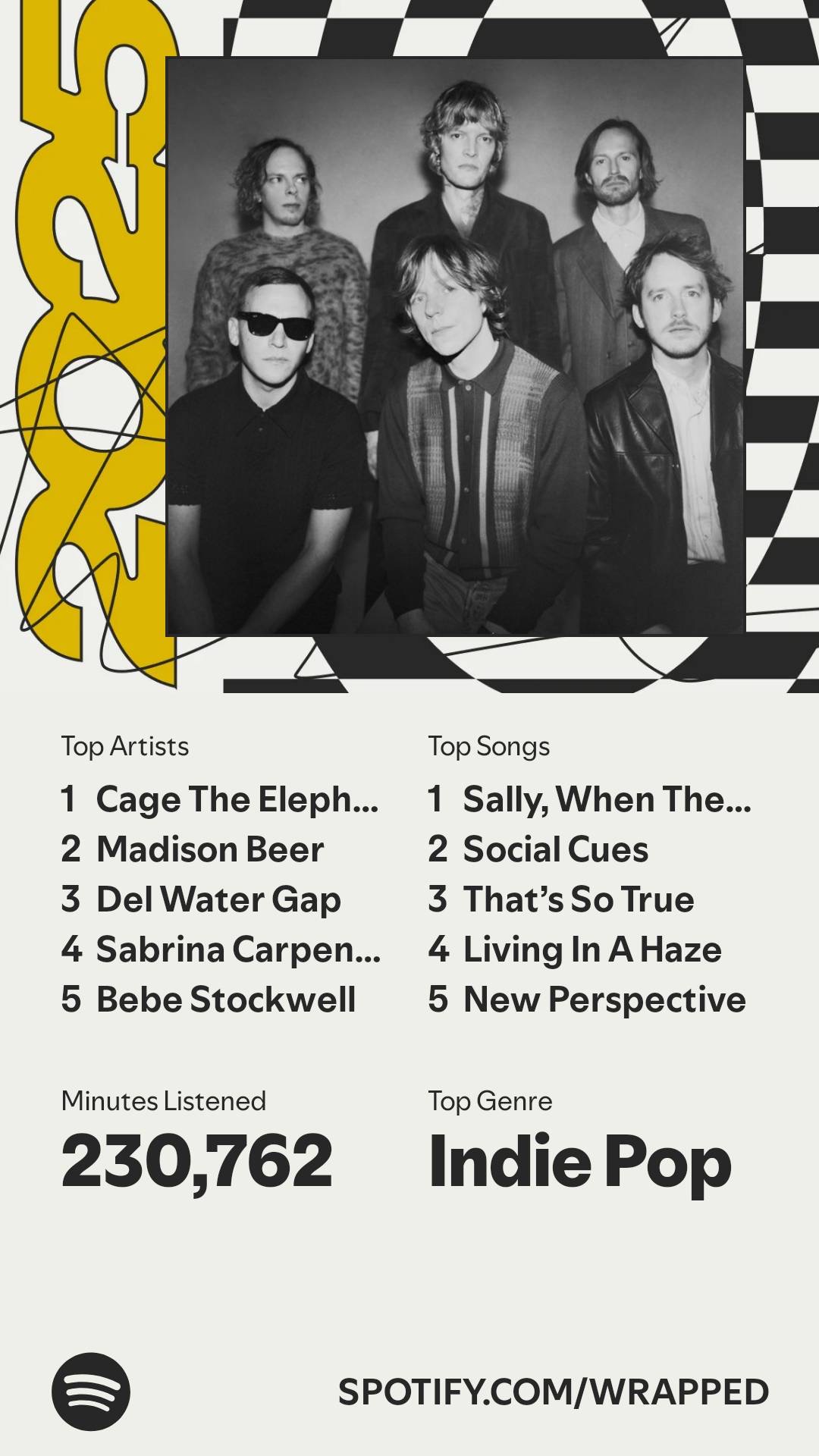
| Well, Spotify wrapped dropped last week so I figured I'd share my top artists and songs that got me through a series of 1 - 4am deployments, bad trades, 6am gym sessions, and of course, accompanied me while I conducted quant research. | | | I wish I could say that I shared my account and the Sabrina Carpenter and Madison Beer wasn't me, but listening to their music has been extremely positive EV so it is what it is. Correlation never implies causation, BUT it could; so if you're looking to add to your edge in the markets throw on Espresso or make you mine. This has also quantified how much coding and research work in the quant space I've done this past year: 230,762 minutes? When I'm not instructing live classes, or meeting with students, professionals, or institutions I apparently have Spotify on. I've worked an incredible amount this year, and in a space governed by uncertainty one thing will never change: I'll never stop creating the best educational quantitative finance content I possibly can. | With that I will leave you to the Weekly Guild Letter. I hope you enjoy, and I hope you learn something! - Roman | | | 🧮 Quant Model of the Week |
| Fundamental Theorem of Asset Pricing (FTAP) |
| When you strip away all the finance jargon, the Fundamental Theorem of Asset Pricing is really just telling you one thing: if markets don’t allow arbitrage, then every asset has a fair price: the discounted, risk-neutral expectation of its payoff at time T. That’s it. You take the randomness out by taking the expectation, and what’s left is the path the price should follow on average, a martingale under the risk-neutral measure. It’s the same idea as averaging dice rolls, just applied to full-blown stochastic processes. Here’s what the theorem suggests: | | | Where X is the model (stochastic differential equation) selected to represent the dynamics of the asset, F is a filtration available at spot time t and the entire process is observed under the discounted risk-neutral expectation. Effectively, the drift term in our model X disappears under the risk-neutral measure because we’ve constructed a world where investors only require compensation for time, not risk. The expectation is taken under this adjusted measure, pulling randomness out of the payoff. And the discount factor ensures that a dollar tomorrow is valued correctly today. In other words, the FTAP tells us something surprisingly intuitive: price is just the present value of the average payoff, once you step into a world where risk has been neutralized by replication. 📈 Model applications
The FTAP sits underneath almost everything in derivative pricing. It’s the quiet engine behind Black–Scholes, behind interest-rate models, behind Monte Carlo pricing, behind risk-neutral trees. Anytime you see a price written as
“discounted expectation of payoff,” you’re looking at the FTAP in action. It turns pricing into a workflow:
pick a model → calibrate it → simulate/payoff → discount → average.
No matter how exotic the derivative or complicated the dynamics, the FTAP is the piece that doesn’t change. And if you saw my algorithmic market-making video, you already know this is exactly how massive financial institutions make money every day: quote around the fair value, hedge, standardize the uncertainty, and let the expected value do the heavy lifting. The FTAP is the theoretical backbone of that entire playbook.
🎓 A little story
The first time I saw the FTAP was in the simplest possible setting: a one-period binomial model. It didn't make any sense to me at first. Markets have risk, why are we pretending that they don't? The risk-neutral measure was effectively assigning convenient probabilities to the random process to make it evolve at the risk-free rate (basically). But then I learned about the Black-Scholes argument. If you can build a portfolio of the stock and the bond that exactly matches the payoff of a derivative in every state of the world, then that portfolio is risk-free. And if it’s risk-free, it has to earn the risk-free rate, otherwise you’ve built free money. That was the moment everything clicked for me as student.
Risk doesn’t disappear, you eliminate it through hedging.
And once you eliminate the risk, the pricing measure changes. Under this new measure, processes don’t grow at their historical drifts; they evolve as martingales. Black-Scholes is just this argument made continuous. Feynman–Kac is the PDE version of the same logic showing the Black-Scholes PDE solution is precisely the arbitrage free price implied by the FTAP.
It’s all the Fundamental Theorem of Asset Pricing wearing different outfits.
💡 Takeaway
The FTAP gives pricing a foundation: every fair value is just a discounted risk-neutral expectation. It’s simple, but it forces you to think deeply about three things: Markets aren't complete as in the Black-Scholes framework, there are unlimited risk-neutral measures to select implying one of an infinite number of probabilistic frameworks for the underlying to evolve at. Typically, we calibrate to the market to use the same measures traders are pricing the skew/term structure of volatility with. Of course, no model is perfect, and we've only scratched the surface of this notion of risk-neutral pricing. Nevertheless, without the FTAP, pricing would be guesswork. With it, we have a unified framework for turning uncertainty into valuation, one expectation at a time. | | | 🏆 Quant Question of the Week |
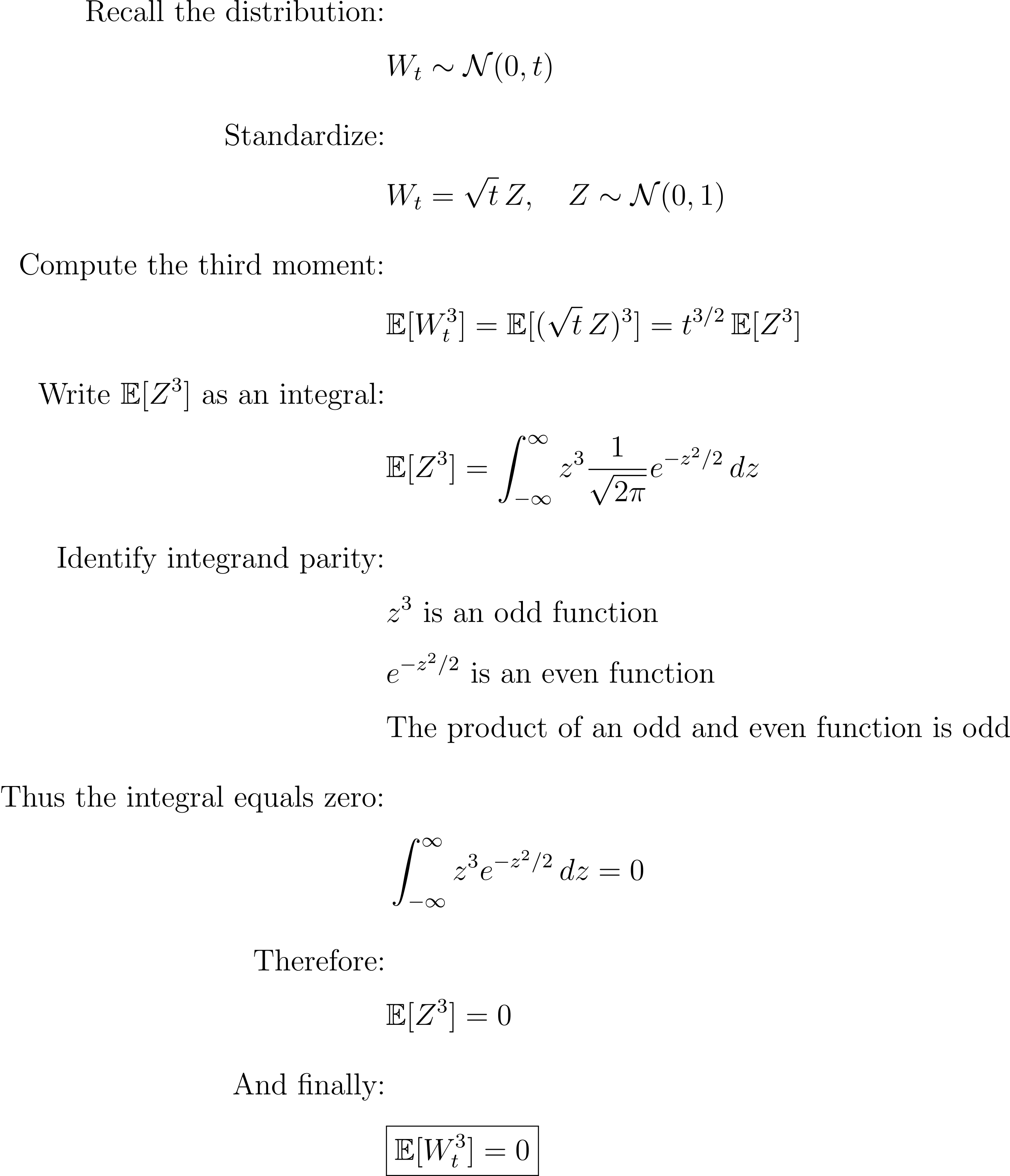
| Solution at the Bottom of this Email 👇 |
| | | Need to study up on topics in math, probability, and finance? 👉 Learn to solve problems like this on Quant Guild — the platform I wish I had when I was studying to become a quant. | | | 📅 Quant Guild Week in Review |
| Algorithmic Market-Making and Getting a Quant Job |
|
|
|
|---|
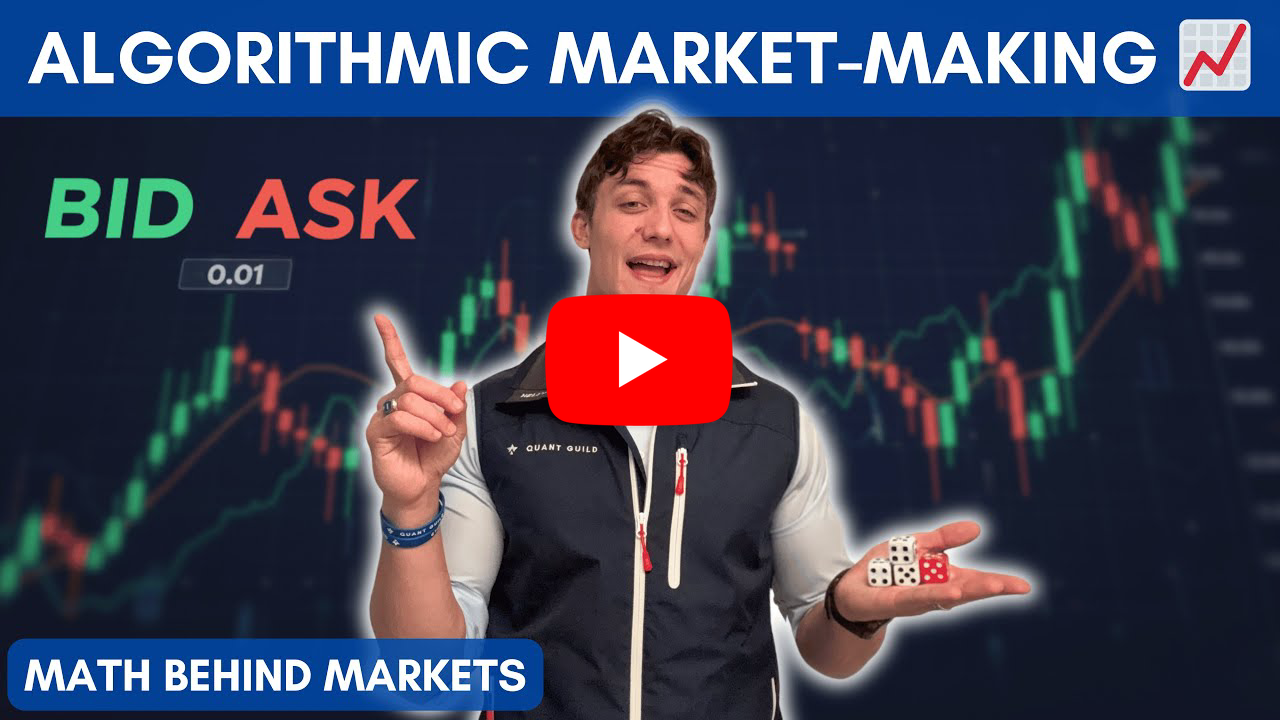
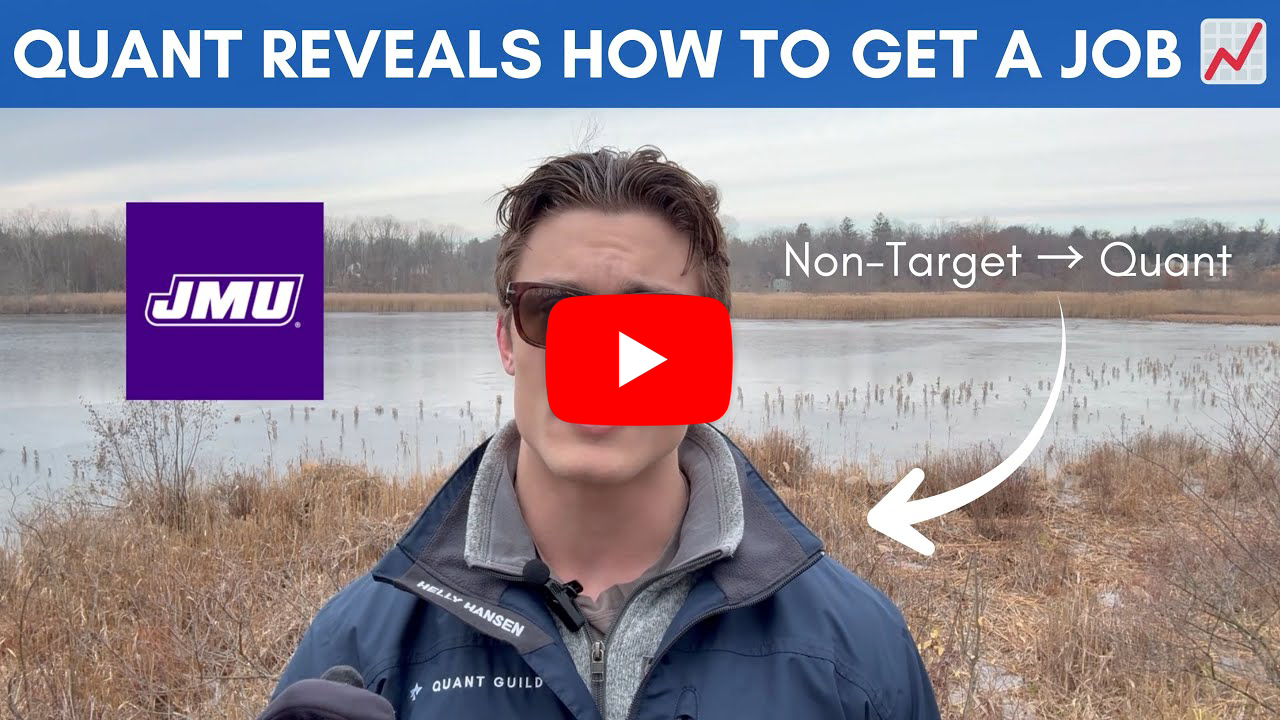
📈 Quant Explains Algorithmic Market-Making | In this video, I break down what algorithmic market-making actually is, not the Hollywood version of “high-speed trading bots,” but the real math and probability behind how institutions systematically make money by providing liquidity. To make it intuitive, I start with a simple dice market: if you can understand how to make a market on a dice roll, you can extend that same logic to any source of uncertainty: stocks, options, weather, sports betting, whatever. I show how a market maker chooses a midprice by minimizing mean-squared error, which leads directly to using the expected value of the underlying uncertainty. From there, I explain how quoting a bid–ask spread around that fair price creates a positive expected drift, but also why you can’t just widen spreads forever, because liquidity dries up. The sweet spot is where expected profit and trading frequency balance out. Then we scale the intuition from dice to options market-making. Instead of an instantaneous payoff, options settle in the future, so the midprice becomes the risk-neutral discounted expectation under whatever model you choose: Black-Scholes, Heston, rough Bergomi, etc. After calibrating the model to market data, you simulate paths, compute expected payoffs, and that becomes your theoretical fair price. Market makers quote around that price and accumulate spread, but only if their model is reasonable and their hedging doesn’t eat all their profits. I wrap by showing how bad models, poor calibration, or imperfect hedging can flip expected profit negative, and why modern market-making relies heavily on reinforcement learning and advanced hedging techniques. At its core, though, it’s still the same idea as the dice market: buy low, sell high, on average, in the face of uncertainty. Here's a link to the full video 👇 | | | 🎲 How to Get a Quant Job in 3 Steps | In this video I break down exactly how I went from a non-target background to becoming a quantitative researcher, and I explain the three steps that anyone can follow to do the same. The first step is to master your quantitative skills. Not shallow exposure, but deep understanding. Exams in school are nothing compared to real quant work, and the only stability you can create for yourself in this field is complete command over math, probability, statistics, coding, and model development. I explain how the focus changes depending on whether you want to trade, research, or develop systems, and why passion matters. You need to be doing this work long before money enters the picture. The second step is networking to acquire an interview. Applying online feels productive but it is almost never effective. Nobody wants to sift through thousands of anonymous applications. People hire people, which means you need to introduce a human element into the process. I talk about attending events, reaching out on LinkedIn, asking for informational interviews, and treating the job search the same way someone would have done in the year 1850. You go to town and talk to people. Every role I have ever earned has come from this process. The third step is passing the technical interview. The most common complaint I hear from students is that they “do not test well.” In practice, everyone performs poorly when they do not understand the material. If you truly master your toolkit, the interview becomes simple. You recognize the structure of problems, determine whether they are deterministic or stochastic, recall familiar frameworks, and apply the right tools. Entry level interviews have definite solutions. If you struggle in this stage, the answer is to return to step one and build deeper mastery. Altogether these three steps form a complete roadmap for anyone trying to break into quant finance. Master your skills, earn your interview through real human connection, and then demonstrate your understanding in the technical round. I close the video by offering to expand each of these stages into standalone content if there is interest (let me know in the comments!). Here's a link to the full video 👇 | | |
|
|
|---|
|
 | 📈 Why 10,000+ Quants Study on Quant Guild | Quant Guild is the one-stop platform for mastering the math that powers modern finance. With 90+ specialized lessons, adaptive practice with gamified progress that scales with your skill level, real interview questions, courses from A - Z in coding, math, probability & statistics, and exclusive live classes with me, it’s built to take you from fundamentals to the front-office. Everything’s designed for how real quants think and work — focused, practical, and deeply technical. That’s why over 10,000+ students and professionals study on Quant Guild to sharpen their edge and make smarter decisions in the face of uncertainty. |  |
|
|
|---|
| | I'm in QR preparing for technical interviews and your practice helped me brush up on probability, thanks | | |
| | |
|
| | | I learned more here in two days than an entire semester of college | | |
| - Guy on Discord Who DM'd Me |
|
|
|
|---|
|
| | ✅ Quant Question of the Week |
| | | | | | |
|
|
|---|
|

 Roman Paolucci