 | | | 📜 A Note from the Guild Leader |
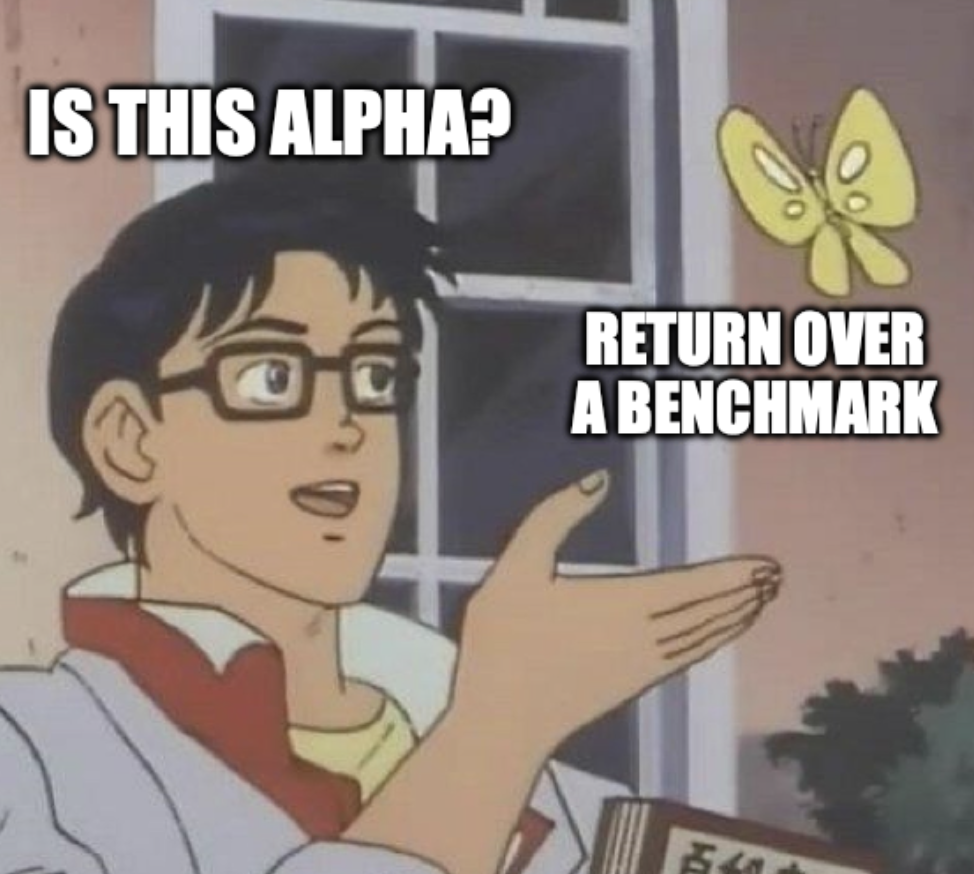
| If you survey finance majors in university (which I have recently done) and ask them "what is alpha?" you'll get a variety of interesting responses... - "It's return in excess to the S&P500" - "It's trading profits" - "It's what market-makers make" and my favorite... - "I'm just trying to pass man" Interestingly, this misunderstanding extends into the professional world where junior analysts and traders often cite alpha as return in excess of a benchmark. | | | Everyone wants to generate alpha but many don't understand structurally what it is. I find the reason that alpha is such an elusive topic is because it actually demands a high level of maths and statistics to understand what it is. Painting with broad strokes, it is returns generated independently (perpendicularly or orthogonally) to other facets of priced risk. Typically, in this context, we are talking about market exposure. In reality when we discuss alpha, we're talking about factor models, machine learning (regression), non-stationarity, linear independence, and omitted variable problems. But if we are to discuss it in simple terms it is not return in excess of a benchmark but rather return that has nothing to do with the benchmark. Effectively, if we are trading an alpha, it doesn't matter what the broader market (or other facets of priced risk) do(es). It can tank. It can go to the moon. Our strategy returns should then be reasonably stable and subject to the typical risks of trading a structural market inefficiency. Keep this in mind any time you are discussing your portfolio or trading in general! If you beat the market, you have not generated alpha, you are likely trading beta, and if you run into a finance major, please tell them to check out Quant Guild 🤠 | With that I will leave you to the Weekly Guild Letter. I hope you enjoy, and I hope you learn something! - Roman | | | 🧮 Quant Model of the Week |
| Fama-French 3 Factor Model |
| The Capital Asset Pricing Model (CAPM) is clearly not enough. The idea was elegant: one market factor, one beta, one source of risk that explained expected returns. But when people actually looked at the data, really looked, it didn’t line up. Small stocks kept outperforming large ones. Cheap stocks beat expensive ones. And these weren’t flukes; they persisted across decades, markets, and geographies. Fama and French didn’t fix this by throwing CAPM away. They extended it. The three-factor model keeps the market factor, but adds two more dimensions of systematic behavior: size and value. The message was simple but uncomfortable, risk isn’t one-dimensional, and markets reward exposure to more than just “the market.” The Fama–French Three-Factor Model reframed how quants think about returns. Expected performance isn’t just about market exposure; it’s about which kinds of assets you’re exposed to and which structural forces you’re riding. What CAPM treated as unexplained “alpha,” Fama–French showed could often be decomposed into additional, persistent sources of risk. Here’s what the model looks like: | | | Let's go through the factors one by one... The market factor is the familiar one. It represents exposure to broad market risk, when the market goes up, assets with high market exposure tend to go up more; when it falls, they fall harder. This is the same systematic risk CAPM was built around, and it reflects the simple idea that investors demand compensation for bearing economy-wide uncertainty. The size factor captures the tendency for smaller companies to outperform larger ones over long horizons. Small firms are generally more fragile: they have less access to capital, thinner margins, weaker balance sheets, and higher sensitivity to economic shocks. The size factor reflects compensation for bearing that extra vulnerability. When you load positively on size, you’re effectively betting on companies that live closer to the edge. The value factor captures the difference between “cheap” and “expensive” stocks, typically measured using fundamentals like book-to-market ratios. Value stocks often look distressed, beaten down prices, poor recent performance, pessimistic narratives. Growth stocks, on the other hand, embed optimism about the future. The value factor reflects compensation for holding assets that the market currently dislikes or doubts. You get paid not for glamour, but for discomfort. Together, these three factors tell a richer story than CAPM alone. Returns aren’t just about how much market risk you take, they’re about what kind of market risk you take. Size and value exposures explain a large chunk of what used to be labeled “alpha,” reframing outperformance as systematic behavior rather than stock-picking magic. In short: the three-factor model says markets reward exposure to broad risk, business fragility, and economic pessimism, and they’ve been doing so remarkably consistently for decades. Error is either alpha or undiscovered priced-risk. | 📈 Model applications In practice, the Fama–French Three-Factor Model isn’t just a diagnostic tool, it’s a construction kit. Instead of taking whatever exposure the market hands you, you can deliberately build portfolios that target specific factor loadings. By tilting toward size or value, you can engineer return profiles that resemble broad market exposure while relying less on pure market beta. This is the core idea behind factor investing. Rather than owning the market outright, you select stocks whose characteristics load heavily on the factors you want, small-cap names to harvest the size premium, value stocks to capture the value premium, or combinations of both. Done correctly, these portfolios can generate market-like expected returns with lower direct exposure to market swings, because part of the return is coming from structural premia rather than broad index moves. From a portfolio construction perspective, this opens up powerful tradeoffs. You can reduce market beta while maintaining expected return by increasing exposure to size or value. You can diversify sources of risk instead of concentrating everything in a single market factor. And you can design portfolios whose performance drivers are more stable across regimes than pure directional bets on the index. Of course, these strategies aren’t magic. Factor returns are cyclical. Size and value can underperform for long stretches, sometimes painfully so. But the Fama–French framework gives you a language to understand why a portfolio is performing the way it is, and whether that performance is coming from market exposure, factor exposure, or something genuinely idiosyncratic. In that sense, the model turns stock selection into an exercise in exposure management rather than guesswork. At scale, this is how many institutional portfolios are built: not by chasing individual names, but by systematically targeting combinations of factors to achieve desired risk–return profiles. The goal isn’t to beat the market every year, it’s to decompose return into its components and choose which risks you want to be paid for. 🎓 A little story When you’re forced to define a signal from scratch, decide what data matters, how to normalize it, how to neutralize it, how to test it across regimes, you start seeing factors for what they really are: systematic bets on behavior. And once I saw that I could improve returns, control risk, and even construct reasonably market-neutral strategies by targeting specific exposures that were stable and compensated over time, the abstraction disappeared. Factor models stopped being descriptive and became operational. That’s also when my view of diversification changed. It’s not just about holding more stocks or spreading across sectors anymore, it’s about diversifying across sources of priced risk. Value, size, momentum, quality, carry, volatility, flow, sentiment, each one comes and goes, cycles in and out of favor. Factor returns are cyclical by nature, which means robustness doesn’t come from believing in a single factor forever, but from blending many imperfect ones together. And anything that isn’t explained by those systematic exposures? That’s the interesting part. That’s structural inefficiency. That’s the intercept, alpha. Sometimes it persists, sometimes it gets arbitraged away, sometimes it mutates into a new factor altogether. But once you’ve lived on the side of discovering and engineering factors yourself, you realize factor models aren’t constraints on creativity, they’re the framework that tells you where genuine edge can still exist. 💡 Takeaway Factor models shift the way you think about returns. Instead of viewing performance as a collection of stock-specific wins and losses, they frame it as exposure to underlying sources of risk, risks that are priced, persistent, and cyclical. Some of these risks, like market, size, or value, have been rewarded over long horizons. Others emerge from behavior, structure, or constraints and can look like alpha until they’re widely understood. The key insight is that returns don’t show up evenly through time. Factor premia wax and wane, sometimes disappearing for years before reasserting themselves. That means success isn’t about betting everything on one factor forever, it’s about understanding where you’re exposed, why you’re exposed, and how those exposures interact across regimes. Diversification, in this world, isn’t just about owning more assets; it’s about diversifying across types of risk. This is where trading, alpha, and factor investing meet. Some strategies are about harvesting known premia, smart beta in its purest form, systematically tilting toward risks that have historically been compensated. Others are about discovering new structure, inefficiencies, or behaviors before they become common knowledge. Both live inside the same framework. Factor models don’t eliminate alpha, they help you identify it, contextualize it, and decide whether it’s something structural, cyclical, or fleeting. In the end, factor models don’t tell you what to trade. They tell you what you’re being paid for. And once you understand that, you can choose, deliberately, which risks to hold, which to avoid, and when to shift exposure as the cycle turns. | | | 🏆 Quant Question of the Week |
| Solution at the Bottom of this Email 👇 |
| | | Need to study up on topics in math, probability, and finance? 👉 Learn to solve problems like this on Quant Guild — the platform I wish I had when I was studying to become a quant. | | | 📅 Quant Guild Week in Review |
| Quant Trading and Quant Portfolio Management |
|
|
|
|---|
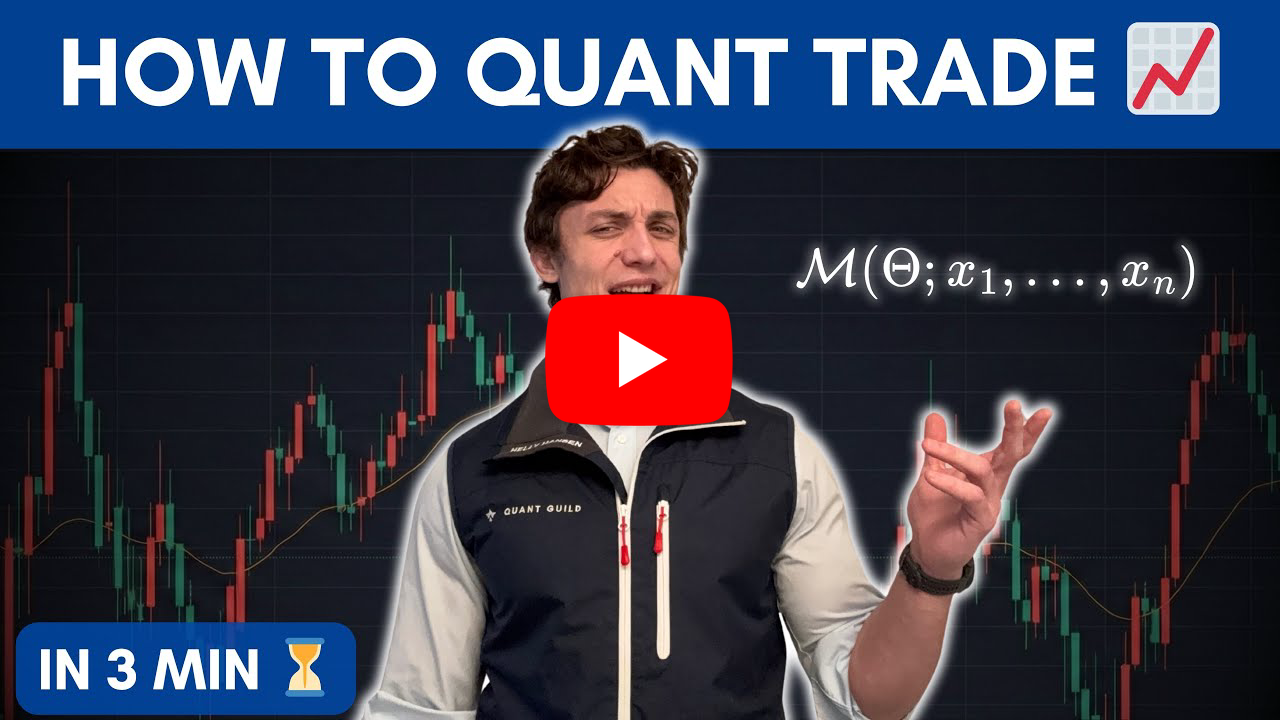
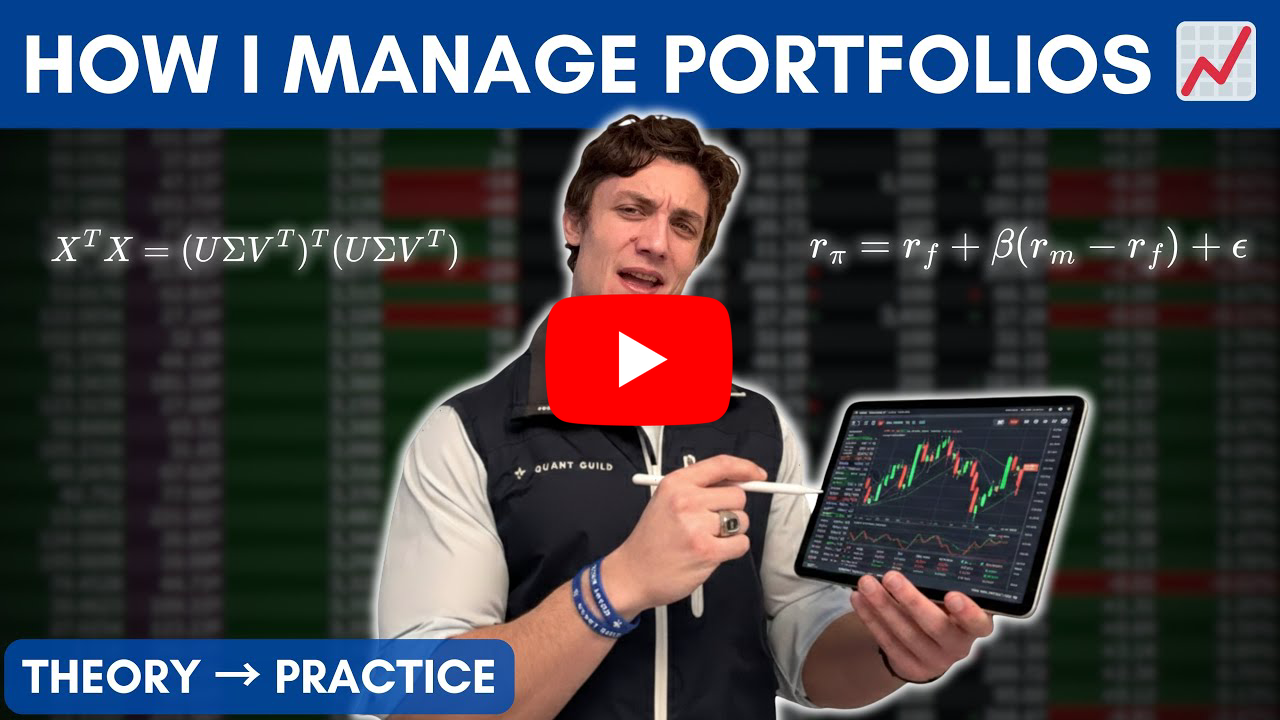
📈 How to Quant Trade in 3 Minutes | In this video I explain what quant trading actually is by stripping away the myths and focusing on the core idea: nobody knows the future. Every trader and every fund has access to the same historical data. There are no crystal balls. The only difference between traders is how well they specify models, parameterize them, and adapt when those models inevitably break. Quant trading is not about prediction. It is about making the best possible guess under uncertainty and updating it as the market changes. I frame this as a model specification and parameterization problem. Given historical data, we build a model to produce an expectation. That expectation is our edge. In the example I use, I model the relationship between implied and realized volatility and show that implied volatility has historically been overpriced. By systematically taking the other side of that mispricing, we can accumulate expected value over time. That is all an edge is: expected value expressed through a trading rule. The key insight is that this only works while the model remains approximately correct. Markets are non-stationary. Distributions shift, regimes change, and structural breaks occur. If you blindly keep trading a model that no longer reflects reality, you will give back every dollar you made and more. That is why quant trading is not about finding a perfect model and running it forever. It is about continuously monitoring performance, identifying when assumptions break, and rebuilding the model when the environment changes. The takeaway is simple. Quant trading is an adaptive process. You build a model, extract an edge, trade it, watch it decay, and then restructure. The traders who survive are not the ones with the fanciest models. They are the ones who understand uncertainty, respect non-stationarity, and adapt faster than everyone else. Here's a link to the full video 👇 | | | 🎲 How a Quant Manages a Portfolio | In this video I explain how I actually think about portfolio management as a quant, and why most people misunderstand what alpha, diversification, and risk really mean. Beating a benchmark is not alpha. Excess return alone tells you nothing about skill. What matters is why the return exists and whether it survives when market conditions change. That requires academic theory, but more importantly, it requires understanding how those models behave in practice. I start by breaking risk into its three fundamental components: idiosyncratic risk, sector risk, and market risk. Idiosyncratic and sector risk can be diversified away. Market risk cannot. Using real stock data across multiple sectors, I show how diversification works when markets are calm and why it breaks down during stress, when correlations spike and everything begins to move together. This is why diversification is called the only free lunch in economics, and also why that lunch disappears when you need it most. From there I move beyond intuition and show how we quantify these ideas using covariance, correlation, and spectral decomposition. Principal component analysis lets us compress a complex portfolio into a small number of independent risk factors. The first component captures market risk, the next capture sector structure, and the remainder represent idiosyncratic variation. This gives us a clean, quantitative way to see what we are actually exposed to, rather than guessing based on labels like “tech” or “defensive.” I then connect this decomposition directly to pricing models like CAPM and factor models. By regressing portfolio returns on market excess returns, we can distinguish beta from alpha. A portfolio can outperform the market simply by being overexposed to market risk. That is not skill. Alpha is return that is orthogonal to market movements. It persists regardless of whether the market goes up or down. Most portfolios that claim alpha are simply leveraged beta in disguise. The final takeaway is that portfolio management is an ongoing adaptive process. Betas, correlations, and factor exposures are statistics, and in the real world they do not converge. They change over time. My job as a quant is not to set a target allocation and walk away. It is to continuously monitor exposures, reassess assumptions, and adjust as market structure evolves. Portfolio management is not about prediction. It is about understanding uncertainty, structuring exposure, and managing risk dynamically over time. Here's a link to the full video 👇 | | |
|
|
|---|
|
 | 📈 Why 10,000+ Quants Study on Quant Guild | Quant Guild is the one-stop platform for mastering the math that powers modern finance. With 90+ specialized lessons, adaptive practice with gamified progress that scales with your skill level, real interview questions, courses from A - Z in coding, math, probability & statistics, and exclusive live classes with me, it’s built to take you from fundamentals to the front-office. Everything’s designed for how real quants think and work — focused, practical, and deeply technical. That’s why over 10,000+ students and professionals study on Quant Guild to sharpen their edge and make smarter decisions in the face of uncertainty. | 🏛️ See How Pol Became a Market-Maker with Quant Guild |  |  |
|
|
|---|
| | I'm in QR preparing for technical interviews and your practice helped me brush up on probability, thanks | | |
| | |
|
| | | I learned more here in two days than an entire semester of college | | |
| - Guy on Discord Who DM'd Me |
|
|
|
|---|
|
| | ✅ Quant Question of the Week |
| | | | | | |
|
|
|---|
|

 Roman Paolucci