 | | | 📜 A Note from the Guild Leader |
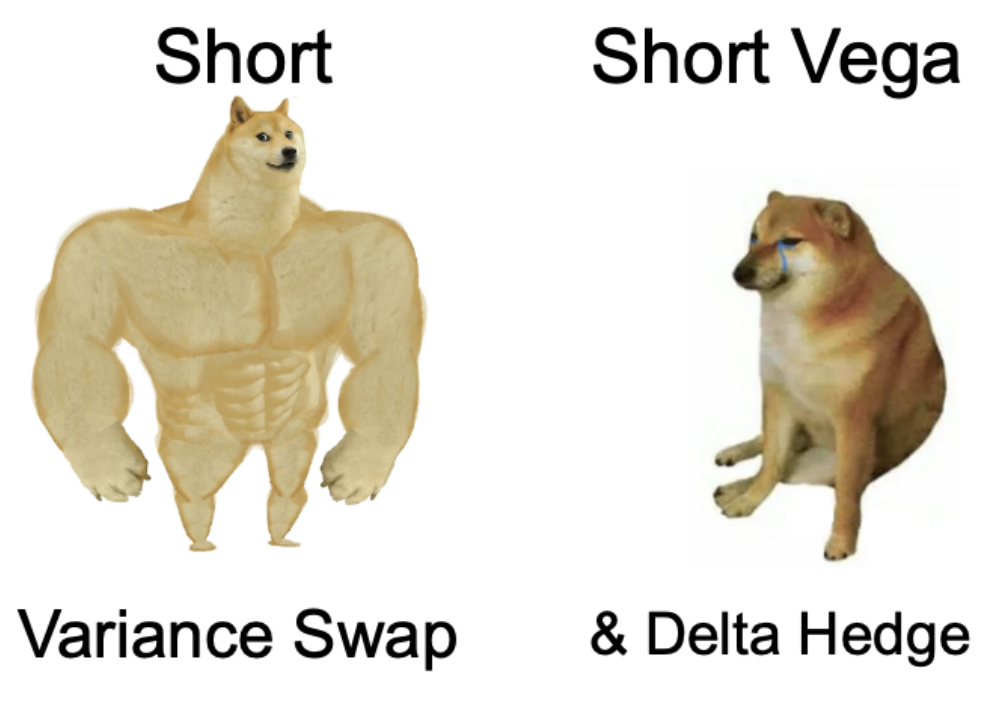
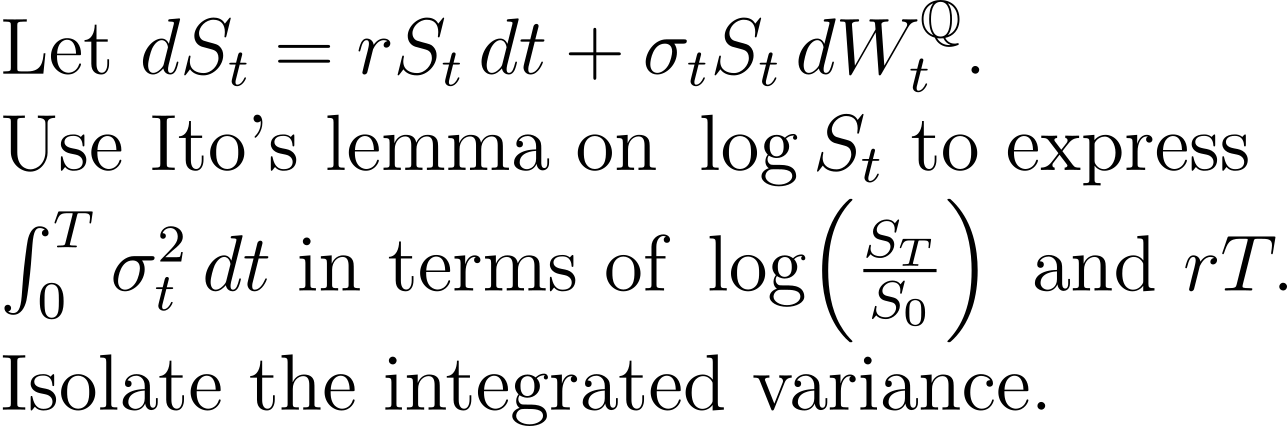
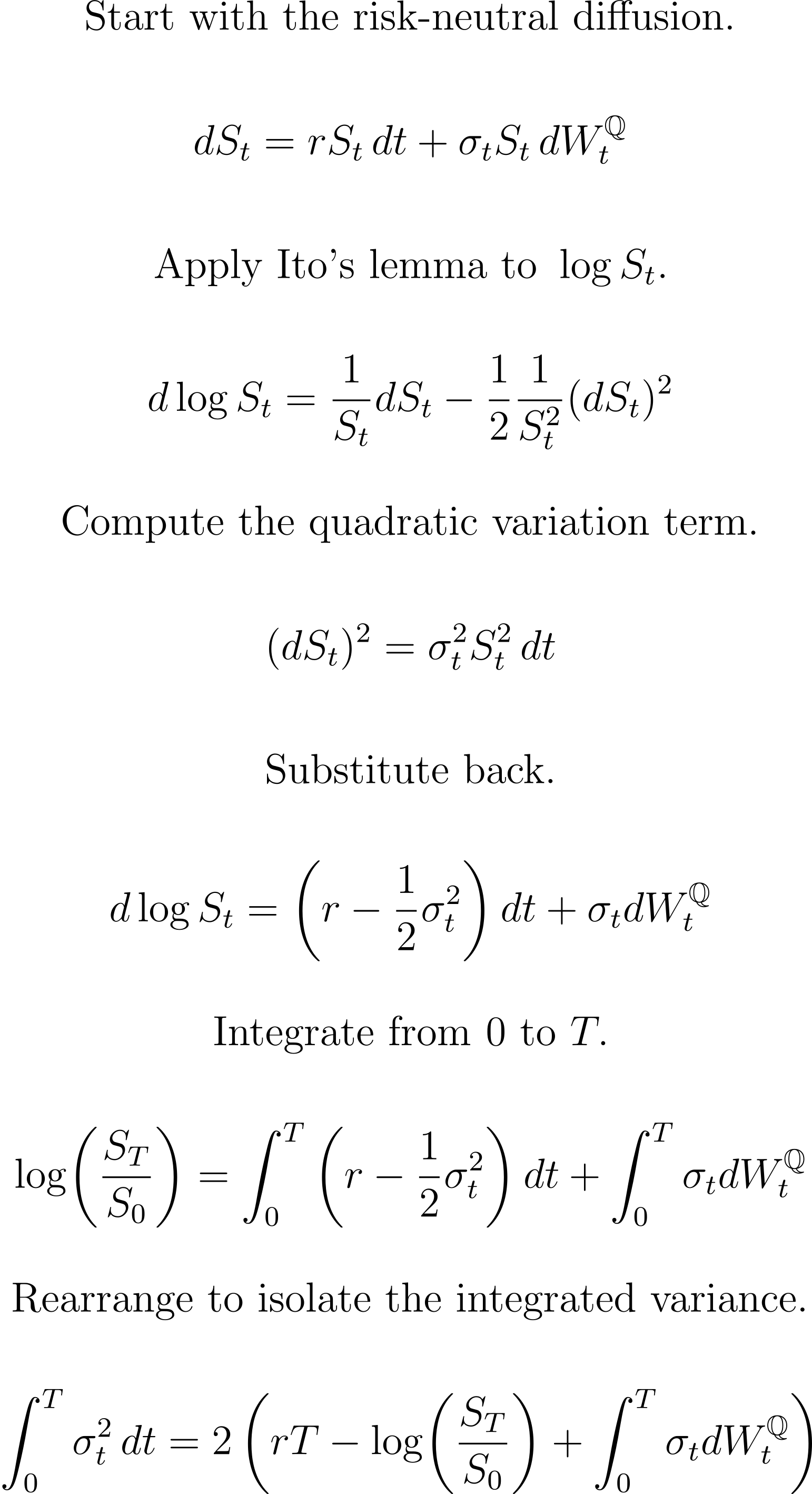
| Variance swaps are sick, and thanks to Goldman Sachs, Derman, Carr, Madan, and others, we have an elegant and intuitive understanding of the price under risk-neutral dynamics for a standard diffusion. In fact, the modern VIX is quite literally just the Goldman Sachs / Carr-Madan variance swap model printed on a ticker. However, in the context of a trade, these variance swaps aren't a pure volatility play. | | | The biggest gotcha in the variance swap world is that you aren't trading σ (volatility); you’re trading σ^2 (variance). While that sounds like a minor pedantic distinction for a math quiz, in a live book, it changes the entire risk profile. Mechanically, this comes down to additivity. Under standard diffusion dynamics, variance is linearly additive over time. By applying Itô's Lemma to a log contract, we can isolate the variance by continuously delta-hedging away the directional spot movements (the cross-terms). With volatility, however, this additivity completely breaks down; the cross-terms persist, making it impossible to cleanly isolate and statically hedge. Effectively, calling a variance swap a pure vol play is like calling a Ferrari a commuter car. It’ll get you there, but the way it handles the corners (and the crashes) is fundamentally different. Curious to learn more? I'll have a video out soon deriving the risk-neutral pricing formula for variance swaps in the context of volatility trading, and the history of the model. Stay tuned! | With that I will leave you to the Weekly Guild Letter. I hope you enjoy, and I hope you learn something! - Roman | | | 🧮 Quant Model of the Week |
| Carhart Four-Factor Model |
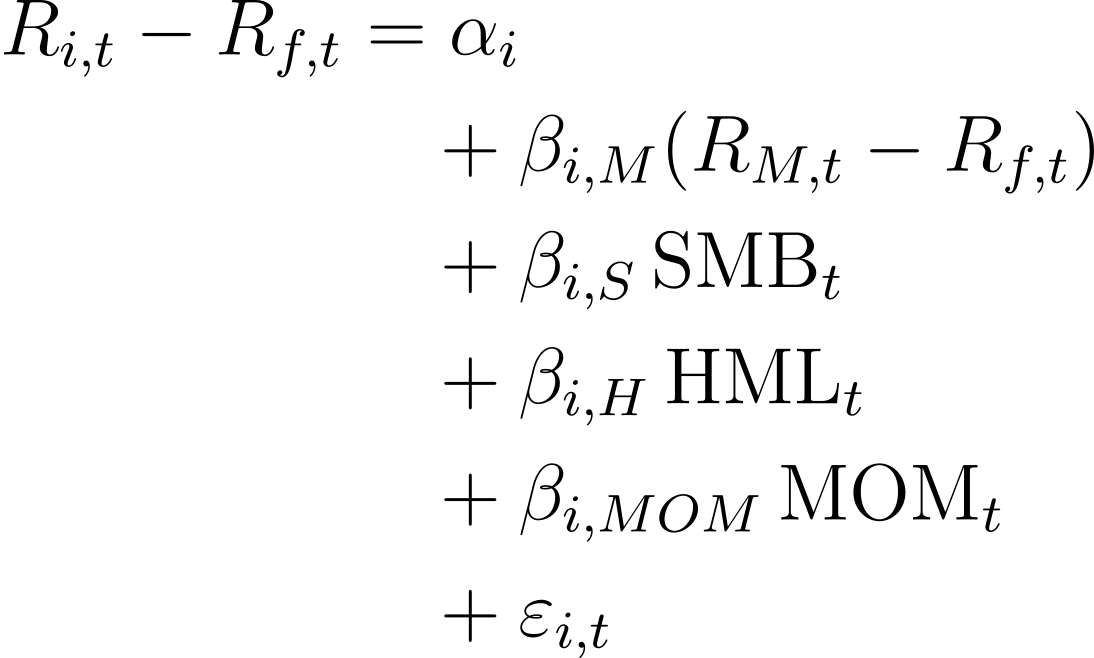
| By the mid 1990s, the Fama–French three-factor model had already reshaped how academics and practitioners thought about returns. Market, size, and value explained far more than CAPM ever could. But one anomaly kept surviving every robustness check. Momentum. In 1997, Mark Carhart extended the Fama–French framework by adding a fourth factor based on prior returns. Stocks that had outperformed over the past year tended to continue outperforming, while recent losers continued to lag. The effect was too persistent to ignore and too systematic to dismiss as noise. The Carhart Four-Factor Model keeps the original three factors and adds momentum as an additional source of priced risk. It acknowledges that markets reward not only exposure to economic characteristics like size and value, but also exposure to persistent price trends driven by behavior, flows, and structural frictions. Here is what the four-factor model looks like: | | | After the original three factors explained market exposure, size, and value, one effect still stood out. Stocks that had recently gone up tended to keep going up. Stocks that had recently fallen often kept falling. That persistence became the momentum factor. Momentum simply captures exposure to trends. If your portfolio loads positively on it, you benefit when winners continue winning and losers continue lagging. It is not about fundamentals like size or value. It is about behavior, flow, and the tendency of prices to move in streaks. Once momentum is added, a lot of what used to look like skill starts to look like systematic exposure to trend. The Carhart model therefore expands the question from “Are you beating the market?” to “Which persistent risks are you actually taking?” | 📈 Model applications In practice, the Carhart four-factor model is used less as a forecasting tool and more as a lens for understanding and engineering returns. It allows you to decompose performance into exposures to market, size, value, and momentum. If a portfolio is making money, you can ask whether that P/L is coming from true stock selection or simply from loading on trending names. On the generation side, the model naturally leads to factor portfolios. You can construct long–short momentum portfolios, tilt toward value while neutralizing market beta, or blend exposures to create diversified sources of return. Smart beta strategies are essentially structured implementations of these ideas, targeting compensated risk premia rather than relying purely on discretionary views. For portfolio managers and traders, the model also serves as a risk management tool. By measuring factor loadings, you can avoid unintended exposures, hedge specific risks, or deliberately allocate capital to factors you believe are in favor. In that sense, P and L becomes less about guessing direction and more about consciously selecting which systematic risks you want to be paid for. 🎓 A little story Some of the first serious work I did with factor models was in the context of what people call “factor zoos.” If you have not heard that term before, it is exactly what it sounds like. Hundreds of published factors. Value variations, quality definitions, momentum flavors, profitability tweaks, investment intensity measures, accrual anomalies, liquidity premia. Every paper seemed to introduce a new animal. At first, it was pure information overload. I was trying to understand which factors were real, which were redundant, which were just repackaged versions of something else. It felt like the answer to performance was hiding somewhere inside a spreadsheet with far too many columns. More factors had to mean more edge, right? What I eventually realized, mostly by watching how senior quants approached the problem, was that they were doing the opposite. They were collapsing complexity back into structure. Instead of chasing every new anomaly, they were asking simpler questions. What risk is this actually capturing? Is it just value in disguise? Is it momentum with a different lookback? Is it a microstructure artifact? They were mapping the zoo back to a small set of underlying drivers. That was a turning point for me. The edge was not in memorizing every animal in the zoo. It was in understanding the ecosystem. Once you see that most factors cluster around a few fundamental sources of risk or behavior, you stop drowning in features and start building portfolios intentionally. Simplicity, not accumulation, is what lets you actually deploy capital with conviction. 💡 Takeaway The key insight is that returns don’t show up evenly through time. Factor premia wax and wane, sometimes disappearing for years before reasserting themselves. That means success isn’t about betting everything on one factor forever, it’s about understanding where you’re exposed, why you’re exposed, and how those exposures interact across regimes. Diversification, in this world, isn’t just about owning more assets; it’s about diversifying across types of risk. This is where trading, alpha, and factor investing meet. Some strategies are about harvesting known premia, smart beta in its purest form, systematically tilting toward risks that have historically been compensated. Others are about discovering new structure, inefficiencies, or behaviors before they become common knowledge. Both live inside the same framework. Factor models don’t eliminate alpha, they help you identify it, contextualize it, and decide whether it’s something structural, cyclical, or fleeting. In the end, factor models don’t tell you what to trade. They tell you what you’re being paid for. And once you understand that, you can choose, deliberately, which risks to hold, which to avoid, and when to shift exposure as the cycle turns. | | | 🏆 Quant Question of the Week |
| Solution at the Bottom of this Email 👇 |
| | | Need to study up on topics in math, probability, and finance? 👉 Learn to solve problems like this on Quant Guild — the platform I wish I had when I was studying to become a quant. | | | 📅 Quant Guild Week in Review |
| Implied Volatility and Responding to Comments |
|
|
|
|---|
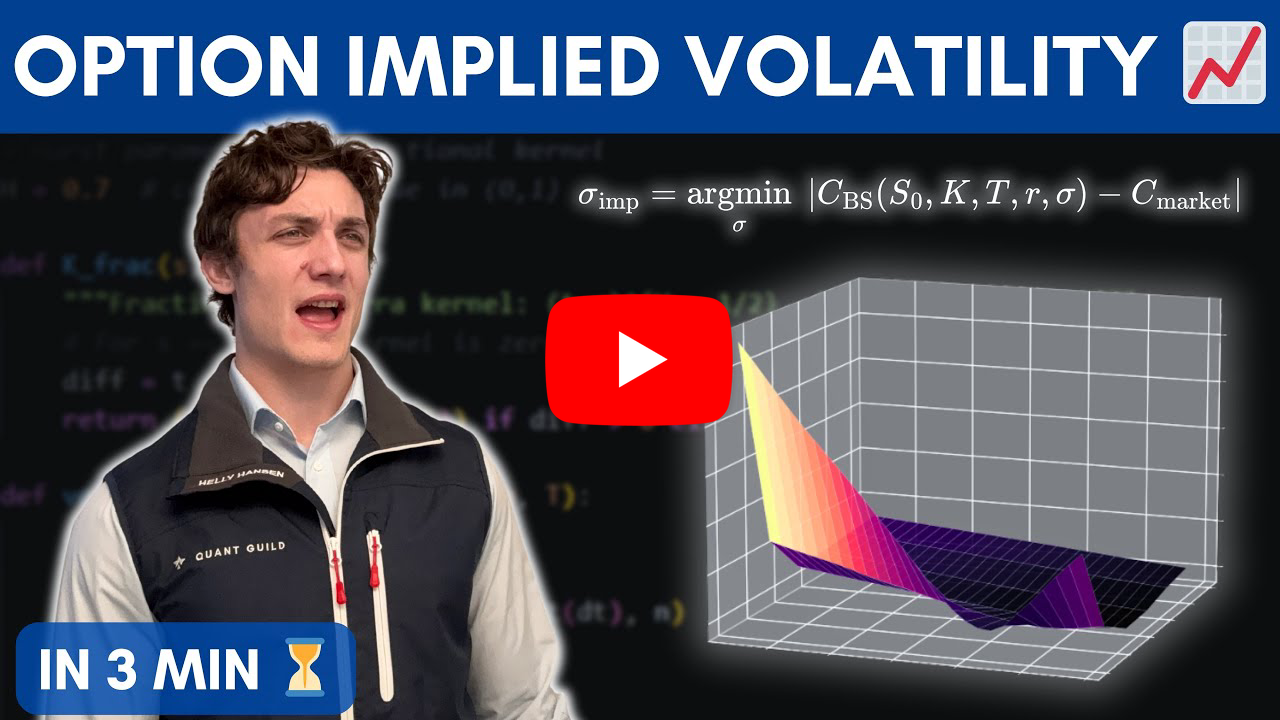
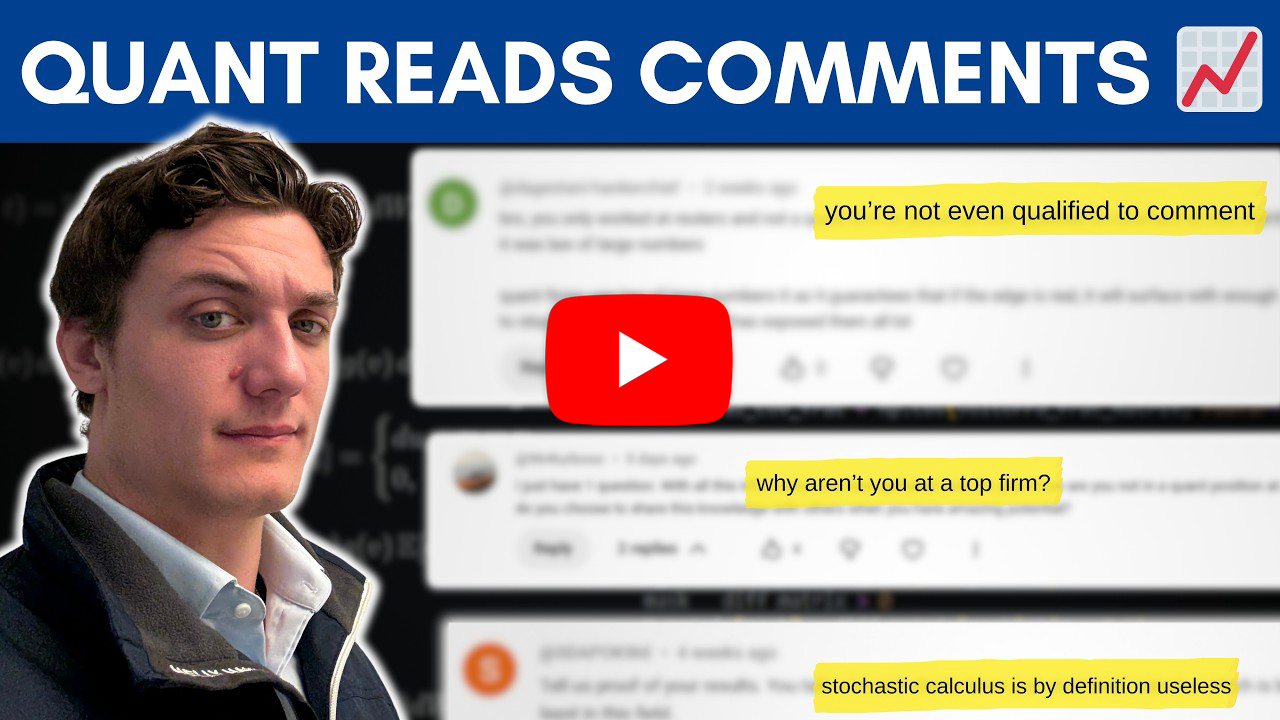
📈 Black-Scholes Implied Volatility in 3 Minutes | In this video I break down what implied volatility actually is and why it sits at the center of modern options markets. I start with the core problem: a European option has a known payoff at maturity, but we do not know what that payoff is worth today. The Black-Scholes framework solves this using a no-arbitrage replication argument. If we can construct a portfolio that perfectly replicates the option payoff in every state of the world, then the price of that portfolio must equal the price of the option. That logic leads to the Black-Scholes PDE and ultimately the closed-form pricing formula. The model has five inputs: spot, strike, time to maturity, the risk-free rate, and volatility. Four of these are observable or contractually fixed. Volatility is not. That means when we observe an option trading in the market, we can treat volatility as the missing variable and solve for it. Implied volatility is simply the value of volatility that forces the Black-Scholes model price to match the actual market price. It is not measured directly. It is backed out. I then clarify one of the biggest misconceptions in options trading: realized volatility is backward-looking and statistical, while implied volatility is forward-looking and market-implied. Implied volatility reflects how much traders demand to be compensated today for bearing uncertainty, including risks that cannot be perfectly hedged. Finally, I explain why the implied volatility smile and surface exist. In a perfect Black-Scholes world, implied volatility would be flat across strikes and maturities. In reality, markets are incomplete, downside risk commands a premium, and traders price that into out-of-the-money puts. When we vary strike we get the skew or smile. When we vary both strike and maturity, we get the full implied volatility surface. The key takeaway is that implied volatility is not a prediction. It is the market’s equilibrium pricing of risk, extracted through the Black-Scholes framework. Here's a link to the full video 👇 | | | 🎲 Quant Reads and Corrects YouTube Comments | In this video I respond to a wide range of comments, but the real value comes from the deeper questions underneath them. People ask about backtesting software, political risk, whether I actually trade, whether stochastic calculus is useful, how to break into finance with a math degree, and whether high win rates prove skill. Each question touches on a bigger structural issue in quantitative finance. I explain why I build backtesting systems in house instead of relying on third-party platforms. Control over data, point-in-time integrity, and walk-forward validation matter far more than convenience. I also generalize the politics question into a broader discussion about model risk. You cannot include every source of risk in a model. There is always a complexity versus efficiency tradeoff. The danger comes when you treat a meaningful source of risk as noise and it materializes violently. On the topic of edge and profitability, I emphasize that citing the law of large numbers does not guarantee convergence in markets. Markets are non-stationary. Regimes shift. Volume alone does not make a strategy correct. I also address the misconception that win rate equals skill. A strategy can win 90 percent of the time and still be structurally fragile if the left tail dominates. What matters is the full P and L distribution, not the headline percentage. I also respond to career-oriented questions. Why not work at a top firm? Why teach? My answer is simple. I care more about the mathematics and about teaching than about titles or bonuses. For students looking to break into finance, the advice is consistent: build real skills. Learn to build models. Understand probability and statistics deeply. If you want to value companies, learn how financial statements translate into cash flow forecasts and equity value. Quantitative ability only matters if you can apply it. Finally, I defend the role of theory. Stochastic calculus, characteristic functions, and Fourier methods are not “useless.” Trillions of dollars of exposure rely on those frameworks. Some practitioners use them daily, others never touch them, but dismissing them entirely reflects a misunderstanding of how the industry actually works. The overarching theme of the video is that quantitative finance is not about slogans, credentials, or surface metrics. It is about understanding uncertainty, modeling it honestly, and knowing the limitations of your assumptions. Here's a link to the full video 👇 | | |
|
|
|---|
|
 | 📈 Why 10,000+ Quants Study on Quant Guild | Quant Guild is the one-stop platform for mastering the math that powers modern finance. With 90+ specialized lessons, adaptive practice with gamified progress that scales with your skill level, real interview questions, courses from A - Z in coding, math, probability & statistics, and exclusive live classes with me, it’s built to take you from fundamentals to the front-office. Everything’s designed for how real quants think and work — focused, practical, and deeply technical. That’s why over 10,000+ students and professionals study on Quant Guild to sharpen their edge and make smarter decisions in the face of uncertainty. | 🏛️ See How Pol Became a Market-Maker with Quant Guild | 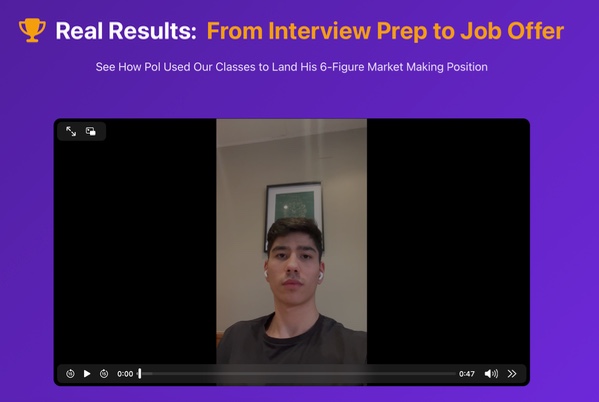 |  |
|
|
|---|
| | I'm in QR preparing for technical interviews and your practice helped me brush up on probability, thanks | | |
| | |
|
| | | I learned more here in two days than an entire semester of college | | |
| - Guy on Discord Who DM'd Me |
|
|
|
|---|
|
| | ✅ Quant Question of the Week |
| | | | | | |
|
|
|---|
|

 Roman Paolucci