 | | | 📜 A Note from the Guild Leader |
| You can't transform the real world into a stationary distribution. In the classroom we are told to produce a distribution using the nth-difference, log returns, the list goes on. But where is time in that distribution? Do you really believe that a two dimensional distribution of returns tells the entire story? That it's just a matter of trivial econometrics or time series analysis to make informed decisions? | | | The real world is not a distribution, it is a composite of an unfathomable number of deterministic (and potentially stochastic) elements that collapse into producing a single "draw". We can impose transformations that make it appear stationary but we operate under that assumption locally at best. This means the "distribution", even after differencing, taking the log, etc.. is subject to change. Will it produce better probabilities and statistics than if we didn't take the difference? Maybe, literally, at best, maybe. Everything is a filter for decision making in a forward looking sense, sometimes these assumptions are more valid than others. When they aren't, your P/L will be eaten in proportion to how insulting your assumptions are to the real world. Nothing converges, keep modeling, keep producing better probabilities and statistics, keep making informed decisions in the face of uncertainty. That is what mathematical modeling is all about; not classroom guarantees, but decision making with an edge over time. | With that I will leave you to the Weekly Guild Letter. I hope you enjoy, and I hope you learn something! - Roman | | | 🧮 Quant Model of the Week |
| | | Portfolio optimization looks clean on paper. Estimate expected returns, plug in a covariance matrix, solve for the weights. Mean-variance optimization gives you the “optimal” portfolio. But in practice, it breaks quickly. The entire framework leans on expected returns, and those are the hardest inputs to estimate. Small changes in assumptions lead to wildly different portfolios. The result is often extreme allocations, overfitting to historical data, and solutions that look precise but are fragile. You are not optimizing a portfolio. You are optimizing your estimation error. That is where the shift happens. As Warren Buffett put it, “diversification is protection against ignorance.” But what if you do have a well-founded view? Real decision making in markets is not just about historical averages. It is about incorporating forward-looking beliefs, macro views, relative value insights, and structural opinions about the world. The Black–Litterman model addresses this directly. Instead of taking expected returns as fixed inputs, it starts with a market-implied equilibrium and blends it with subjective views in a disciplined way. You do not throw away MVO. You stabilize it by acknowledging that returns are uncertain and that your views should be incorporated carefully, not blindly. | 🧮 Model Definition | The Black-Litterman model is defined as follows... | | | There are a few core components that shape how Black–Litterman behaves. First is the equilibrium return, Π. This is the model’s starting point. Instead of guessing expected returns, it backs them out from the market portfolio using risk aversion and the covariance structure. It answers the question: what returns must hold for the current market weights to make sense? Second is the views, expressed through P and Q. The matrix P defines what you have a view on, specific assets or relative relationships, and Q defines the view itself. These are your forward-looking beliefs layered on top of the equilibrium. Third is view uncertainty, captured by Ω. Not all views are equal. Some are strong, some are weak. Ω controls how much the model should trust each view. High uncertainty means the model leans more on the equilibrium. Low uncertainty means the view has more influence. Fourth is tau, which scales the uncertainty of the equilibrium prior. It determines how confident you are in the baseline market-implied returns relative to your views. Put together, the model blends equilibrium with subjective views in a Bayesian way. You start with the market, adjust with your beliefs, and end up with a posterior set of expected returns and a consistent covariance structure. That balance, between what the market implies and what you believe, is what makes Black–Litterman stable where traditional MVO is not. | 📈 Model Applications | In practice, Black–Litterman is used anywhere portfolio construction needs to balance market structure with subjective views. On asset allocation desks, it starts with the market portfolio as a baseline and then incorporates views on expected returns in a controlled way. Instead of feeding raw return estimates into mean-variance optimization, which leads to unstable and extreme weights, Black–Litterman produces more stable portfolios by blending equilibrium returns with investor beliefs. It is especially useful for tilting portfolios. Managers can express views like overweight equities versus bonds, favor one region over another, or position for relative value between sectors, without breaking the entire portfolio. The model adjusts weights proportionally to the confidence in those views, avoiding overreaction to uncertain inputs. The framework is also central to risk management and scenario analysis. Because views are explicitly parameterized with uncertainty, portfolios can be stress-tested under different assumptions about conviction and market conditions. This makes it easier to understand how changes in beliefs translate into changes in allocation. In short, Black–Litterman helps institutions turn opinions into portfolios. It provides a disciplined way to incorporate forward-looking views while maintaining diversification and stability, avoiding the overfitting and fragility that come with traditional mean-variance optimization. | 🎓 A Little Story | The first time I heard about Black–Litterman, I was deep in full-blown academic algorithmic trading mode. Everything, in my mind, had to be systematic. Data in, model out. Parameters estimated. Signals generated. The idea of introducing “subjective views” into a portfolio felt… wrong. Almost lazy. Why would we inject opinion when we could just let the data speak? Then you spend enough time in markets. And you realize the uncomfortable truth: everything is subjective. The model you choose is subjective. The data you include is subjective. The lookback window, the cleaning process, the assumptions about stationarity, all subjective. Even “pure” algorithmic trading just shifts the subjectivity one layer down. You are no longer discretionary in execution, but you are deeply discretionary in modeling. That was when things started to click. Portfolio and asset management is not about replaying history. It is about making decisions now, under uncertainty, with incomplete information. If you have conviction about forward returns, macro shifts, relative value, structural changes, that is not noise. That is the entire game. That is how you outperform. Black–Litterman stopped looking like a compromise and started looking like a framework for reality. It does not pretend that expected returns are objective. It acknowledges that views exist and gives you a disciplined way to incorporate them. And once I saw how powerful model-informed decision making could be in practice, blending structure with conviction, I realized I had been thinking about the problem too narrowly for too long. If there is one thing I would pass on, it is this: learn that lesson early. | 💡 Takeaway | Black–Litterman exists for a very practical reason: portfolios are built on beliefs about the future, not just statistics from the past. Traditional mean-variance optimization assumes expected returns are known inputs. In reality, they are the most uncertain part of the entire process. Black–Litterman introduces just enough structure, equilibrium returns, explicit views, and controlled uncertainty, to combine market information with investor conviction without producing unstable portfolios. But Black–Litterman is not a perfect description of reality. It is a framework for decision making. A way to blend subjective views with objective structure in a disciplined, transparent way. The goal is not to find the “true” expected return. It is to produce allocations that are stable, interpretable, and aligned with both the market and your beliefs. That balance is the real lesson. Models like Black–Litterman succeed not because they remove subjectivity, but because they manage it intelligently. | | | 🏆 Quant Question of the Week |
| Solution at the Bottom of this Email 👇 |
| | | Need to study up on topics in math, probability, and finance? 👉 Learn to solve problems like this on Quant Guild — the platform I wish I had when I was studying to become a quant. | | | 📅 Quant Guild Week in Review |
| Quant Ranks Trading Mistakes and the Black-Litterman Model |
|
|
|
|---|
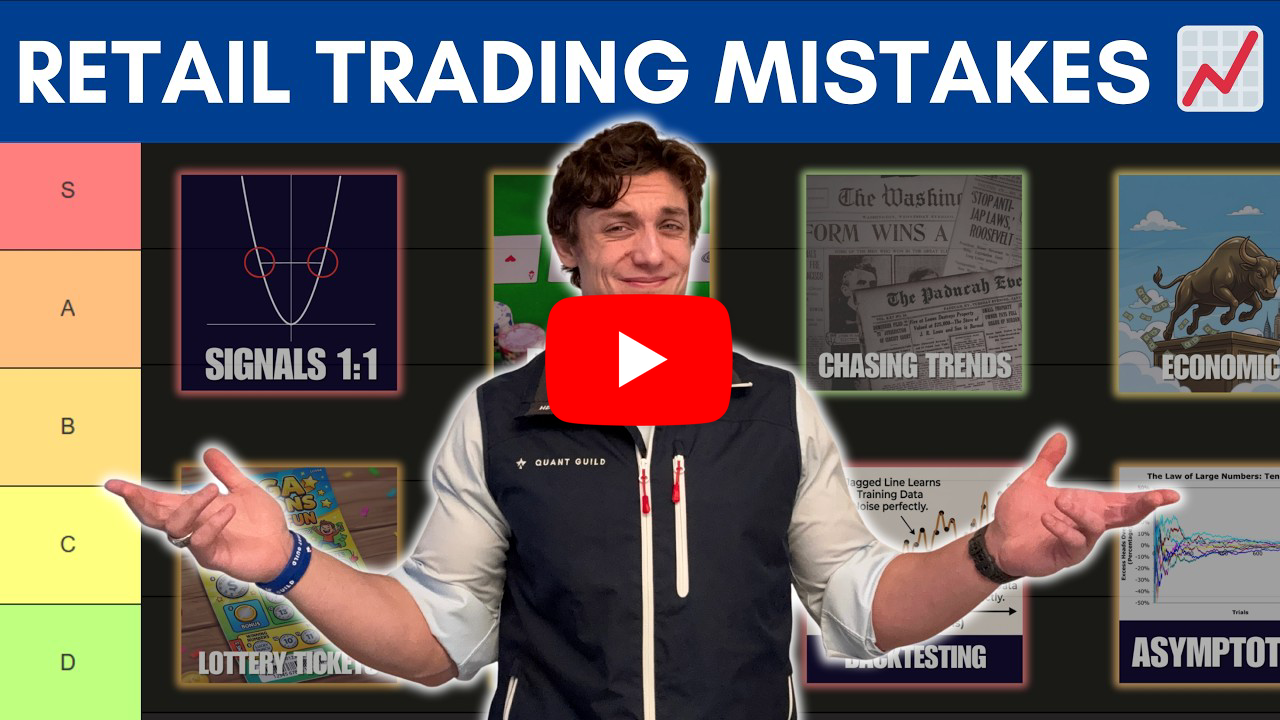
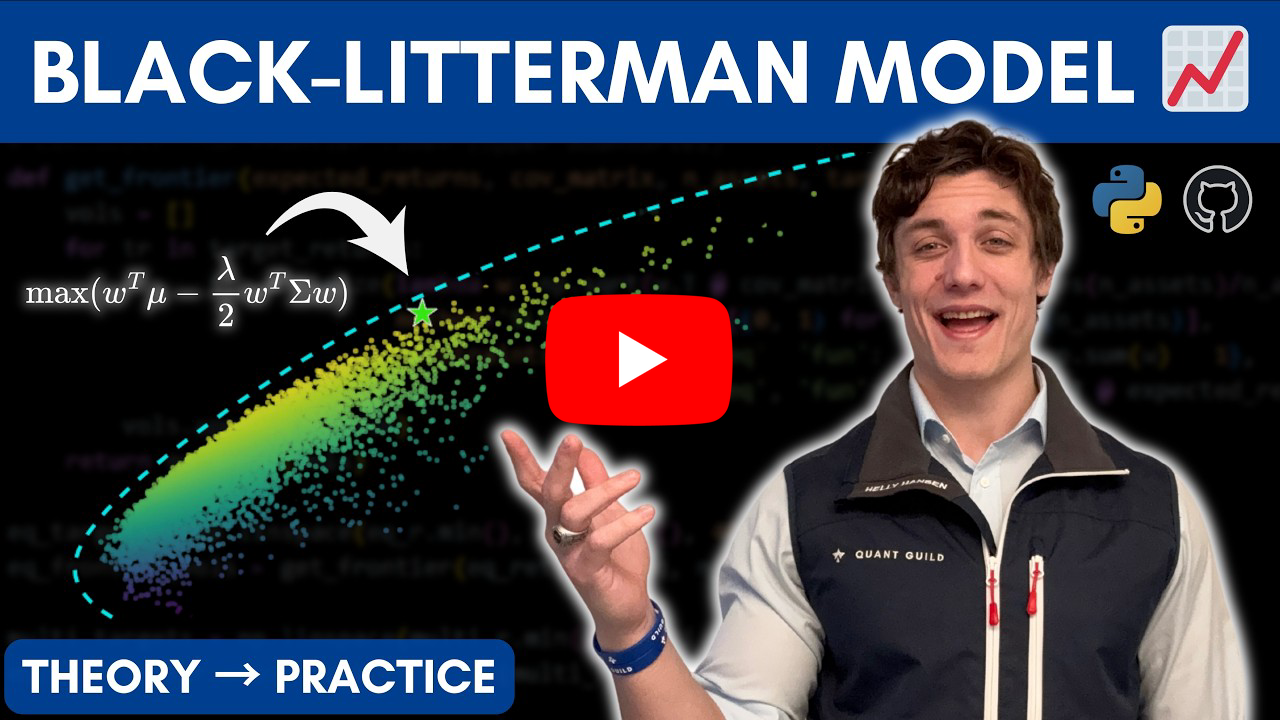
📈 Quant Ranks Retail Trading Mistakes that Blow Up Your Account | In this video I break down the most common retail trading mistakes and explain why, without fixing them, trading is no different from gambling. The core issue is that most people misunderstand the statistical nature of markets. There are no one to one signals that guarantee profit. Every decision is probabilistic, more like poker than anything else. Treating signals as deterministic is one of the fastest ways to lose money. I then explain why many traders misuse statistics entirely. Concepts like win rates and averages assume stable distributions, but markets are non stationary and path dependent. There is no fixed data generating process. On top of that, ignoring macroeconomic context means you are blindly exposed to market beta. You are effectively just riding the market without understanding the forces driving it. I also highlight behavioral mistakes that consistently destroy performance. Resulting is a major one, where traders judge decisions based on outcomes instead of the quality of the process. Chasing trends after they are already in the news leads to buying tops and selling bottoms. Misusing options as investments instead of structured strategies and treating speculative assets like lottery tickets both reflect a misunderstanding of risk and expected value. From a more technical perspective, I emphasize how poorly executed backtesting and arbitrary stop losses can create the illusion of edge without any real robustness. Most retail strategies are overfit, lack economic justification, and break immediately out of sample. Finally, I point out that asking whether someone is “profitable” is almost meaningless. Without understanding the underlying process, that number tells you nothing about skill or sustainability. The main takeaway is simple. Trading success comes from knowledge and experience, not shortcuts. If you do not understand probability, risk, and how markets actually function, you are not trading. You are gambling. Here's a link to the full video 👇 | | | 🎲 Black-Litterman vs. Mean-Variance Portfolio Optimization in Python | In this video I explain why classical mean-variance optimization looks elegant in theory but fails in practice, and how the Black-Litterman model improves it. Mean-variance optimization relies on expected returns and covariance to construct the efficient frontier and identify the optimal portfolio. The problem is that we do not have reliable forward-looking expected returns. We estimate them from historical data, which makes the optimization extremely unstable and sensitive to small changes. Even tiny perturbations in inputs can lead to completely different portfolio allocations and poor out-of-sample performance. I show that this instability comes from treating noisy historical estimates as structural truth. In reality, markets are non-stationary and there is no true data-generating distribution to learn from. As a result, mean-variance optimization often overfits noise and ends up producing portfolios that are effectively just unstable beta exposure rather than robust strategies. The Black-Litterman model addresses this by starting from a stable anchor: the market equilibrium portfolio. Instead of relying purely on historical returns, it backs out implied returns from market weights and uses that as a baseline. From there, we can incorporate subjective views about the future and assign confidence to those views. This creates a Bayesian framework that blends market consensus with informed judgment. The key advantage is stability. Because the model is anchored to the market portfolio, allocations do not shift wildly with small changes in inputs. Only strong, well-supported views meaningfully tilt the portfolio away from equilibrium. The main takeaway is that mean-variance optimization tries to extract structure from noise, while Black-Litterman acknowledges uncertainty and combines data with informed belief. That shift from pure estimation to structured decision-making is what makes it far more practical in real-world portfolio construction. Here's a link to the full video 👇 | | |
|
|
|---|
|
 | 📈 Why 10,000+ Quants Study on Quant Guild | Quant Guild is the one-stop platform for mastering the math that powers modern finance. With 90+ specialized lessons, adaptive practice with gamified progress that scales with your skill level, real interview questions, courses from A - Z in coding, math, probability & statistics, and exclusive live classes with me, it’s built to take you from fundamentals to the front-office. Everything’s designed for how real quants think and work — focused, practical, and deeply technical. That’s why over 10,000+ students and professionals study on Quant Guild to sharpen their edge and make smarter decisions in the face of uncertainty. | 🏛️ See How Pol Became a Market-Maker with Quant Guild | 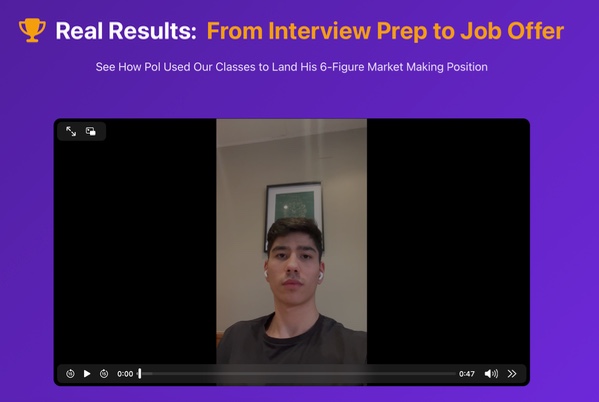 |  |
|
|
|---|
| | I'm in QR preparing for technical interviews and your practice helped me brush up on probability, thanks | | |
| | |
|
| | | I learned more here in two days than an entire semester of college | | |
| - Guy on Discord Who DM'd Me |
|
|
|
|---|
|
| | ✅ Quant Question of the Week |
| | | | | | |
|
|
|---|
|

 Roman Paolucci