 | | | 📜 A Note from the Guild Leader |
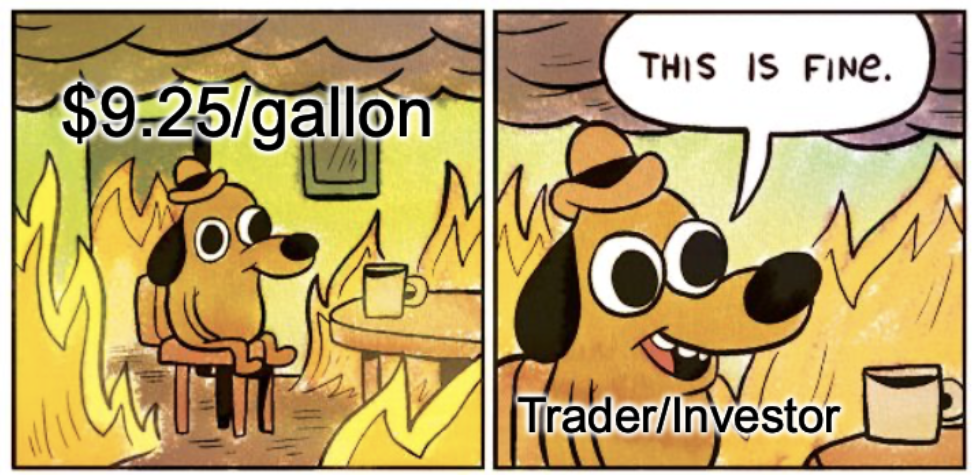
| Earnings season for big tech is in full swing and after Intel's stunning performance the waters are choppy in anticipation of setting the level for not only the next set of giants, but likely the trajectory of the markets as traders and investors continue to get numb (as they should) to the global geopolitics. | | | If you're unsatisfied with your favorite company's performance, fret not! There is always the potential for them to declare they are a "Dot Com Company" by publicly dedicating their entire infra to "Artificial Intelligence". BuT RoMAn mY cOmpAny Has NoThiNG To DO WiTh aI That didn't stop BIRD, they got a nice gap up and have been bleeding ever since. Do be cautious out there, it never ceases to amaze me what equity markets are willing to price news as; a tremendous amount of money is won (lost) on these trades! | With that I will leave you to the Weekly Guild Letter. I hope you enjoy, and I hope you learn something! - Roman | | | 🧮 Quant Model of the Week |
| | | Random variables don’t move in isolation. They move together. Covariance is the simplest way to measure that co-movement. It tells you how two variables vary relative to each other. If they tend to rise and fall together, covariance is positive. If one goes up while the other goes down, it is negative. If there is no consistent relationship, it is near zero. Now scale that up. Instead of looking at one pair of variables, you consider many. The covariance matrix is just the organized collection of all pairwise covariances between a set of variables. Each diagonal entry represents the variance of a single variable. Each off-diagonal entry captures how two different variables move together. In markets, this matrix encodes the structure of risk. It tells you not just how volatile individual assets are, but how their risks interact. And once you have that structure, you can begin to understand portfolios, diversification, and how shocks propagate through the system. | 🧮 Model Definition | This is what the covariance matrix looks like in matrix form. | | | The covariance matrix is the mathematical object that collects all pairwise relationships between a set of random variables. Each entry measures how two variables move together, while the diagonal captures the variance of each individual variable. In practice, we do not observe the true covariance matrix, we estimate it from data. As the sample size increases, these sample covariances converge to the true underlying covariances, assuming the data is well-behaved. This is a law of large numbers effect. With more observations, the noise in the estimates averages out, and the empirical matrix becomes a more accurate representation of the true structure of dependence. In reality, of course, markets are not perfectly stationary, so the “true” covariance is itself evolving. But the principle remains: more data improves the estimate, even if the target is moving. | 📈 Model Applications | In pairs trading, the covariance matrix is used to identify assets that move together. If two assets have high covariance (or correlation), their price relationship is relatively stable, making them candidates for mean-reversion trades. Traders monitor deviations from this relationship and bet on convergence. But covariance is about co-movement, not long-term equilibrium. That is where cointegration differs. Cointegration looks for a stable linear relationship between non-stationary series. Two assets can be highly correlated yet drift apart over time, breaking a pairs trade. Cointegrated pairs, on the other hand, have a spread that is stationary, meaning deviations are more likely to revert. | 🎓 A Little Story | There was a period where I got oddly obsessed with a very specific question: When is the matrix product actually the covariance matrix? It sounds trivial at first. You see XTXXTX or XXTXXT everywhere in linear algebra and statistics, and people casually say “that’s the covariance.” So I took it at face value. I wrote an entire piece on it, trying to pin down exactly when that statement is true and when it quietly fails. The deeper I went, the more I realized how much is swept under the rug in most explanations. The matrix product only matches the covariance if the data is centered and properly scaled. Otherwise, you are not computing covariance, you are computing something else entirely, raw second moments. That distinction sounds small, but it is not. It was one of those moments where you realize how easy it is to repeat formulas without really understanding the assumptions underneath them. The math is clean, but only if you respect the setup. | 💡 Takeaway | Not every matrix product is a covariance matrix. It only works if the data is properly centered and scaled. Otherwise, you are computing raw second moments, not true covariance. That sounds minor, but it matters. Small assumptions drive big results. The real lesson is to respect the setup. In quant work, formulas are easy to apply but easy to misuse. Always ask what you are actually computing, not just what it looks like. | | | 🏆 Quant Question of the Week |
| Solution at the Bottom of this Email 👇 |
| | | Need to study up on topics in math, probability, and finance? 👉 Learn to solve problems like this on Quant Guild — the platform I wish I had when I was studying to become a quant. | | |
|
|
|---|
| | Investing? Algo Trading? IBKR! |
| I've been with Interactive Brokers for over 10 years in a trading and investing capacity; I also use their API in all of my open-source Quant Builds, check them out below! |
| | |
|
|
|---|
|
| | 📅 Quant Guild Week in Review |
|
|
|
|---|
|
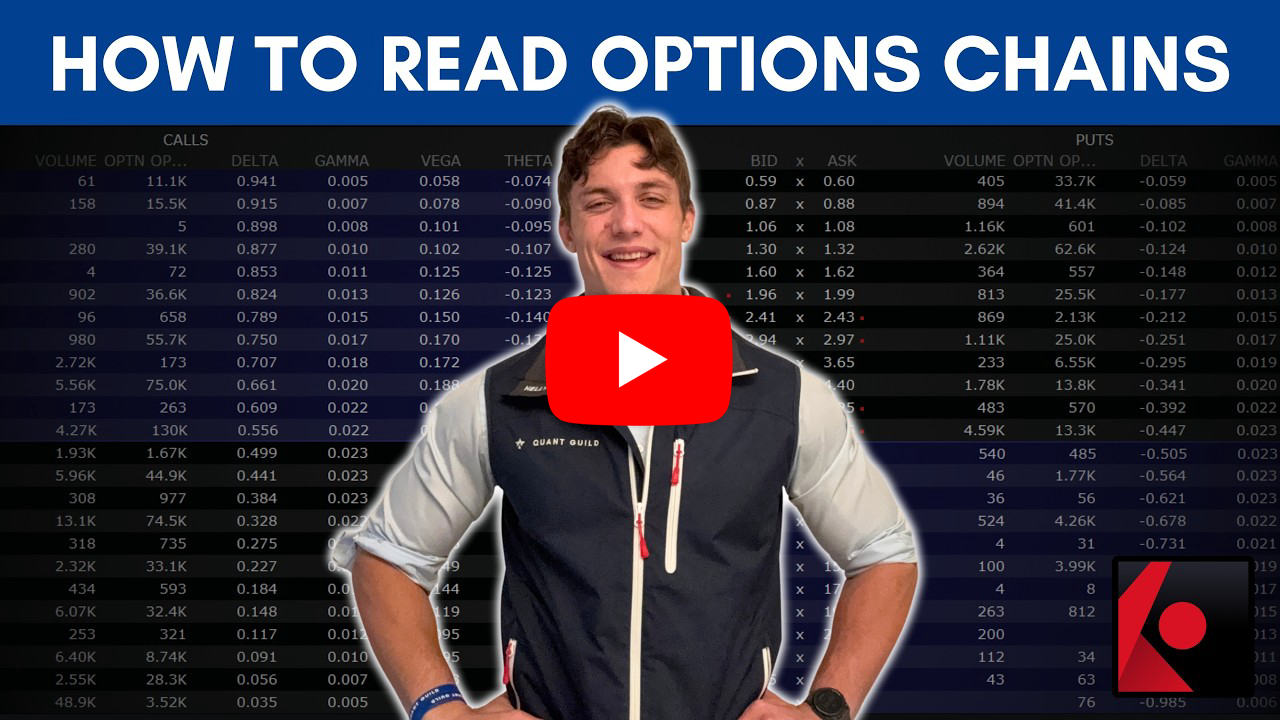
| | 📈 How to Read an Options Chain | In this video I frame life through the lens of expected value and explain how we should think about downside events and recovery. Life naturally fluctuates around an expectation, but sometimes we experience extreme negative deviations where multiple bad events cluster together. That downside variance is unavoidable. What matters is how we respond to it. I argue that every action we take after a negative event has either positive or negative expected value. This is not abstract. It is the same logic as a casino. Over time, consistent positive EV decisions compound and recover your trajectory, while negative EV decisions push you further into decline. The key idea is that you are both sides of the trade. When you make poor decisions, you are effectively taking value away from your future self. I then challenge the idea of “judgment-free” thinking. If we cannot distinguish between actions that are structurally positive EV and those that are negative EV, then we cannot make progress. The distinction becomes obvious when you look at long-term outcomes. Certain behaviors consistently lead to better health, stability, and growth, while others lead to deterioration. The asymptotics make this clear even if the short-term feels ambiguous. The main takeaway is that there is no judgment in experiencing downside variance. Everyone goes through it. The judgment comes in how you respond. Your recovery and long-term trajectory are determined by whether you consistently choose actions that have positive expected value. Here's a link to the full video 👇 | | |
|
|
|---|
|
 | 📈 Why 10,000+ Quants Study on Quant Guild | Quant Guild is the one-stop platform for mastering the math that powers modern finance. With 90+ specialized lessons, adaptive practice with gamified progress that scales with your skill level, real interview questions, courses from A - Z in coding, math, probability & statistics, and exclusive live classes with me, it’s built to take you from fundamentals to the front-office. Everything’s designed for how real quants think and work — focused, practical, and deeply technical. That’s why over 10,000+ students and professionals study on Quant Guild to sharpen their edge and make smarter decisions in the face of uncertainty. | 🏛️ See How Pol Became a Market-Maker with Quant Guild |  |  |
|
|
|---|
| | I'm in QR preparing for technical interviews and your practice helped me brush up on probability, thanks | | |
| | |
|
| | | I learned more here in two days than an entire semester of college | | |
| - Guy on Discord Who DM'd Me |
|
|
|
|---|
|
| | ✅ Quant Question of the Week |
| | | | | | |
|
|
|---|
|

 Roman Paolucci