 | | | 📜 A Note from the Guild Leader |
| Well I got banned from YouTube for impersonating myself, that was a fun week. Automations by LLMs (AI) initially created the ban, consistently denied appeals, and kept blaming me for "impersonating Roman Paolucci"... I can't help but think about the impact of artificial intelligence on the world. This isn't some grandiose anti-progress manifesto, but rather a serious concern that I have regarding the offloading of medial tasks to LLMs. | 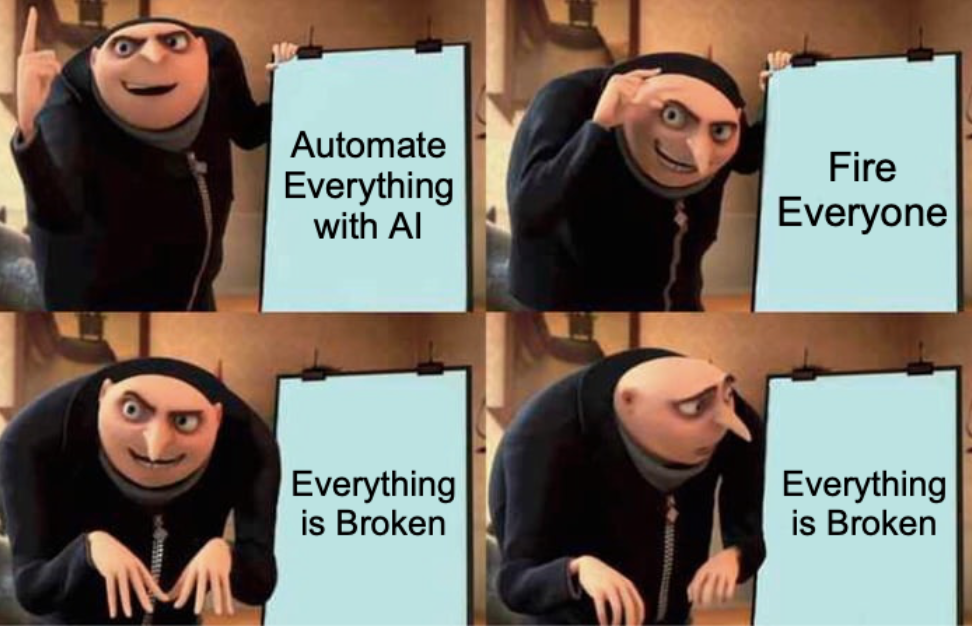 | What happens when tasks you didn't think could be automated are... We take for granted the equilibrium created by supply and demand, and there is a reason for that volume, it is was the market can facilitate in terms of a transaction for a particular good or service. What happens when you artificially spike the supply? You don't get something for nothing, and the something you are paying with is the massive non-zero probability of failure and zero perceived risk by these LLMs. What happens when a service used to facilitate 1,000 transactions a year but now its 100,000 with a 1% fail rate? You have 100x the volume but have idiosyncratic failure that only humans can fix. Remember, in a probabilistic model you will always have a failure rate. buT roMaN tHe 100x VolUMe wIll PaY foR the SupPort No it won't, let's offload that to AI too. It doesn't matter what the impact of the 1% is on our customers right? We're doing 100x the volume! Even if the 1% fail rate impacts access to our portfolio hedges, prescription medication, safety in an autonomous vehicle, trial outcomes...in essence things that require perception of RISK. Something AI will never be able to comprehend as a cluster of elements in a massive matrix...I'm not pessimistic or optimistic about the direction of AI, I'm just going to try to survive, not in the professional don't get replaced sense, but the don't let this indirectly kill me sense. | With that I will leave you to the Weekly Guild Letter. I hope you enjoy, and I hope you learn something! - Roman | | | 🚀 New Quant Guild Membership System |
| Looking to master your quantitative skills for trading and market making roles? Whether you are just getting started on your journey, looking to fill knowledge gaps, or are grinding for technical interviews there is a tier for everyone! | | | | | 🧮 Quant Model of the Week |
| | | Asset prices are not just random walks. They evolve through time with drift, volatility, and compounding effects that shape how derivatives are priced. The Black–Scholes model takes a simple approach to capturing that behavior. Instead of modeling every possible path explicitly, it describes price dynamics using a continuous stochastic process with constant drift and volatility. At its core, the model decomposes price movement into two pieces: a deterministic drift and a random diffusion. These combine in a multiplicative way, producing lognormal price behavior and enabling closed-form solutions for option prices. In real markets, this is powerful. You reduce complex uncertainty into a few parameters that can be estimated, tracked, and traded. Movements in prices and options become movements in volatility, time, and sensitivity measures like delta and gamma. | 🧮 Model Definition | This is what the Black-Scholes Equation looks like. | | | At a high level, the Black–Scholes equation is controlled by a small set of intuitive terms that describe how an option’s value evolves. First is the time component. This captures how the option changes simply as time passes, often referred to as theta. Even if nothing else moves, the option’s value decays or evolves with time. Second is the diffusion term. This is driven by volatility and the curvature of the option price with respect to the underlying. It captures how uncertainty and convexity contribute to the option’s value. Third is the drift term. This reflects the effect of the underlying asset growing at the risk-free rate in a risk-neutral world. It links the option’s sensitivity to the underlying price with the expected movement of that price. Finally, there is the discounting term. This accounts for the time value of money, ensuring that future payoffs are properly discounted back to today. Put together, the equation balances these effects. Time decay, drift, volatility, and discounting all interact so that the option price evolves in a way that prevents arbitrage. | 📈 Model Applications | In practice, the Black–Scholes equation is used to price and hedge options in a consistent, arbitrage-free way. On trading desks, it provides a framework to compute fair option prices and extract implied volatility from market quotes. Rather than guessing prices, traders invert the model to understand how the market is pricing risk. It is central to risk management and hedging. The equation gives rise to sensitivities like delta, gamma, and theta, which traders use to dynamically hedge positions and manage exposure to price moves, volatility, and time decay. It is also used for simulation and valuation. From equity options to structured products, Black–Scholes serves as the baseline model for pricing, scenario analysis, and benchmarking more complex models. | 🎓 A Little Story | The first time I really saw the Black–Scholes model wasn’t in a classroom. It was in a casino in the Bahamas. Don’t ask. I was watching a table, cards flipping, chips moving, people betting with absolute conviction on outcomes they couldn’t control. And somewhere in the middle of that chaos, it clicked. Everyone was pricing risk implicitly, but doing it badly. Emotion, bias, noise. And then my brain jumped to Black–Scholes. The idea that you could take something inherently random, eliminate the risk through hedging, and price it as if the world were “risk neutral” felt completely insane at first. You are telling me we can ignore preferences, ignore expected returns, and still get a fair price? In a casino, that sounds like cheating. But that’s exactly the point. You are not predicting the outcome. You are constructing a position where the randomness cancels out. Once the risk is gone, the price is just the discounted expectation. No guessing. No emotion. Just structure. Sitting there, watching people gamble, it hit me how different markets can be from gambling, at least in theory. In one world, you bet on outcomes. In the other, you engineer away uncertainty and price what remains. That was the moment risk-neutral pricing stopped being abstract and started feeling real. | 💡 Takeaway |
The Black–Scholes equation is not about predicting where prices go. It is about removing the need to predict at all. By constructing a hedge, you eliminate risk and force the option price to evolve in a way that earns the risk-free rate. The equation is just the mathematical expression of that balance, time decay, diffusion, and discounting all offsetting each other so no arbitrage exists. The real insight is structural. You do not need to know the future to price uncertainty. You need a way to neutralize it. That is the difference between guessing and pricing. | | | 🏆 Quant Question of the Week |
| Solution at the Bottom of this Email 👇 |
| | | Need to study up on topics in math, probability, and finance? 👉 Learn to solve problems like this on Quant Guild — the platform I wish I had when I was studying to become a quant. | | | 📅 Quant Guild Week in Review |
| Covered Calls, Trading Options, Prioritizing the Journey |
|
|
|
|---|
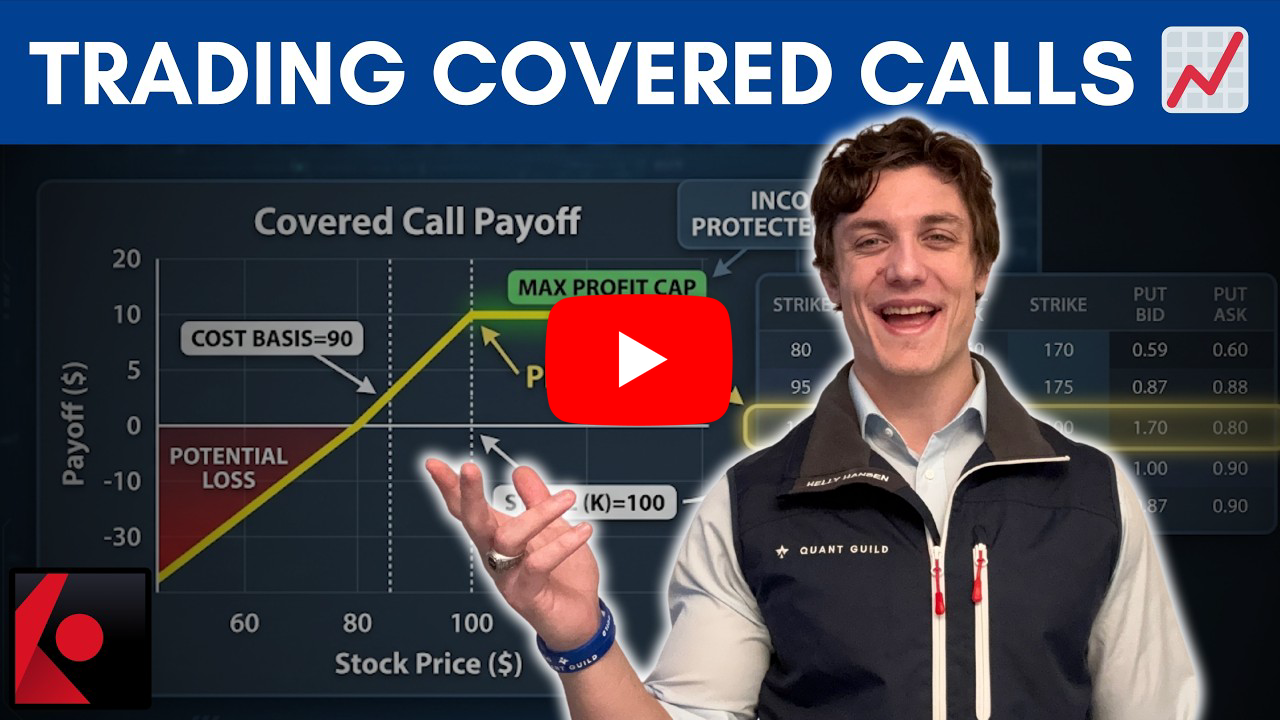
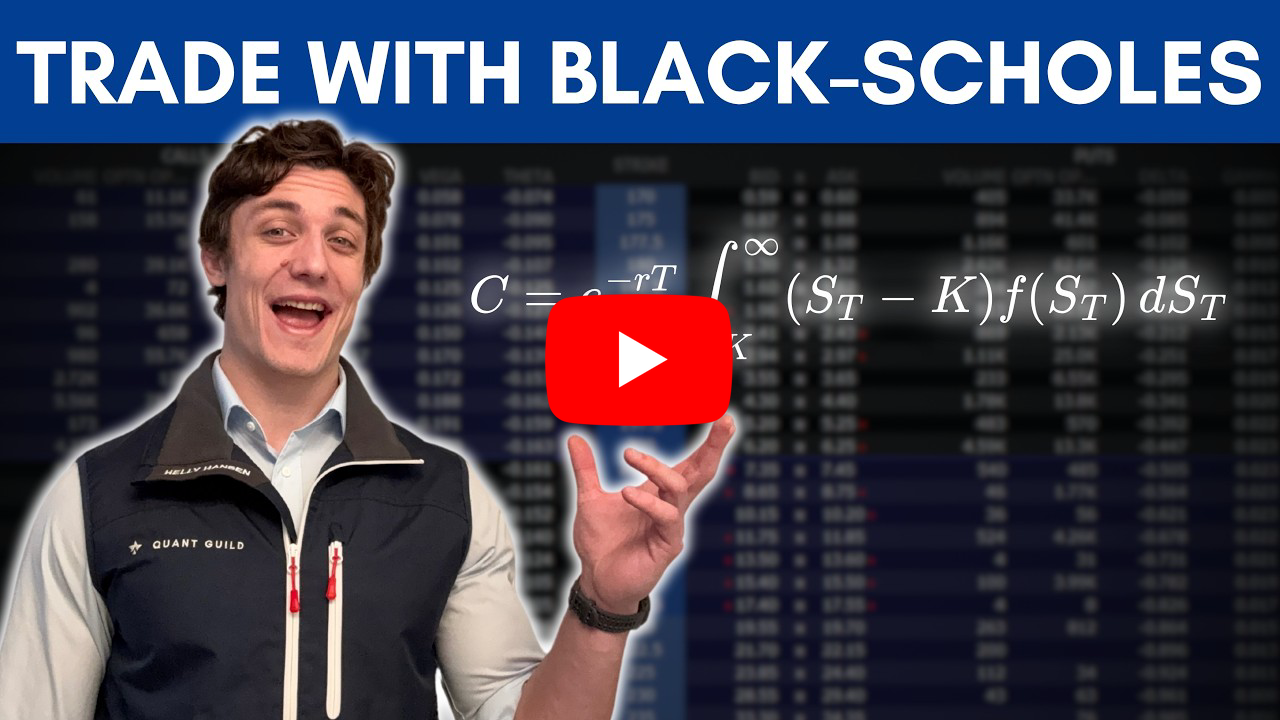
📈 How to Trade the Covered Call | In this video I walk through the covered call strategy from first principles and show how it translates into a real trade. The idea is simple. You own a stock and sell a call option against it to generate income. That premium is guaranteed cash today, but it comes with a tradeoff. You give up some upside and still carry the full downside risk of the stock. I start by explaining the structure of options and why short positions exist. When you sell a call, you receive a premium but take on the obligation to sell shares at the strike price if assigned. On its own, that can be risky. But if you already own the stock, you are “covered.” You do not need to go into the market and buy shares at a higher price. You can simply deliver the shares you already own. From there, I break the strategy into three possible outcomes. If the stock stays between your cost basis and the strike, you collect the premium and benefit from the stock’s appreciation. If the stock rises above the strike, you are assigned and sell your shares at that price. You still make a profit, but your upside is capped. If the stock falls below your cost basis, you begin to lose money on the position, and the premium only partially offsets that loss. The key insight is that this is not a free lunch. You are trading uncertain upside for guaranteed cash flow. It works best when you are willing to hold the underlying asset anyway and want to systematically generate income from it. I then show how to implement the trade in practice using a live example. You buy 100 shares, sell a call at a chosen strike and maturity, and collect the premium. From that point on, your payoff is fully defined by those three states of the world. The takeaway is that a covered call is a structured way to monetize ownership. It is not about predicting the market. It is about positioning, managing tradeoffs, and generating consistent cash flow while accepting the risks that come with holding the underlying. Here's a link to the full video 👇 | | | 🎲 How to Trade Options with the Black-Scholes Model | In this video I explain how the Black-Scholes model is actually used in practice, and why most people misunderstand it. The model is not a prediction tool. It does not tell you where prices are going. It is a framework for relative pricing and decision-making under uncertainty. I start by showing that raw option prices are meaningless on their own. Two at-the-money options on different stocks can have the same price, but they are not comparable because the underlying assets behave differently. The model allows us to translate those prices into implied volatility, which gives us a common language to compare contracts. This turns apples to oranges into apples to apples. From there, I focus on implied volatility as the key output. It tells us how the market is currently pricing uncertainty, but only in the present moment. It is constantly changing as supply, demand, and the underlying price evolve. Treating it as something stable or predictive is a mistake. I also address delta, which is often interpreted as the probability of expiring in the money. While that interpretation comes from the model, it does not hold in reality. These “probabilities” are constantly being repriced and do not converge like textbook examples. They are useful as relative measures, not absolute truths. The practical takeaway is that the model is a filter. It helps you compare contracts, structure trades, and think in relative terms, such as selecting strikes by delta instead of raw price. It gives you a consistent framework for positioning, not a crystal ball. The main idea is simple. All models are wrong, but some are useful. The Black-Scholes model is useful because it provides structure for making decisions in an environment defined by uncertainty and constant repricing. Here's a link to the full video 👇 | | | 🌱 Math Proves the Journey Matters More than the Destination | In this video I explain why the idea that “the journey matters more than the destination” is not just philosophical, it is mathematical. Every day we operate with expectations, and we implicitly assign a range of outcomes around those expectations. That range is variance. Some days are better than expected, some worse, but over time we adapt to both the outcomes and the variability itself. When something extreme happens, either a big win or a major setback, it feels shocking because it breaks outside that expected range. But over time, we adjust. Our expectations shift, our variance window shifts, and what once felt extraordinary becomes normal. This is the key mechanism. We adapt to everything. That is why goals lose their weight over time. Early on, a goal feels distant and meaningful, but as you progress, it gets absorbed into your expectations. By the time you achieve it, it no longer carries the same significance because it is now part of what you expect from yourself. The implication is that 100% of your time is spent on the path to the goal, not at the goal itself. And even when you reach it, you are immediately on a new path. If you do not find peace in the process, the destination will not fix that, because you will have already adapted to it. The takeaway is simple. Progress is nonlinear and adaptation is inevitable. If you want fulfillment, you have to optimize for the journey, not the outcome, because the outcome will always become your new baseline. Here's a link to the full video 👇 | | |
|
|
|---|
|
 | 📈 Why 10,000+ Quants Study on Quant Guild | Quant Guild is the one-stop platform for mastering the math that powers modern finance. With 90+ specialized lessons, adaptive practice with gamified progress that scales with your skill level, real interview questions, courses from A - Z in coding, math, probability & statistics, and exclusive live classes with me, it’s built to take you from fundamentals to the front-office. Everything’s designed for how real quants think and work — focused, practical, and deeply technical. That’s why over 10,000+ students and professionals study on Quant Guild to sharpen their edge and make smarter decisions in the face of uncertainty. | 🏛️ See How Pol Became a Market-Maker with Quant Guild | 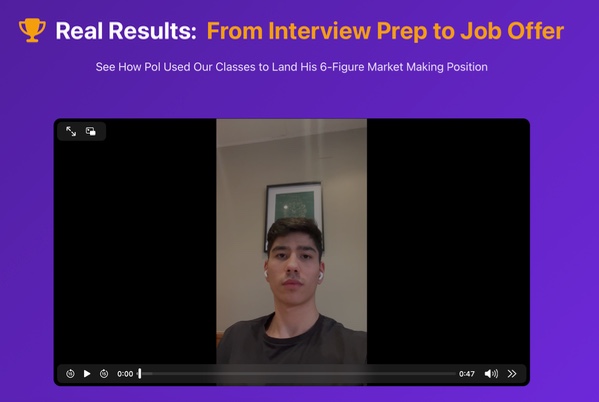 |  |
|
|
|---|
| | I'm in QR preparing for technical interviews and your practice helped me brush up on probability, thanks | | |
| | |
|
| | | I learned more here in two days than an entire semester of college | | |
| - Guy on Discord Who DM'd Me |
|
|
|
|---|
|
| | ✅ Quant Question of the Week |
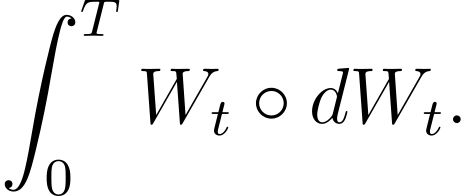
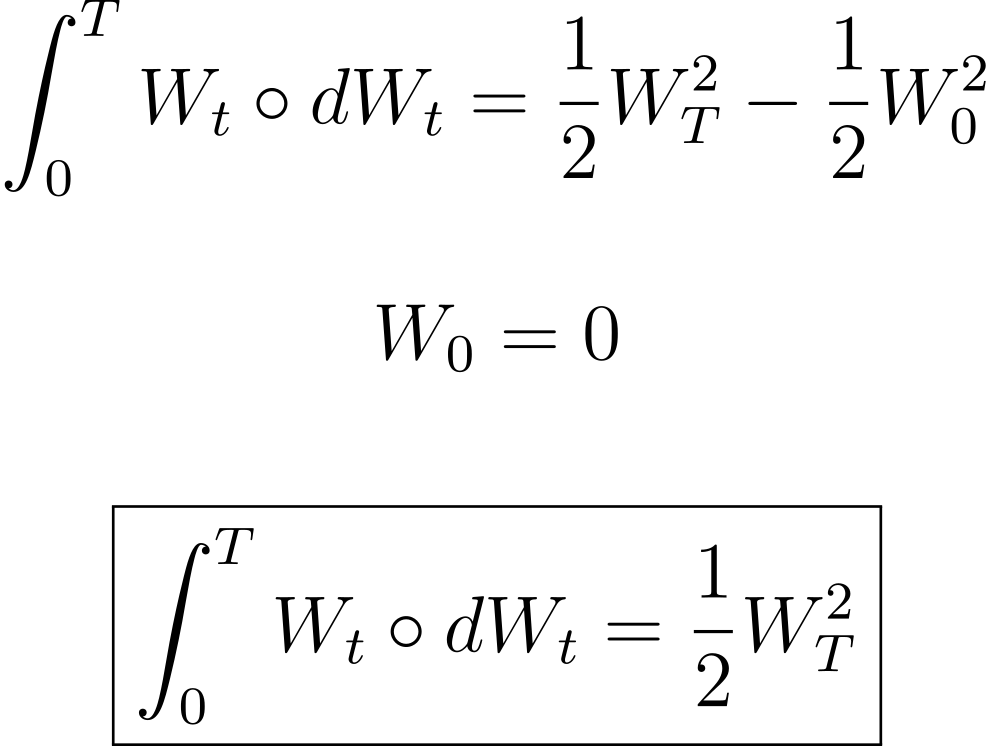
| | | | | The Stratonovich integral is not concerned with Ito's Lemma due to the nature of its evaluation of endpoints! However, we run into problems in the causal sense! | | |
|
|
|---|
|

 Roman Paolucci