 | 📜 A Note from the Guild Leader |
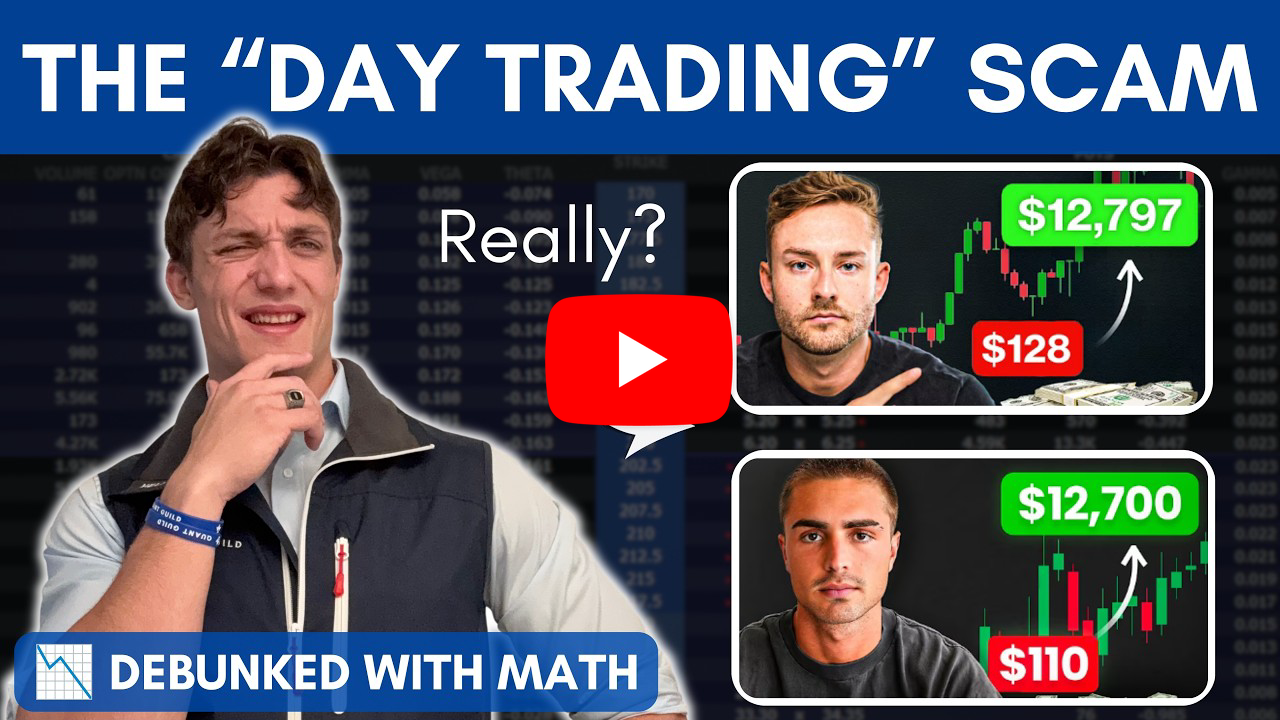
| | | The day trader thing has always been ridiculous to me. Not in the sense that discretionary trading isn't viable, literally all trading is discretionary. Even quantitative trading requires discretion of model and parameter risk. The faux trading and results are what I take issue with. Marketing +9,987% returns as feasible, like these figures knew or could do something that others couldn't. Anyone can bet the house on red. We take for granted being in the finance industry what reasonable, even good risk-adjusted return looks like. The general population does not. Unfortunately, when folks are in dire need of money the lottery ticket effect is easily exploited... | | | 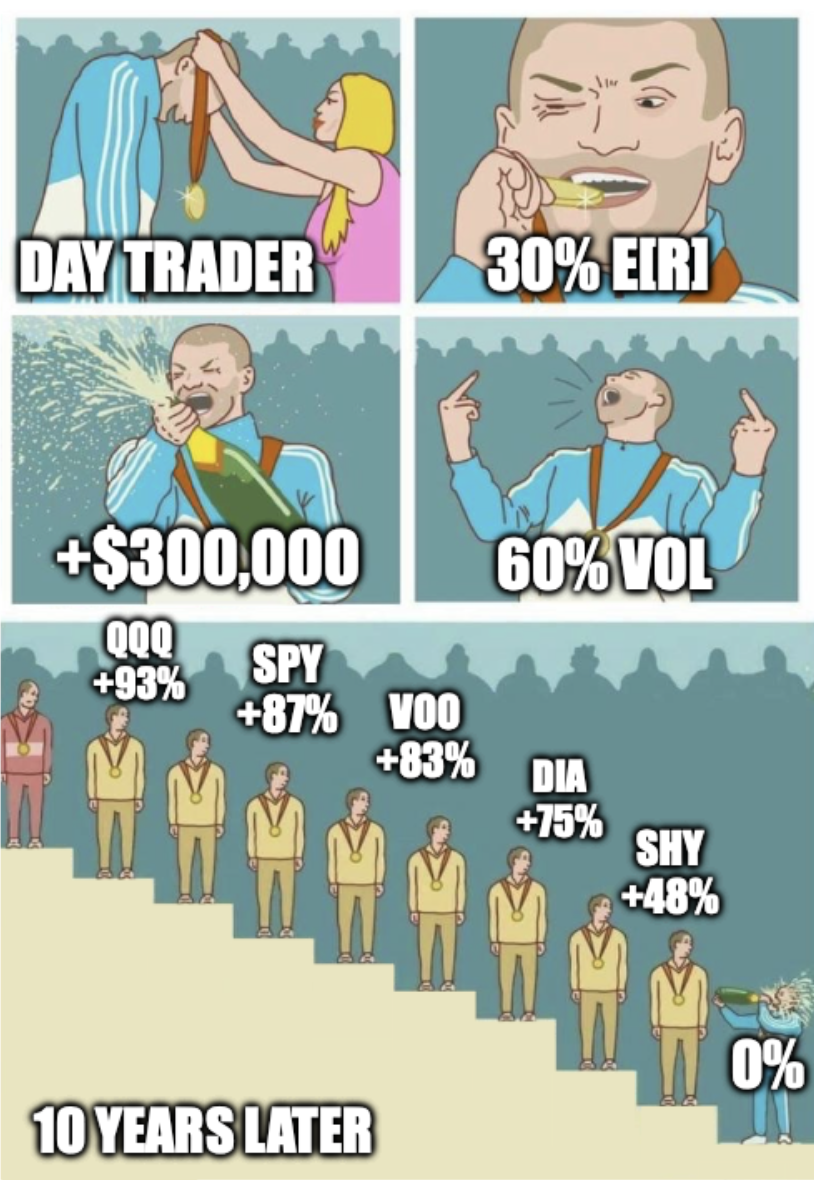 | But Roman, isn't it possible? Actually no, not at all. Mathematically and statistically there is no feasibility for the results they champion. This is due to one of a variety of reasons from insane CAGR implying more wealth than is available in the universe to volatility drag producing net zero or negative geometric growth year over year. I created my first video criticizing two relatively "popular" idiots figures in the day trading space, video linked below. I must say, I was sick watching some of their videos incorrectly citing statistical theorems and asymptotics. They are leading others down an path they aren't and can't be fully invested in themselves... Their content and following are impressive from a business perspective, no argument there. But the foundation is built on deception... You never get somethin' for nothin'. | | | With that I will leave you to the Weekly Guild Letter. I hope you enjoy, and I hope you learn something! - Roman | | |
|
|
|---|
|
📅 Quant Guild Week in Review |
| Alpha, Stock Picking, and the "Day Trading" Scam |
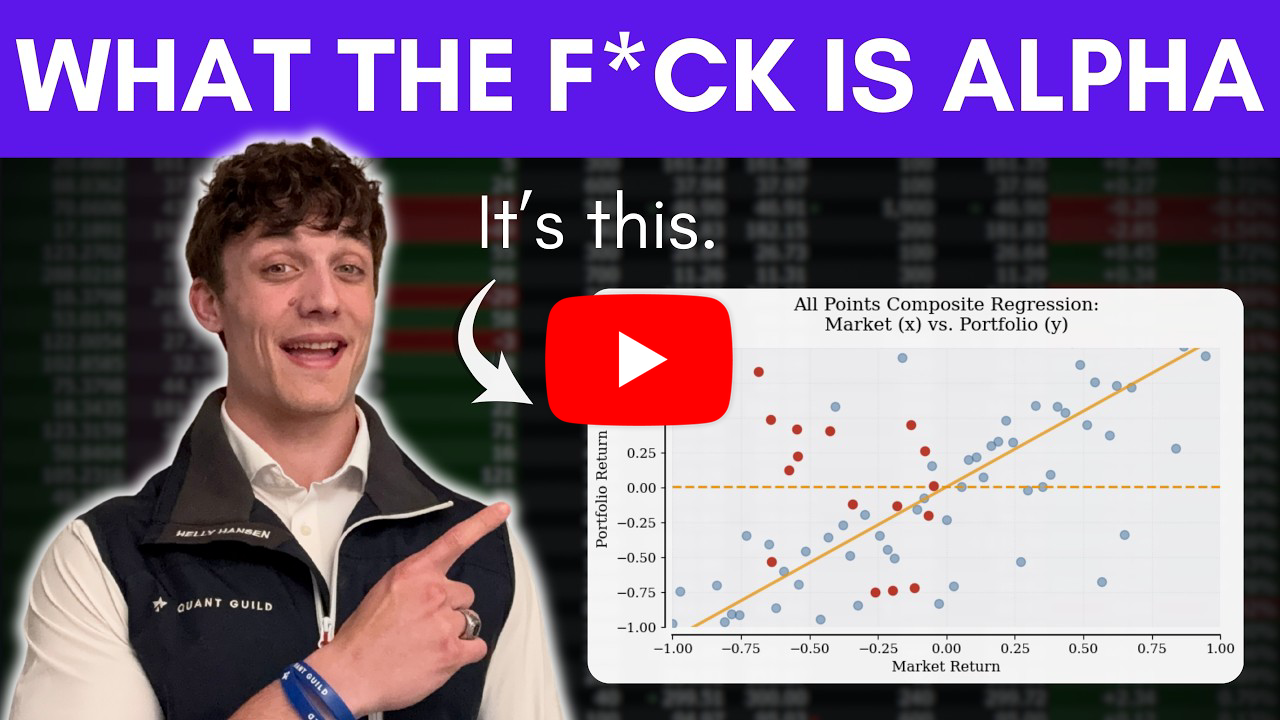
| | | 🏕️ What the F*ck is Alpha? (And Where to Find It) | In this video I explain what alpha actually is and why it is so often misunderstood. Alpha is not simply outperforming the market. It is the portion of your returns that cannot be explained by a pricing model or your exposure to common sources of risk like market beta. I discuss how true alpha comes from positioning and exploiting structural inefficiencies, not from taking more market risk or picking a high-beta stock. The goal is to engineer portfolios that produce returns independent of the broader market, particularly during periods of stress. Here's a link to the full video 👇 | | | | | 🎲 Stock Picking is Worse than Gambling at a Casino | In this video I explain why stock picking is often worse than gambling at a casino. Even if you consistently pick winning stocks, a large portion of your returns still comes from market beta, leaving you exposed to severe drawdowns during market crises. I show how chasing high returns often comes at the cost of much higher volatility drag, making long-term compounding far less reliable than most investors realize. Rather than trying to find the next winning stock, I argue that the real edge comes from engineering portfolios that manage risk and compound more efficiently over time. Here's a link to the full video 👇 | | | | | 💻 A REAL Quant Debunks the "Day Trading" Scam | In this video I explain why most day trading content is fundamentally misleading. The promise of turning a small account into a fortune through indicators and quick trades ignores the mathematics of risk, volatility drag, and long-term compounding. I show why strategies that produce spectacular short-term returns often come with catastrophic downside, while truly successful investing is built around position sizing, survival, and consistent geometric growth. Markets are uncertain, models break, and there are no shortcuts to sustainable returns. Here's a link to the full video 👇 | | |
|
|
|---|
|
| | 🧮 Quant Model of the Week |
| | | Risk is not just about volatility. It is about bad volatility. Traditional measures like standard deviation penalize upside and downside fluctuations equally. But investors rarely complain when returns are higher than expected. What matters is the variability that works against us. Semi-deviation addresses this by measuring only downside dispersion. Instead of treating every deviation from the mean as risk, it focuses exclusively on returns that fall below a chosen target, making it a more intuitive measure of downside uncertainty. | 📚 Model Definition | This following is the mathematical formulation of semi-deviation... | | | Traditional volatility compresses an entire return distribution into a single measure of dispersion, treating upside and downside fluctuations identically. Semi-deviation changes the question. Instead of summarizing all variability, it compresses only the portion of the distribution that falls below (or above) a chosen target. In other words, it deliberately discards information that may not be relevant to the investor. Positive surprises are ignored when measuring downside semi-deviation, while downside moves are ignored when measuring upside semi-deviation. The result is a risk measure that focuses on one side of the distribution. It sacrifices symmetry in exchange for a summary that better reflects how many investors actually think about risk: not as any deviation from expectation, but as the deviations they care about most. | 📈 Model Applications | In practice, semi-deviation is used anywhere downside risk matters more than total volatility. Portfolio managers use it to evaluate strategies that produce asymmetric return distributions, where upside volatility is desirable but downside volatility is costly. It is also the foundation of downside risk metrics such as the Sortino ratio, which replaces standard deviation with downside deviation. Because semi-deviation ignores favorable fluctuations, it often provides a more realistic assessment of strategies with skewed payoffs, option-based portfolios, or trend-following systems. The key insight is simple: not all volatility deserves to be called risk. Semi-deviation measures only the part of the distribution that investors are actually trying to avoid. | 🎓 A Little Story | The first time I heard about the Sharpe ratio, I did not get it. People kept saying volatility was bad, and I remember thinking, who cares if we have an extreme POSITIVE spike in returns (sure, I didn't know about volatility drag at the time but you get the criticism ;p) It felt like finance had invented a metric that punished success. Why should a portfolio get penalized because it occasionally made too much money? That criticism stayed with me for a while. Then I started learning more about compounding, portfolio construction, and optimization. I realized the Sharpe ratio was never trying to measure wealth. It was measuring consistency. It deliberately treats upside and downside volatility symmetrically because, in a mean-variance framework, dispersion itself is the object being optimized. That was also when I began appreciating metrics like semi-deviation and the Sortino ratio. Sometimes symmetric volatility is exactly what you care about. Other times, only downside risk matters. The lesson for me was bigger than the Sharpe ratio itself. There is no universally "correct" metric. Every performance measure encodes an objective. Once you understand the objective, the metric starts making a lot more sense. | 💡 Takeaway |
Semi-deviation is not a replacement for the Sharpe ratio, Information ratio, or CAGR. It is another lens. Every performance metric compresses a return stream differently and therefore emphasizes a different objective. Sharpe rewards consistency, Information measures active skill, CAGR captures long-run wealth creation, and semi-deviation isolates downside risk. No single metric tells the whole story. Good investors understand what each one measures, what it ignores, and use them together to build a more complete picture of portfolio performance. | | | 🏆 Quant Question of the Week |
| Solution at the Bottom of this Email 👇 |
| | | Need to study up on topics in math, probability, and finance? 👉 Learn to solve problems like this on Quant Guild — the platform I wish I had when I was studying to become a quant. |
|
|
|---|
| | I'm in QR preparing for technical interviews and your practice helped me brush up on probability, thanks | | |
| | |
|
| | | I learned more here in two days than an entire semester of college | | |
| - Guy on Discord Who DM'd Me |
|
|
|
|---|
|
| | ✅ Quant Question of the Week |
| | | | | | |
|
|
|---|
|

 Roman Paolucci