 | | | 📜 A Note from the Guild Leader |
| | | It's time we start talking about Bitcoin, but not in a crypto moonshot capacity, I'm not wired to think like that. Rather, and more importantly, let's discuss its viability as a monetary asset. | | | As stated in previous YouTube videos and email notes, I reject the notion of bubbles in favor of expectations and their realized deviations however large or small. The expectations for Bitcoin vary wildly, calls for it to hit $300k and calls for it to hit $0 - all entirely baseless and propagate moonshotting or doomsaying. The more important and interesting question is its viability as a monetary asset. This is not about a trivial analogy to gold... "bTc iS tHe NeW GoLd" Instead, how can we use the price discovery process of gold post collapse of Bretton-Woods in the 70's to inform the price discovery process of Bitcoin? This isn't exclusively an institutional game like 50 years ago, retailers are involved and can move the market, in fact taking the social aspect of price discovery into account and the insane contemporaneous correlation between social sentiment and crypto returns it would be abnormal should the extreme volatility we observe in Bitcoin NOT be present. This is exactly what I spoke about in my fireside chat this week. I'll leave a link to it below 👇 | | | | | With that I will leave you to the Weekly Guild Letter. I hope you enjoy, and I hope you learn something! - Roman | | |
|
|
|---|
|
📅 Quant Guild Week in Review |
| Stock Market Bubbles, CAGR, Modeling Tail Risk |
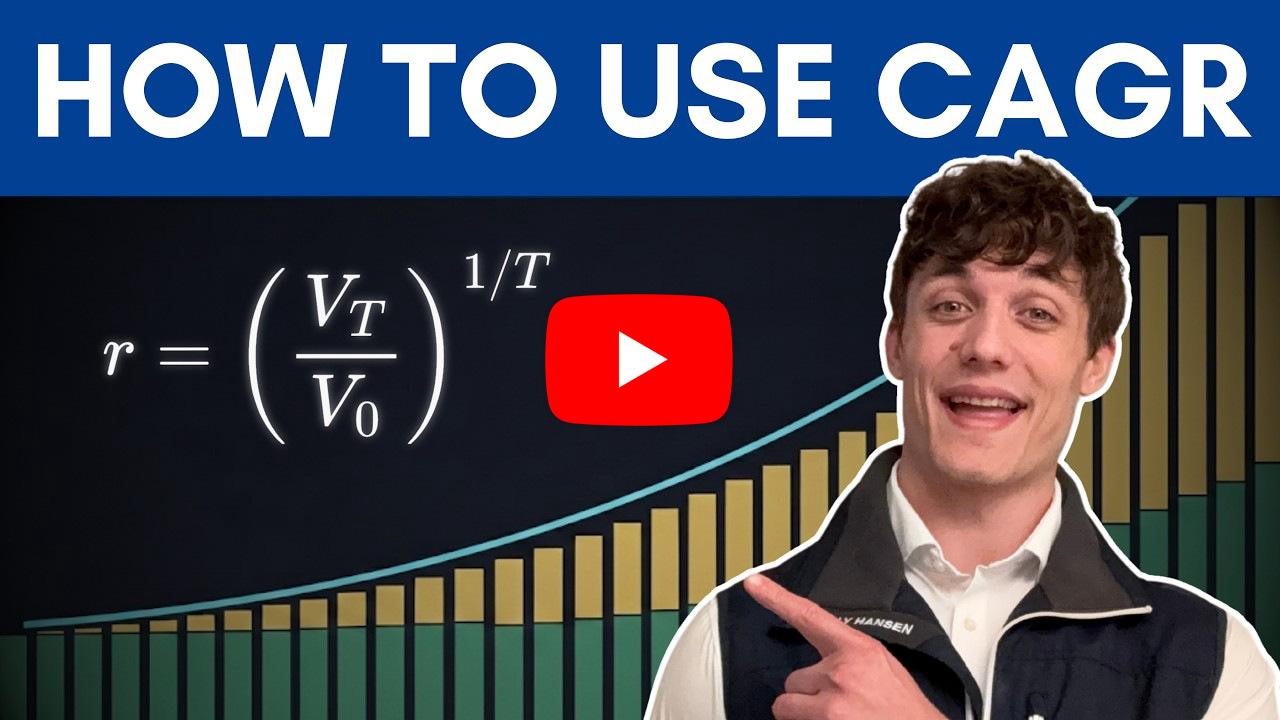
| | | 🏕️ How to Think About Stock Market Bubbles | In this video I explain why I dislike the term "market bubble" and prefer to think in terms of expectations. Markets are constantly pricing future outcomes, and when those expectations change or are shattered, prices adjust accordingly. The important question is not whether we're in a bubble, but how prepared you are if expectations suddenly shift. I also discuss why nobody can predict when a crash will occur, but history makes it clear that major drawdowns are inevitable over a long investment horizon. Rather than trying to forecast the next crisis, I focus on constructing portfolios that can survive them and take advantage of the opportunities they create. Here's a link to the full video 👇 | | | | | 🎲 Compound Annual Growth Rate (CAGR) | In this video I explain what Compound Annual Growth Rate (CAGR) actually measures and why it is one of the most useful concepts in quantitative finance. Rather than focusing on the noisy path a portfolio takes, CAGR tells us the constant annual rate that would produce the same ending wealth through geometric compounding. I also show why this measure is so useful in practice. It provides a simple way to compare investments, understand long-term wealth accumulation, and quickly identify unrealistic performance claims that violate the mathematics of compounding. Here's a link to the full video 👇 | | | | | 💻 Modeling Tail Risk: A Quant Survival Guide | In this video I explain why modeling tail risk is fundamentally a problem of survival, not prediction. Traditional risk models built on static assumptions dramatically underestimate the probability of extreme market events, giving investors a false sense of security. I show how regime-based models provide a much more realistic framework by recognizing that market behavior changes over time. Rather than trying to predict the next crisis, the goal is to better estimate risk so portfolios can survive periods of extreme stress. Here's a link to the full video 👇 | | |
|
|
|---|
|
| | 🧮 Quant Model of the Week |
| Hidden Markov Models (HMMs) |
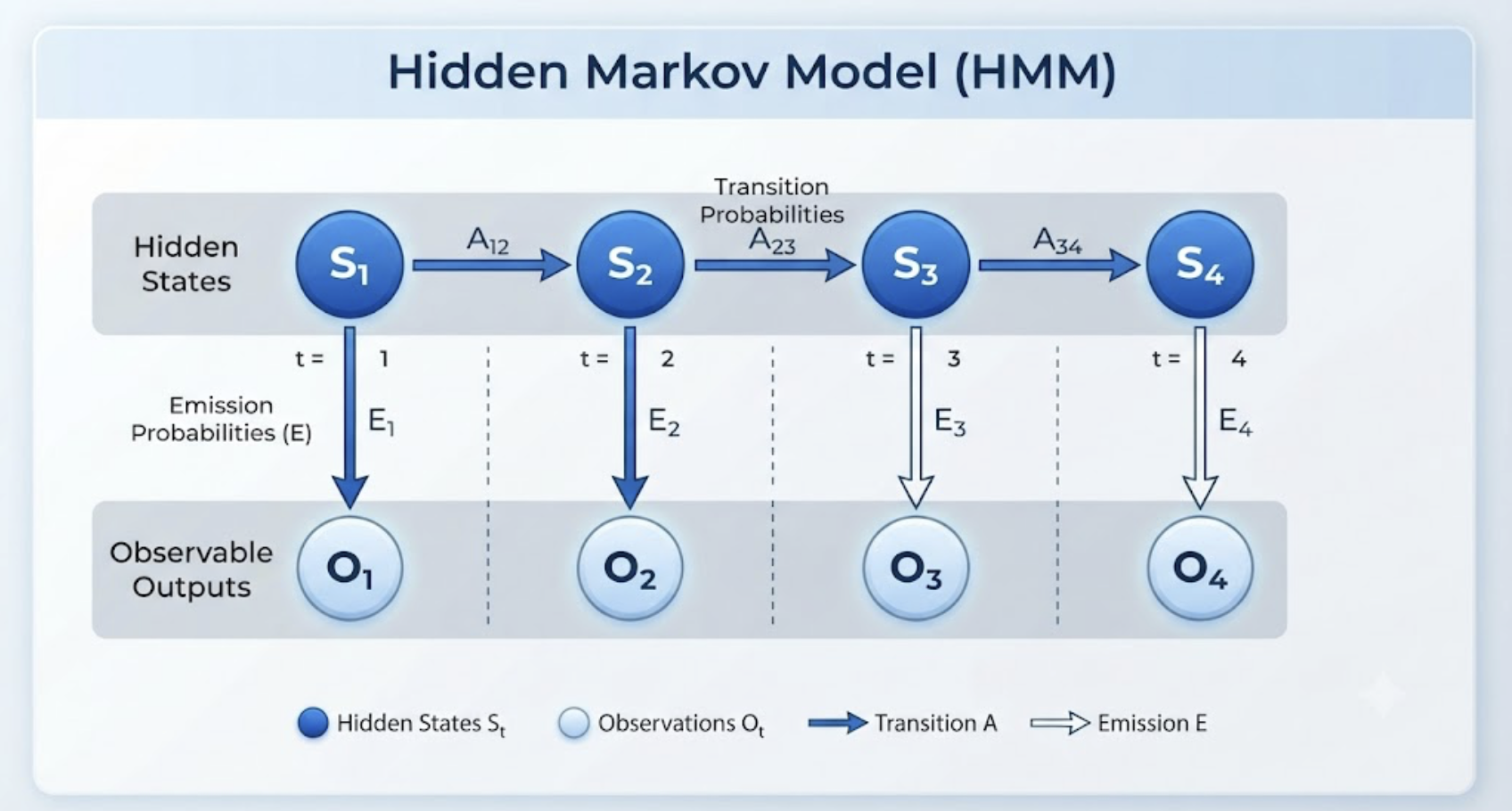
| | | Markets do not announce the regime they are in. We observe prices, returns, and volatility, but the underlying state driving those observations, bull market, bear market, crisis, or recovery, is hidden. We have to infer it indirectly from noisy data. Hidden Markov Models extend Markov chains by introducing these latent states. Instead of observing the state directly, we observe signals generated by it and use probability to infer which regime is most likely active. This simple extension makes HMMs one of the most widely used tools for regime detection, speech recognition, and sequential inference. When the state cannot be observed directly, Hidden Markov Models provide a principled way to estimate it. | 📚 Model Definition | This following structure is an example of a Markov chain... | | | At a high level, a Hidden Markov Model has two layers: hidden states (S₁, S₂, S₃, S₄) and observations (O₁, O₂, O₃, O₄). The hidden states evolve according to a Markov chain. The transition matrix A determines the probability of moving between states, with entries such as A₁₂, A₂₃, and A₃₄ describing the likelihood of transitioning from one hidden regime to the next. Each hidden state then generates an observation through the emission model E. The emission probabilities (E₁, E₂, E₃, E₄) describe how likely each hidden state is to produce the observations we actually measure. The key challenge is that we never observe Sₜ directly. We only observe Oₜ and use the transition probabilities A together with the emission probabilities E to infer the most likely sequence of hidden states. In other words, an HMM separates the latent process (Sₜ) from the observed data (Oₜ), allowing us to infer hidden regimes from noisy observations. | 📈 Model Applications | In practice, Hidden Markov Models are widely used for market regime detection. Rather than assuming markets behave the same way through time, HMMs infer latent states such as bull markets, bear markets, low-volatility, and crisis regimes from observable returns, volatility, or macroeconomic data. They are also used in statistical arbitrage, volatility modeling, speech recognition, and anomaly detection, wherever the underlying process cannot be observed directly but leaves measurable signals. The challenge is that the hidden states are only as useful as they are stable. Markets evolve. Relationships change. A regime learned from one decade may not correspond to the same economic environment in the next. As a result, the estimated transition probabilities, emission distributions, and even the interpretation of the hidden states can drift over time. This is the fundamental limitation of HMMs. They infer regimes from historical data, but there is no guarantee those regimes remain stationary. The model can uncover hidden structure, but whether that structure persists is ultimately an empirical question. | 🎓 A Little Story | The first time I learned about Hidden Markov Models, I immediately applied them to volatility regime modeling. On paper, they seemed perfect. Markets clearly switch between calm periods and turbulent ones, so why not let an HMM infer those hidden regimes automatically? Then I looked at the results. I thought they were garbage. The states jumped around, the inferred regimes were unstable, and small changes in the data could produce completely different classifications. I remember showing the results to a Quant Trader friend of mine, who looked at the output for about thirty seconds before declaring that HMMs were "Russian propaganda." I still laugh thinking about that. But over time, I realized the problem was not the theory. The problem was the data. Markets do not owe us stable latent regimes. If the underlying structure is changing, no statistical model is going to magically recover a clean, persistent state process. An HMM can only infer the patterns that exist in the data it is given. That was an important lesson for me. It is easy to blame a model when it produces unstable results. Sometimes the model is wrong. But sometimes the instability is telling you something true about the world you are trying to model. | 💡 Takeaway | Hidden Markov Models are powerful because they acknowledge something most models ignore: the system driving the data may itself be hidden. But inferring hidden structure is not the same as discovering permanent truth. If the underlying regimes are unstable, the inferred states will be unstable too. That is not necessarily a failure of the model—it may be an honest reflection of the data. The real lesson is that models cannot create structure where none exists. HMMs are excellent at uncovering latent patterns, but they cannot guarantee those patterns will persist. In quantitative finance, that distinction is often more important than the model itself. | | | 🏆 Quant Question of the Week |
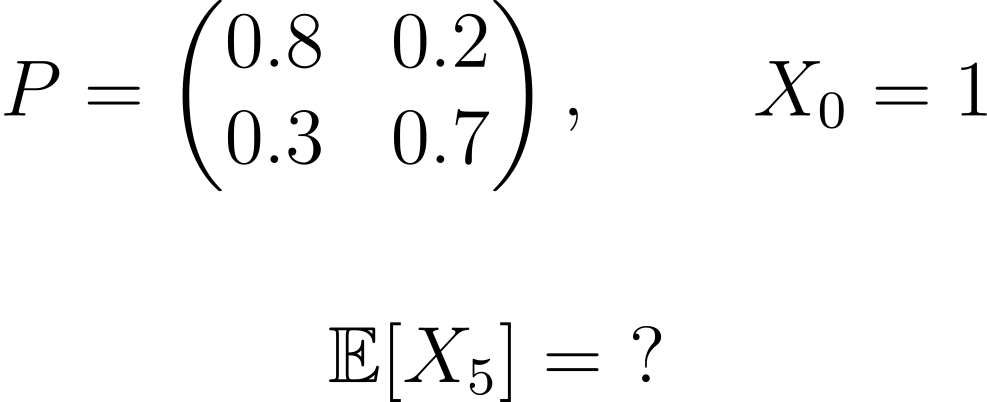
| Solution at the Bottom of this Email 👇 |
| | | | | Need to study up on topics in math, probability, and finance? 👉 Learn to solve problems like this on Quant Guild — the platform I wish I had when I was studying to become a quant. |
|
|
|---|
| | I'm in QR preparing for technical interviews and your practice helped me brush up on probability, thanks | | |
| | |
|
| | | I learned more here in two days than an entire semester of college | | |
| - Guy on Discord Who DM'd Me |
|
|
|
|---|
|
| | ✅ Quant Question of the Week |
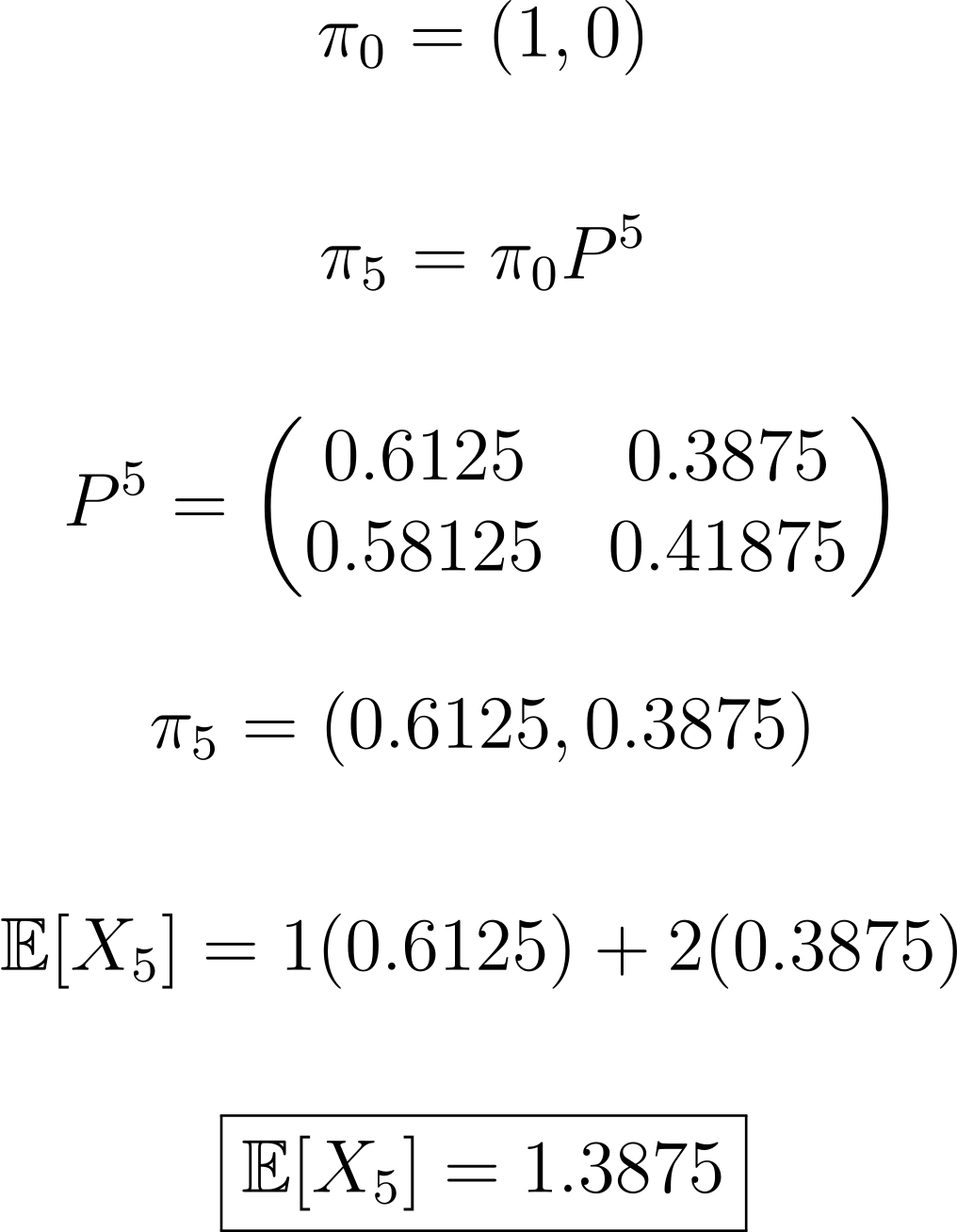
| | | | | The following Markov chain is constructed with an absorbing state and the probability is observed applying the Chapman-Kolmogorov result. | | | | |
|
|
|---|
|

 Roman Paolucci