 | | | 📜 A Note from the Guild Leader |
| | | The only thing better than financial advice or judgement is unsolicited financial advice or judgement. Models don't have to be quantitative to break. If more people understood this we wouldn't have many of the problems we do in the world. | | | It's easier to see quantitative models break. The probability of an event that actually happened according to your model is once every 10 million years, clearly it's just wrong. Qualitatively, it's much harder to discern when a model (advice) breaks. And people love to (albeit inappropriate) blame bad advice. A great example is Dave Ramsey's baby steps. He's helped millions of people who needed that specific framework. In the same way a marathoner needs a marathon coach. And in the exact same way a marathoner DOES NOT need a powerlifting coach. The key part most people miss. Advice (models) break when you are no longer a candidate for the regime they represent, or you misrepresent yourself as a candidate for the model's regime. This is where the hard to swallow pills come out. Many prefer to blame their own action or inaction on the poor advice (models) of others. I've seen it from the lowest level to the highest level: from teachers on shoestring budgets to millionaires following bad tax advice. But why didn't the model work...there are only three reasons assuming the model isn't garbage: 1.) You are not the appropriate candidate for the model 2.) You misrepresented yourself as a candidate for the model 3.) You just did not execute the model This is exactly why I propagate the notion of mastering your quantitative skills. You will never "know for certain" whether a model is garbage outright, whether you are actually the right candidate for it, but you can certainly control which model you choose along with the execution. All of the power comes from this control, optimal decision making under uncertainty and of course iteration. In other words, educate yourself sufficiently so you can confidently operate on your own in the following capacity:
1.) I have a target state or goal 2.) I need help getting there 3.) I've found a model(s) that offer guidance to the target 4.) Execute on whatever model seems optimal and iterate Iterating is violently unpleasant because we are trying our best. We might switch our model and have to go back. Is this failure? If something doesn't work the first time are we giving up? Maybe. The real question is how badly do you want the target state? If someone has something you want that you don't, they wanted it more than you. Another hard to swallow pill. When they needed to iterate because a model broke or they "failed", they did not stop. They tried again. I'm sure it was painful, they probably had no support. But they did anyway. This is qualitative Bayesian updating. It's how we get better at literally everything, and why I encourage you to get after it, learn, pick a model, and start today. Failure is always acceptable because it's never the end, it's opportunity to iterate. I'm not at all suggesting it will be pleasant, but structurally this is how you must look at the world otherwise every challenge will be just another reason to stop following a model (advice) to reach your target state. You can and achieve your target state (with mathematical certainty), just start, honestly, with intention, continue updating your priors, and do not stop. | | | With that I will leave you to the Weekly Guild Letter. I hope you enjoy, and I hope you learn something! - Roman | | |
|
|
|---|
|
📅 Quant Guild Week in Review |
| Financial Advice Fails, 5 Levels of Investing, AI Stock Trading Bot, My 2025 Crisis Alpha, Intermediate Quant Projects |
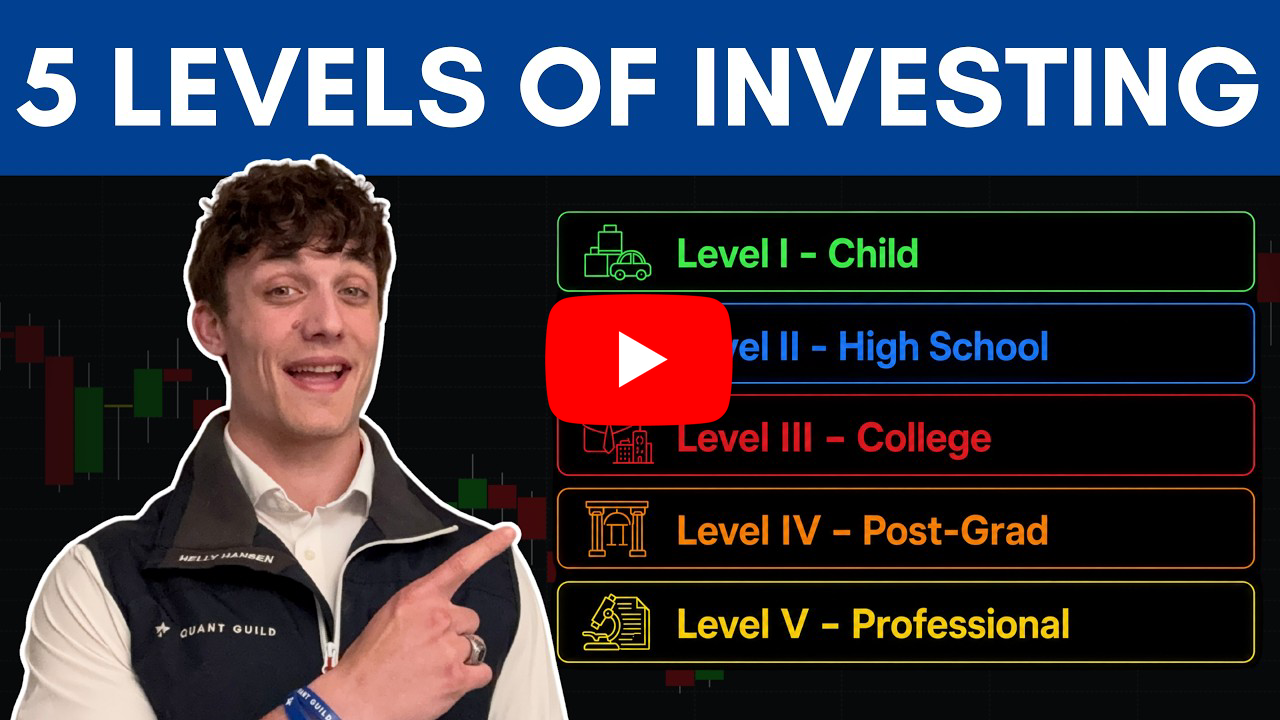
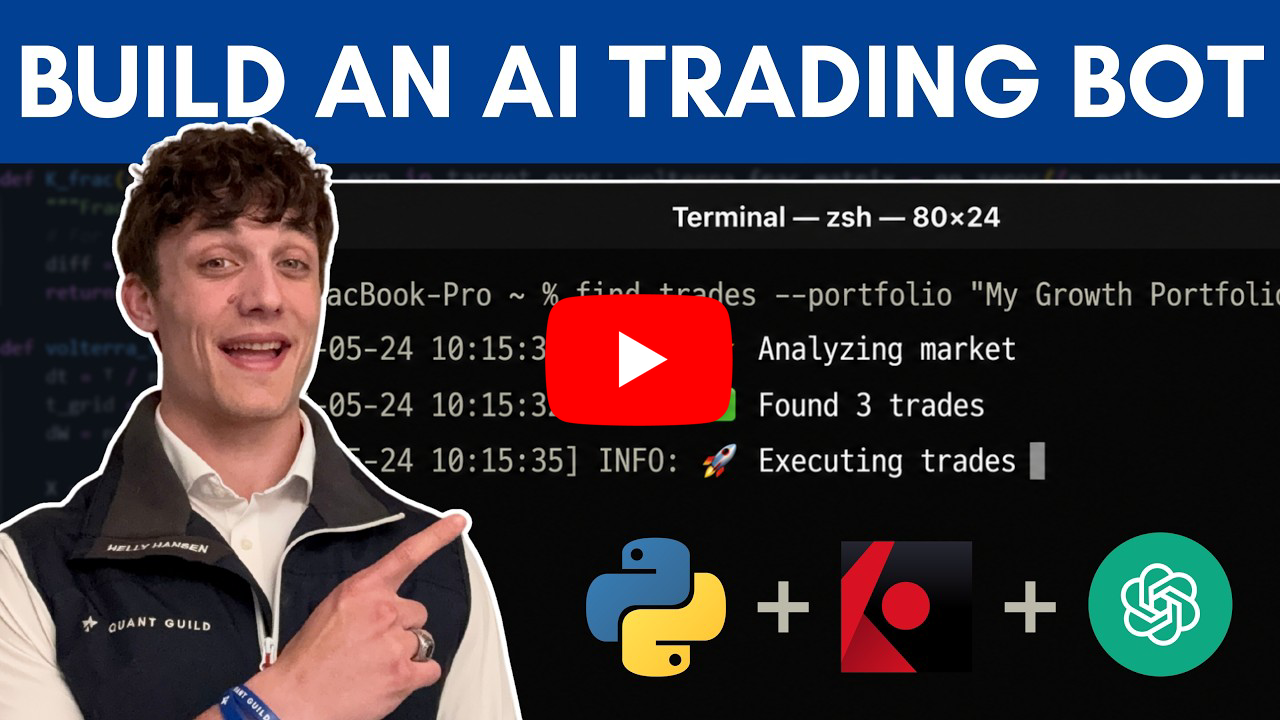
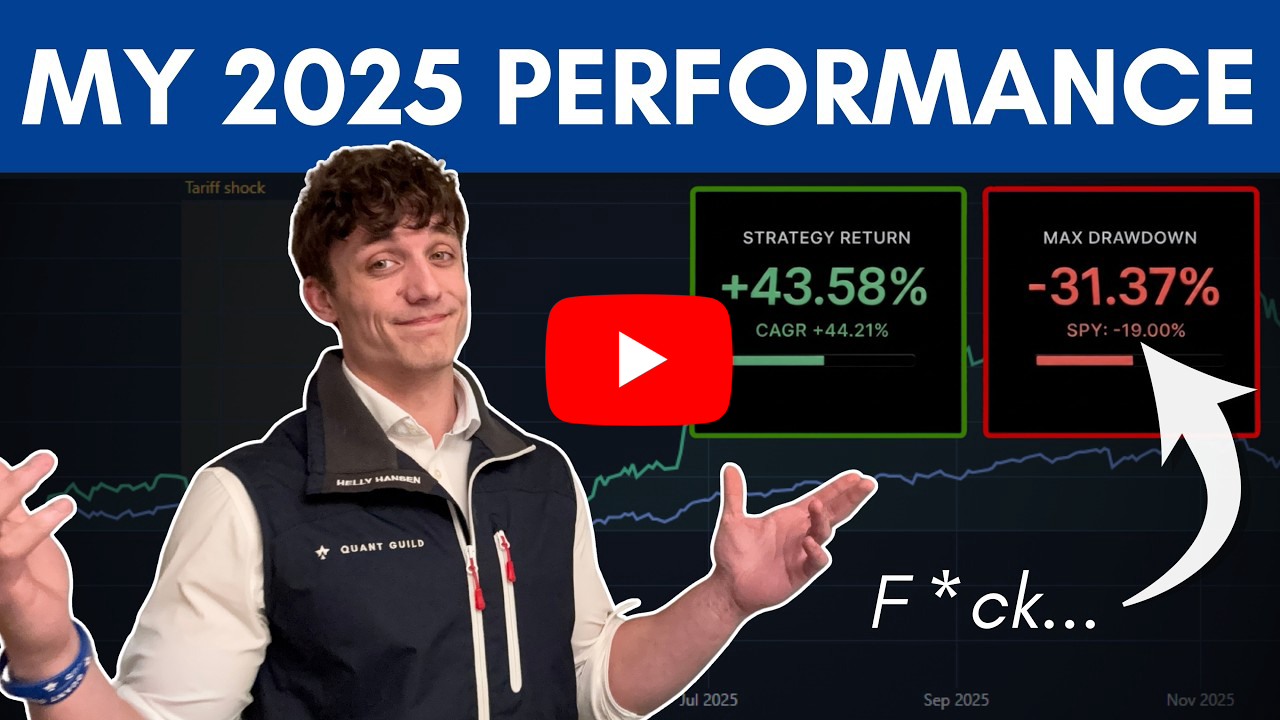
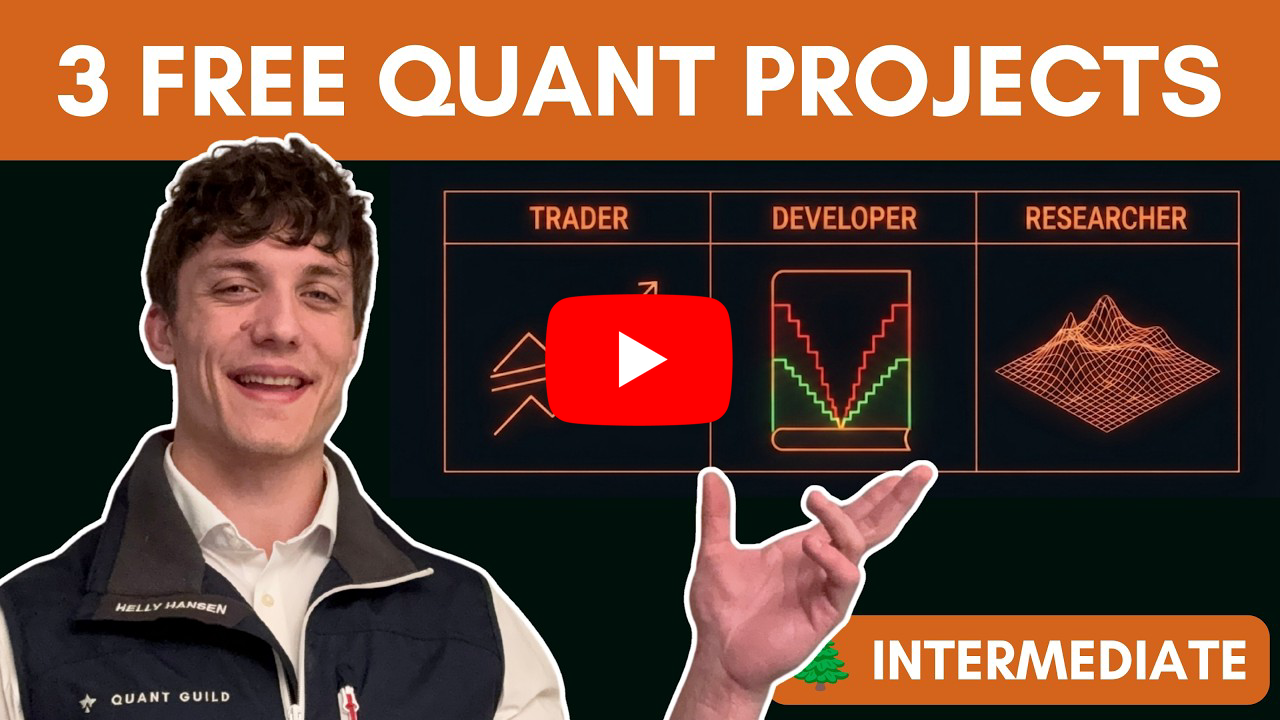
| | | 🏕️ Financial Advice Fails (And AI Can't Help) | In this video I argue that effective financial advice cannot be reduced to a universal formula. Every person's circumstances, goals, risk tolerance, and ability to follow a plan are different, which means good advice must be tailored to the individual rather than applied as a one-size-fits-all solution. I explain why experience matters, using examples from fitness, investing, and everyday decision-making to show that advice is only valuable if it is practical and actionable for the person receiving it. I also discuss the limitations of relying on credentials alone and why blindly following experts or generalized frameworks can be misleading. Here's a link to the full video 👇 | | | | | 🎲 Quant Explains Investing at 5 Levels | In this video I explain investing at five different levels, starting with simple intuition and gradually building toward quantitative portfolio management. Along the way I introduce the ideas of risk and reward, fair value, market efficiency, diversification, and the different sources of risk that investors are actually exposed to. I show why simply owning many stocks is not the same as being diversified. Companies can share the same underlying risk factors, and during market stress those hidden exposures become painfully obvious. True diversification comes from understanding the principal directions of risk and allocating capital across structurally different sources of return. Here's a link to the full video 👇 | | | | | 💻 How to Build an AI Stock Trading Bot with Interactive Brokers | In this video I build an AI-powered stock trading bot from scratch using Interactive Brokers, OpenAI, and Python. Rather than focusing solely on trade generation, I design a complete portfolio management system that can reason about positions, remember past decisions, evaluate risk, and interact with a live brokerage account. I walk through the architecture of the application, including the backend, user interface, persistent memory, and the communication between the language model and Interactive Brokers. The AI is able to retrieve market data, develop and revisit investment theses, size positions according to portfolio objectives, and eventually automate the process of monitoring and managing a portfolio. Here's a link to the full video 👇 | | | | | 🧮 Live Capital Management: My 2025 Crisis Alpha | In this video I review my own live portfolio performance during the 2025 market drawdown and critically evaluate the decisions I made along the way. Rather than presenting a success story, I treat the experience like reviewing game film, identifying both the mistakes that increased my drawdown and the decisions that ultimately drove my returns. I discuss the role of volatility, drawdown monetization, crisis positioning, and why I believe market dislocations create some of the best opportunities for long-term outperformance. I also explain how I think about hedging, allocating capital during periods of extreme uncertainty, and balancing downside protection with the ability to capitalize on recoveries. Here's a link to the full video 👇 | | | | | 🛠️ Projects to Help you Become a Quant (Intermediate) | In this video I walk through three intermediate-level projects that bridge the gap between classroom theory and real quantitative finance. Rather than focusing on isolated concepts, these projects are designed to expose you to the workflows used by traders, researchers, and quantitative developers. I cover a market making simulator to understand pricing models and model risk, a derivatives pricing engine to connect stochastic calculus and partial differential equations to real option pricing, and an order book simulator to build intuition for market microstructure, execution, and liquidity. Here's a link to the full video 👇 | | |
|
|
|---|
|
| | 🧮 Quant Model of the Week |
| | | | | Credit risk is not just about whether a firm defaults. It is about when default becomes unavoidable. Early structural credit models treated default as something that could only occur at a fixed maturity, comparing a firm's assets to its liabilities at a single point in time. In reality, companies can become insolvent long before their debt matures. The Black–Cox model extends the structural framework by introducing a default barrier. Instead of waiting until maturity, default occurs the moment the firm's asset value falls below a predetermined threshold, making default a first-passage problem rather than a terminal event. The result is a model that captures the timing of default much more realistically, providing a richer framework for pricing corporate debt, estimating default probabilities, and understanding credit risk. | 📚 Model Definition | This following structure is an example of a Markov chain... | | | The Black--Cox model combines three ideas: firm value dynamics, a default barrier, and first-passage default. The firm's asset value, Vₜ, is assumed to follow a geometric Brownian motion, evolving with a constant expected growth rate μ and volatility σ. This captures the uncertainty surrounding the value of the firm's assets over time. The model also introduces a default barrier, Dₜ, which represents the minimum asset value the firm must maintain to remain solvent. Rather than being fixed, this barrier changes through time, reflecting the present value of the firm's debt obligations as maturity approaches. The key idea is that default is not determined only at maturity. Instead, default occurs the instant the firm's asset value falls below the barrier. This first-passage mechanism allows the model to capture firms that become insolvent before their debt matures, making it a more realistic representation of credit risk. Finally, the quantity of interest is the probability that the asset value crosses the default barrier before time T. This probability forms the foundation for pricing risky corporate debt, estimating default probabilities, and valuing credit-sensitive securities. | 📈 Model Applications | In practice, the Black--Cox model is used to analyze and price credit risk by modeling default as the first time a firm's assets fall below a critical threshold. It is particularly useful for pricing risky corporate debt and estimating default probabilities. By allowing default to occur at any point before maturity, the model captures an important feature of real-world credit events that earlier structural models overlook. The framework is also used in credit risk management, capital structure analysis, and the valuation of credit-sensitive securities. Financial institutions can estimate the likelihood of default under different market conditions and use the model to assess the impact of leverage, asset volatility, and debt levels on a firm's creditworthiness. Of course, the model relies on assumptions that are difficult to satisfy in practice. The firm's asset value is not directly observable, and parameters such as asset volatility must often be estimated indirectly. In addition, real firms typically have complex debt structures that are far more complicated than the single default barrier assumed by the model. | 🎓 A Little Story | The first time I was asked to discuss analytical solutions for path-dependent options as a student, I was completely convinced the answer was obvious. "You need simulation, bro." As far as I was concerned, if the payoff depended on the entire path of the underlying, you could thank Feynman-Kac for pointing you toward a PDE if you were lucky, but in practice you were firing up a Monte Carlo simulation. Then someone brought up the Black--Cox model. I remember thinking, "Wait... there's an analytical solution to a first-passage problem?" There absolutely was. My buddies had no trouble letting me know how confidently wrong I had been. It was one of those humbling moments where everyone else in the room already knew something that I didn't. But once I understood the mathematics behind barrier crossing and first-passage times, I wasn't embarrassed anymore. I was fascinated. The idea that you could derive closed-form expressions for probabilities involving an entire stochastic path, rather than just its terminal value, was so fucking cool. Sometimes you really do need simulation. But sometimes mathematics finds a shortcut that feels almost magical. Black--Cox was one of the first models that made me appreciate just how powerful those analytical results can be. | 💡 Takeaway | The Black--Cox model is a reminder that timing matters just as much as outcomes. Earlier structural models asked whether a firm would default by maturity. Black--Cox asks a more realistic question: what if the firm defaults before it ever gets there? That seemingly small change transforms default from a single terminal event into a dynamic process driven by the entire path of the firm's assets. The broader lesson extends well beyond credit risk. Sometimes, what matters is not just where a process ends, but the path it takes to get there. In finance, the journey can be just as important as the destination. | | | 🏆 Quant Question of the Week |
| Solution at the Bottom of this Email 👇 |
| | | | | Need to study up on topics in math, probability, and finance? 👉 Learn to solve problems like this on Quant Guild — the platform I wish I had when I was studying to become a quant. |
|
|
|---|
| | I'm in QR preparing for technical interviews and your practice helped me brush up on probability, thanks | | |
| | |
|
| | | I learned more here in two days than an entire semester of college | | |
| - Guy on Discord Who DM'd Me |
|
|
|
|---|
|
| | ✅ Quant Question of the Week |
| | | | | | | | |
|
|
|---|
|

 Roman Paolucci