Before discussing the underlying mathematical structure required to operate in the trading and investing space, it's useful to draw analogies to other professions that take advantage of the same structure. In fact, trading and investing are a lot like Brazilian Jiu-Jitsu and fishing ... actually they're exactly the same.
Knowing what to do or when to call it quits in real time are the most difficult components of developing capability in any field. Trial and error play a huge role, and so does failure. Interestingly, due to the broader notion of convexity (which I will discuss next week), the behavior of trial and error leads to the most gains as long as you don't blow your account (or quit).
You just need to survive. Many don't.
Either because they run out of capital or because they just quit.
Let's talk about a few examples to illustrate the idea of Bayesian updating.
Brazilian Jiu-Jitsu: I want to submit my opponent. I don't know what techniques are the highest probability against my opponent, but I know which techniques I am adept at, and I may have watched him submit to some techniques in the past. Has he since learned to defend them? Will they still work? Is past performance indicative of future performance?
I step onto the mat and shake the referee's hand along with my opponent's. I have some noisy signals, what might work, what might not work, but I have to try. So I try, I get a takedown and find myself applying the technique that has submitted him in the past. But it's not submitting him. Where is the line of trying too hard, burning out, and running out of gas and being one extra second of effort away from finishing the fight? Welcome to the game.
Fishing: I want to catch fish. I don't know where the fish are, or where the highest probability spots are to catch the most fish, but I know where I have caught fish in the past, and I know what the fishing reports are saying, what I'm seeing on the water (birds, fish jumping, other boats, my fish finder). I have noisy signals.
I setup a drift and start fishing. No hits. Is this spot dead? Do we need to move to another spot? Are there no fish here? Or are we a few seconds away from the honey hole? We've found fish! So we are set for good! Right? We assumed risk, followed the noisy signal, stuck it out, and found our reward.
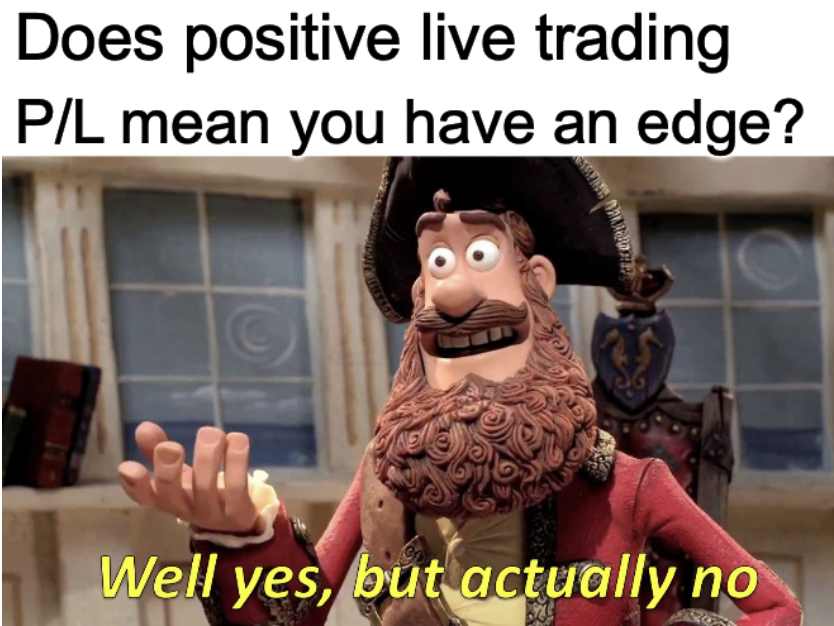
That's all there is to it right? A few moments later, no fish. Our lucrative signal just ran out of P/L, I thought we had an edge? Welcome to the game.
Trading and investing: I want to make money achieve the highest risk-adjusted return possible. I don't know the true data generating distribution, I might have some idea of what it looks like empirically, I know what has worked in the past, the current macroeconomic outlook, trends and the broader market as a whole.
I have a noisy signal.
Mean reversion is killing it right now, I'm generating P/L hand over fist. Structure broke. Is it ephemeral? Or are we in a momentum arc now? Should I adjust my model now or later? Every second I'm losing P/L. Adjust too quick and we go back to reversion I lose more money. Adjust too slow and I miss the boat.
And just like that, I welcome you to the game.
The game of course is Bayesian updating. We have our prior beliefs that we can construct using one of an infinite number of things from contemporaneous reports, knowledge, experience, an underlying thesis, forecasts, models, the list goes on.
We observe new information. Is it signal or noise? When should we call it quits and move on? When do we have to stick it out? Interestingly, and most importantly, we don't have to be perfect. We just have to stay in the game long enough to receive our payout. We have to survive.
Some point fingers at "success" and call it luck, others recognize it's mathematical certainty if you continue learning, updating your priors, and taking action; of course all with the broader notion of survival in mind.
We may have negative edge given actions based on some priors. Positive edge based on others. But if we are constantly working to apply new information optimally, we can keep marching toward positive expectancy.
Sometimes we will be faster than others and make money. Other times we'll be slower and lose money. As long as we survive and make it to the long run we'll be playing with house money.
This is Bayesian updating. It is how we get better at everything. I borrow most of the concepts herein from the statistics and reinforcement learning literature in the context of optimizing a policy function based on an an expected reward.
Notice, expected reward. We can't ever know with certainty. Why? Because there are too many sources of variance that can never be constrained.
It doesn't matter if you have the best baseball player on earth, the pitcher chooses which pitch to throw and the batter doesn't have a crystal ball. The objective is to optimize average performance, to gain an edge, it's how we train rational agents mathematically to learn, all inspired by how we learn in the real world.
It's a dynamic process that requires work, the furthest thing from set and forget.
TL;DR: Regardless of the pond you chose to swim in, you don't get to chose not to swim. In other words, everything takes work. There is never a set and forget strategy for any industry that can indefinitely print you success. You must be dynamic enough to recognize new opportunity, and patient enough to wait out the shocks. Understanding which you are facing (and know, you will sometimes be wrong) requires knowledge and experience.

 Roman Paolucci