 | | | 📜 A Note from the Guild Leader |
| | | Dave Portnoy said it himself, the first million is the hardest, it took him roughly ten years to accumulate that kind of wealth. Most never get there. Why? The math and economics are painfully simple, it's about convexity. Dave actually understands this qualitatively, his formal quote: "Once you get it [money], it's easy to get a lot more..." That's literally convexity. But there's no free lunch, right? If it were that easy, why isn't everyone a multimillionaire? I'll let Harvey Specter explain the hidden piece of the puzzle... | | |  | | | Geometric growth, multiplicative growth, compound growth, growth on growth, convexity is typically discussed in the context of interest. This bores everyone, including me. Which is unfortunate, because it's how all growth occurs. The big payoff that awaits you is primarily a function of what? Rates? Nope. Principal? Nope. Time. Shocker, everyone wants the payoff now but this leaves an incredible amount of opportunity for the patient and capable to accumulate gains in the long run. The start, however, is slow, sometimes painfully so. Other methods may appear to be outpacing the long term methodology. But what good is wealth in the short run if it doesn't make it to the long run? This is textbook tortoise and the hare. Boring? Maybe, but do you want to make money? The most important idea that I can convey to you in this note that I am writing today: convexity does not stop at interest. It applies to everything, even qualitative skills. Trading, investing, sports, ..., anything you can improve at. Think of it this way, when you learn a new skill or idea are you the same person as when you go out and learn another? No, you have acquired a skill since then, and you can apply that knowledge to the next thing, and the next. You do not learn or acquire skills on fixed principal, they compound together over time until you become exorbitantly competent in a field(s). But it takes time. The biggest problem with this framework? There isn't always a quantitative way to gauge your growth profile. This doesn't change the fact the framework holds, but it makes it difficult to assess progress along a stochastic path. You may have quantitative proxies for progress in the form of match score, rankings, even P/L but it does not do the broader idea justice. When we start the path at the start of any journey we see people much further along than us. It is difficult to understand the climb or how they got there. It wasn't over night, not even close, and it wasn't one lesson they learned, it was a series of (extraordinarily painful) failures that produces that growth on growth: convexity. If time is literally what produces this convex reward profile, what's the difference between someone who makes it and someone that doesn't? Clearly not everyone is a millionaire, famous athlete, so on and so forth... The "winners" survive. A violently underestimated idea because it's not sexy. I talk about it all the time. The objective in the trading and investment management space is to make it to the long run. You now have an idea as to why that is the case. That is where the convexity of your payoff lives. This is not conjecture, this is not some abstract thought experiment, this is the truth I wish I knew when I was younger. If you survive you can make it there. If you don't survive, you never will. Conjecture? No, but contingent on Bayesian updating? Sure, a topic I've discussed and will continue to discuss another time. Survival is more important than everyone realizes. How many people quit because they run out of money? Perhaps infrequent. How many quit because it got really hard? It's more common than you think. Or perhaps the ever common "why should I bother even try?"... "just coast"..."at least I'm never disappointed"...what devastating ideology, those poor minds... I knew a fantastic tennis player, he could've easily been top 100 in the world. That was the payoff waiting for him along the convex return profile, but he didn't survive. He quit. It "stopped being fun". That's what not surviving looks like. He still loves tennis, but not like that. It's a shame, it was always fun, that was his mistake, he did not survive. Which is why I will always win with my like minded brothers and sisters, I'm too insane to quit even when things get really hard. And if you've been following me for quite some time you will know, things have gotten really hard at times... Roman these are arbitrary platitudes "don't give up" etc... No, this is not motivation, this is math. There is a difference, one has structure. Want to make a whole bunch of money? Why is it easier when you have it? Need to pay your bills? Your income only covers your bills? What is left to save and invest? Exactly. When your living expenses are covered by your investments, every dollar you earn goes toward the same investments funding your living expenses, and the budget grows then at a growing rate: convexity. | | | 🔥 Hot Take of the Week: Convexity and Wealth Tax I have an important remark now, at least to me, maybe it's even a little political (exciting!). I was debating whether I should even bother to include it. Talked to the boss man about it and he said the second you can't say whatever the fuck you want on a platform you've built from nothing you've sold out. Or worse, you're afraid of what other people might think of you. So thanks boss man (me, yes, I'm crazy :P), here's my hot take of the week: Do you want to take some of my muscle and cardiovascular health because I understood (at least qualitatively) the convex payoff of maintaining fitness at age 12? Now that I'm in tremendous shape, do you wish to charge me a fitness tax for the work that I put in? It's easier for me to maintain, so if you take some I can get it back faster: convexity. It seems fair, take some of my muscle and cardiovascular health...because I did what everyone else wasn't willing to do? 5am strength training, 6-13 mile runs at 10pm after work, getting kicked out of the gym after closing time, eating chicken broccoli and rice everyday. Wait. Why am I the adult in the room they can virtuously take from? But it's fair right? The folks who are out of shape just couldn't do what I can. They didn't have the opportunity I did...them as adults now...that I did at 12? Ok, what if you take from me now too much? Oh I get it...I can just work hard and make it back faster than they could have gained it in the first place, right? But what if you take too much from my reserves. What you thought was fair was what I needed to function. You and I will always disagree over what that sum is. Now I get injured, and I never recover. You've just stunted not only my growth, but irreversibly destroyed my trajectory. But it's fair because I had it at one point in time, right? Nobody cares what it looks like after you take from me, just that I have something to take in the first place. And of course, it'll then be my fault for not protecting it, right? After you took what you deemed to be a reasonable sum to take for me to recover? Then when I am in need of taking, I, alongside everyone else, can go to take from those with their health together and the cycle begins anew. Or we could all just literally do it ourselves. Hard? Yep, shocker, taking is easy. Cool, now let's apply this idea to wealth. RoMAn iT'S nOt thE SaME. Actually, it's exactly the same. Wealth is often compared to quality of life, base health is arbitrarily the closest thing governing a covariance structure between it and anything else. But hey, if you believe you are entitled to my health for the work I've done then mannnnnnn, you aren't gonna like this next one. I'm not rich, but I can't stand the "rich stay rich so take from them" idea. Because they understood convexity earlier than you or your bloodline we deserve to take more? Give me a break. Someone along the way suffered more than you know to build that. They did their 5am strength training, 6-13 mile runs at 10pm, and that is their payoff. Nobody is entitled to any sum of that, especially if it's being lit on fire anyway... Mad? Unsubscribe here | | | In any case, that's why the first million is the hardest, Dave. You have to cover all the shit you need to stay alive while simultaneously trying to keep the ship from sinking. It's quite an unpleasant experience. Couple that with people actively rooting for your downfall, which every founder or allocator of risk will face, and you've got an environment that is too difficult to face without a silver bullet. That silver bullet is confidence. And it's directly related to your ability to stare into the abyss of uncertainty and act optimally. People love to call it cockiness, but (as usual) they're wrong. Which I will continue to discuss in my note next week with more on Bayesian updating. | | | With that I will leave you to the Weekly Guild Letter. I hope you enjoy, and I hope you learn something! - Roman | | |
|
|
|---|
|
📅 Quant Guild Week in Review |
| You can never Remove Emotions from Trading and TJR Doesn't Understand Trading or Backtesting |
| | | 🎲 You Can Never Remove the Emotion from Trading | In this video I explain why the idea that algorithmic trading removes emotion is fundamentally flawed. While algorithms execute trades automatically, the choice of model, the selection of parameters, and the decision of when to recalibrate are all made by people. Emotion and judgment simply move upstream in the decision-making process. I compare discretionary and algorithmic traders across changing market regimes to show that edge is not fixed. Markets evolve, models break, and successful traders continually adapt by updating their beliefs and incorporating new information rather than blindly following static rules. Here's a link to the full video 👇 | | | | | 📊 TJR Doesn't Understand Trading or Backtesting | In this video I critique common misconceptions around trading education and backtesting, arguing that vague advice like "find what works for you" is not a substitute for statistical reasoning. A trading edge is not created by intuition or personal preference, it must be grounded in evidence and a sound understanding of probability. I also explain why many popular backtesting approaches suffer from confirmation bias. Looking backward to identify trades that already worked tells you very little about whether a strategy will perform in the future. Proper backtesting requires testing robust models across different parameter choices and market regimes, not validating hindsight. Here's a link to the full video 👇 | | | | |
|
|
|---|
🧮 Quant Model of the Week |
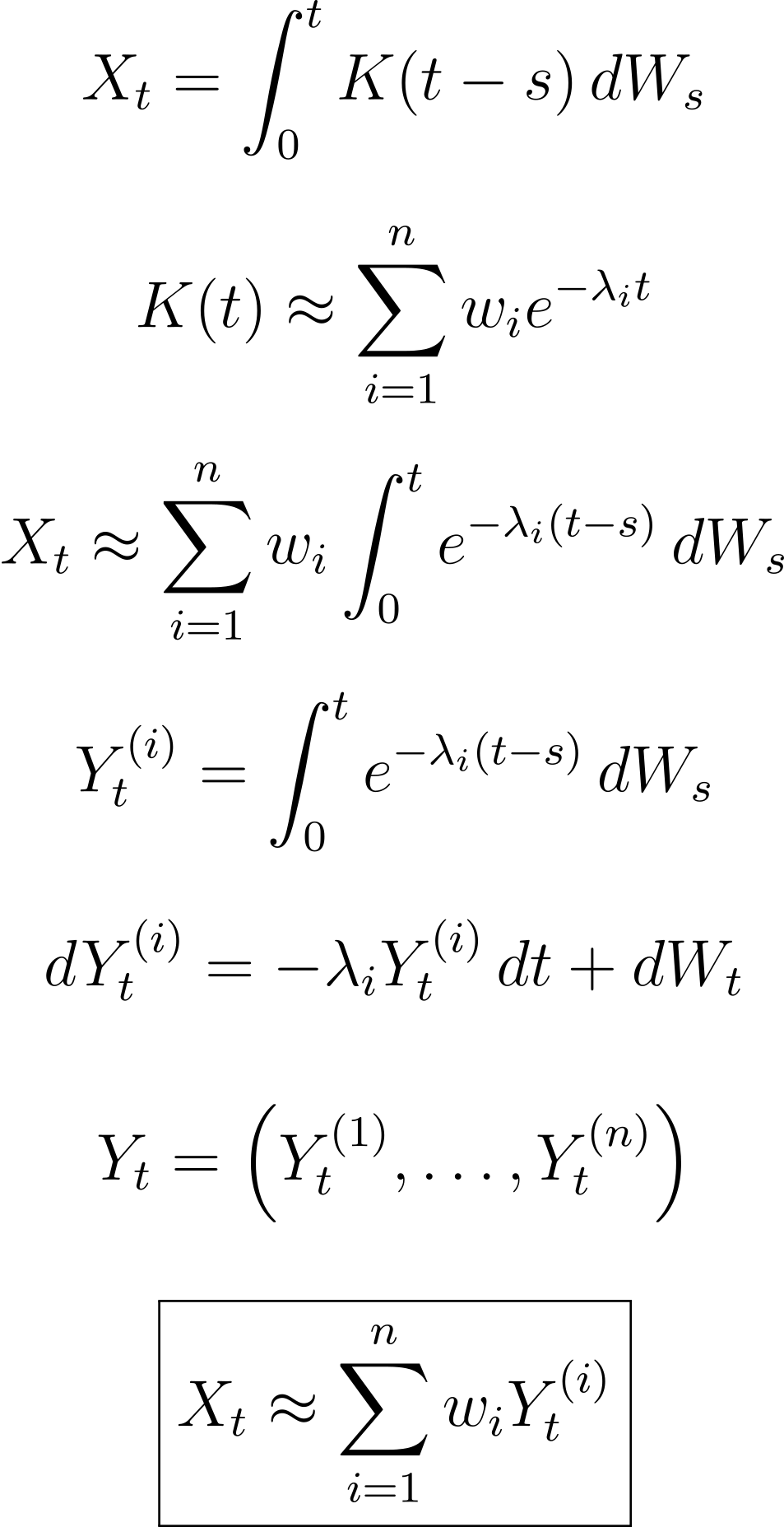
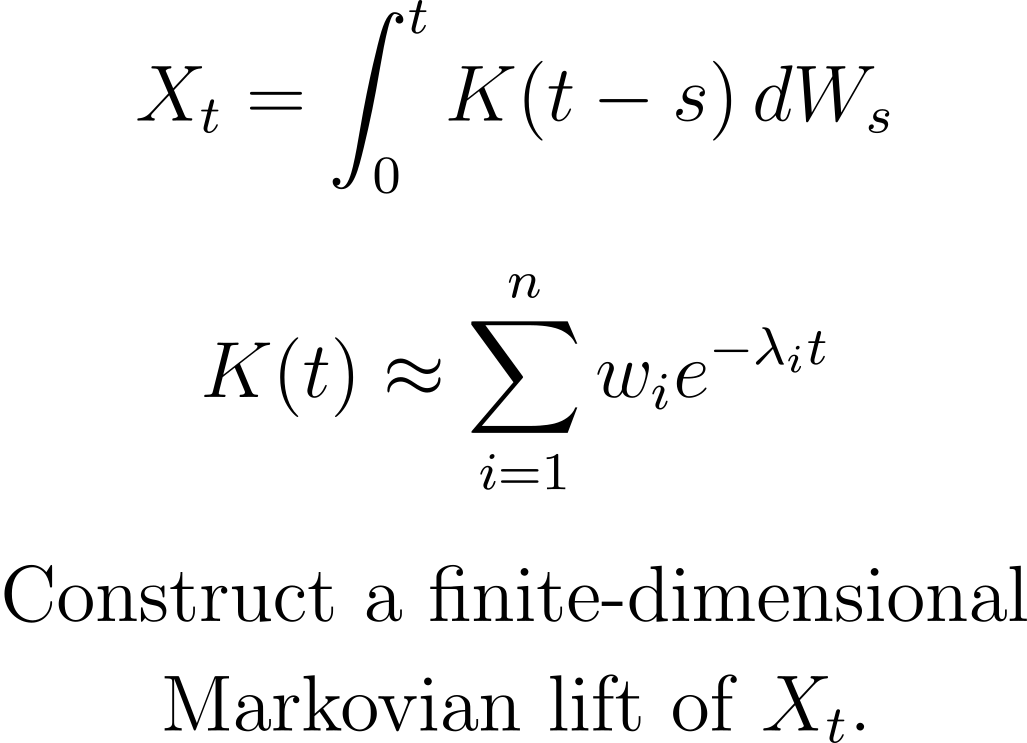
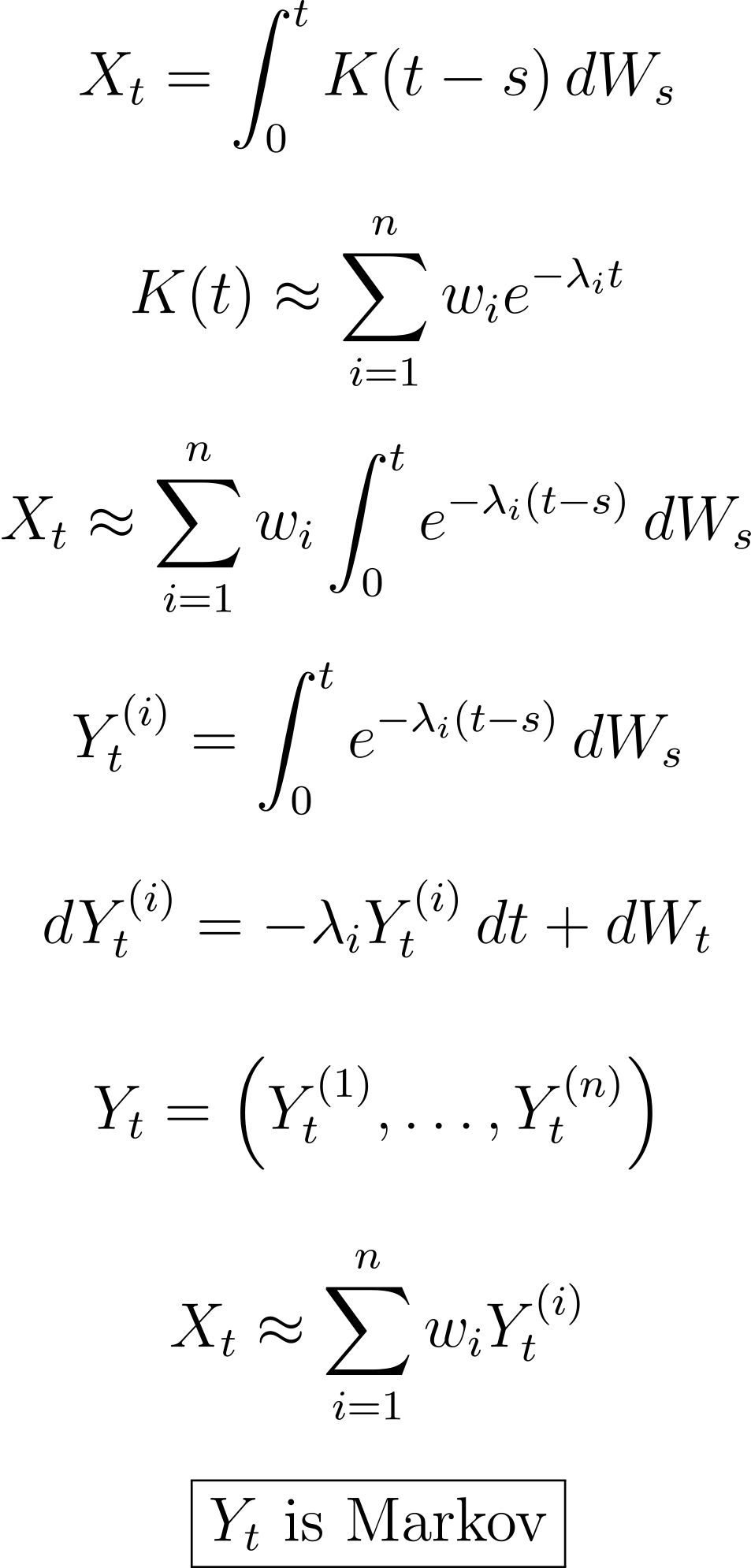
| | | | | Many of the most realistic stochastic models are not Markovian. Processes with memory, such as rough volatility models, depend on their entire history rather than just their current state. While this improves realism, it also makes simulation, calibration, and pricing dramatically more difficult. Markovian lifting provides an elegant solution. Instead of working directly with a non-Markovian process, it approximates the memory using a finite collection of Markovian factors. The original dynamics are "lifted" into a higher-dimensional state space where standard Markovian tools become available again. | | | 📚 Model Definition | Let's observe the structure required for this lifting technique... | | | Markovian lifting works by replacing memory with additional state variables. The original process, Xₜ, is defined through a kernel K(t), which gives the process its long memory. This kernel depends on the entire past, making the dynamics inherently non-Markovian. The key idea is to approximate this kernel as a weighted sum of exponential functions. Each exponential represents a different decay rate, with weights wᵢ and speeds λᵢ chosen to closely match the original memory kernel. Each exponential term then defines its own auxiliary process, Yₜ⁽ⁱ⁾. Unlike the original process, these auxiliary variables satisfy simple Markovian stochastic differential equations. Each factor remembers the past only through its own current value, making it computationally straightforward to simulate. Finally, the original process is reconstructed as a weighted sum of these Markovian factors. Instead of carrying the entire history forward, the model carries only the finite-dimensional state vector Yₜ. | | | 📈 Model Applications | In practice, Markovian lifting is used whenever a model is non-Markovian but computational efficiency is essential. Many modern stochastic models, particularly those involving memory or fractional dynamics, depend on their entire history. This makes simulation, calibration, filtering, and pricing computationally expensive because the full path must be carried forward through time. Markovian lifting addresses this by replacing infinite memory with a finite collection of state variables. Once lifted, the model can leverage the vast ecosystem of numerical methods developed for Markov processes, including efficient simulation, PDE solvers, filtering algorithms, and risk calculations. The tradeoff is approximation. The lifted model does not reproduce the original process exactly, but with enough factors it can capture the essential memory while remaining practical for real-world computation. | | | 🎓 A Little Story | I cannot remember where I first heard about Markovian lifting. I think it was through a paper by the guy who wrote Mathematics and Computation in Finance, Lekh something? My memory is much worse than the models I'm talking about. What I do remember is reading about the idea and thinking, this is absurdly clever. Instead of fighting the non-Markovian nature of the process, you simply change its representation. You trade one impossible object for many simple ones, and suddenly all of the machinery developed for Markov processes becomes available again. A common theme in the quantitative results I adore is the simplicity and elegance. Taking something intractable or difficult here and transforming it into something tractable or easy there. Exactly why I love Fourier inversion so much. Markovian lifting is that same kind of idea, and it's one I have appreciated more every time I've come back to it. | | | 💡Takeaway | Markovian lifting is a reminder that the right representation can be just as important as the right model. Rather than simplifying the underlying dynamics, it simplifies how we compute with them. Memory is not discarded, it is reorganized into a collection of Markovian factors that preserve the essential behavior while making the mathematics tractable. The broader lesson is that many breakthroughs in quantitative finance come not from changing the problem, but from viewing the same problem through a different lens. Sometimes the smartest solution is simply a better representation. | | | 🏆 Quant Question of the Week |
| Solution at the Bottom of this Email 👇 |
| | | | | Need to study up on topics in math, probability, and finance? 👉 Learn to solve problems like this on Quant Guild — the platform I wish I had when I was studying to become a quant. |
|
|
|---|
| | I'm in QR preparing for interviews and your practice helped me brush up on probability, thanks | | |
| | |
|
| | | I learned more here in two days than an entire semester of college | | |
| - Guy on Discord Who DM'd Me |
|
|
|
|---|
|
| | ✅ Quant Question of the Week |
| | | | | | | | |
|
|
|---|
|

 Roman Paolucci