 | | | 📜 A Note from the Guild Leader |
| | | Have you ever played a video game? [or insert other activity / hobby here] Why aren't you playing it now, like right now? Maybe you would prefer to, but your policy function dictates that something (work, school, errands, ...) weighs of greater importance, at least ephemerally. But you have stopped playing some games altogether, haven't you? The novelty wore off, you accomplished everything there was to accomplish. They try to move the goal post on you, but it only went so far, you're bored... Developers got smarter, they started optimizing for the moving goal post. Look at Instagram and TikTok, you can't keep people away. When your expectation adjusts, they hit you with another shot of dopamine to drag you back for more. What does this have to do with trading and investing? Well quite literally everything... | | | 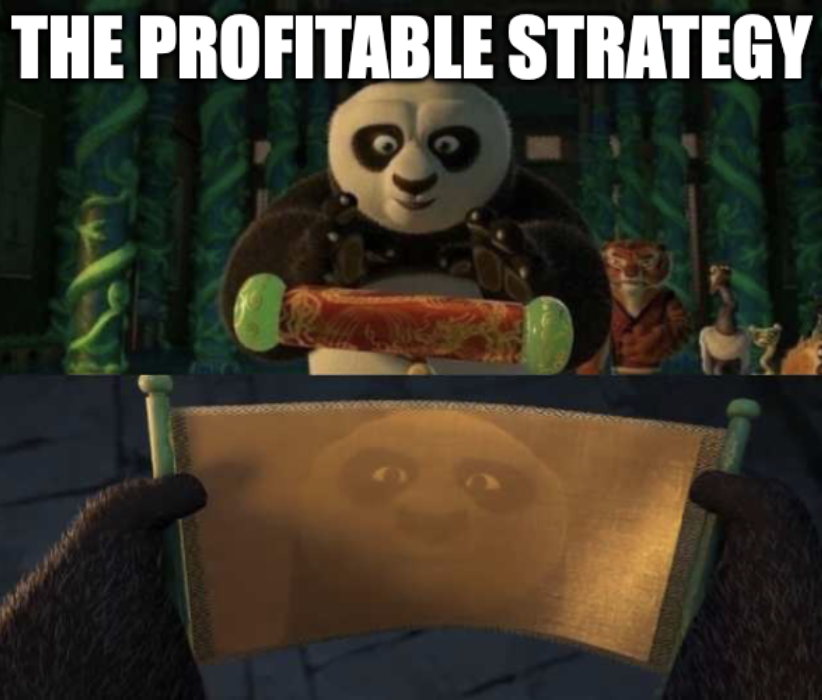 | | | Do you actually want to understand the trading and investing space? Or do you want to make money? Because those are two different problems. Here's a compression of information for you, buy AMZN or NVDA, you'll make money, you're welcome. If that's enough for you great, if not keep reading. The former is concerned with understanding uncertainty, the latter is concerned with harnessing it. To achieve the fullest potential in the latter, one must master the former. Boring? Probably, but shocker, you don't get something for nothing. Uncertainty governs everything, it is a deeply philosophical concept that has been debated (free will or lack thereof) for as long as the human condition. Two completely different sides of the coin, both fear and hope, require uncertainty. But notice, they both dissipate when conditioned on what? Information. Knowledge. You can't be afraid if you know. You can't be hopeful if you know. Now you're backstage. You might have to give a speech, you didn't prepare anything. Nightmare fuel for most, but if I tell you that you've been replaced or don't have to go on it's a euphoria of chemicals released to the brain: certainty (if this is not nightmare fuel for you please adhere to the broader point and subsequent example). You are playing in the championship game today. You've lost in quarters and semis every year, for years. You have to win. You deserve to win(?). There's going to be thousands millions watching you. If you knew the opposing team's star player was injured, if you knew the betting odds have you as the -1000 favorite, if you know the opposing team's hand signals...does this change how you think going into the game? Whether it's good or bad is subject for discussion, but in either case, we've replaced uncertainty with information... These examples may induce tremendous stress and anxiety. But not from the actual events themselves. This is the core and most important distinction. A 90% drawdown isn't itself "bad", it doesn't generate any stress. It's the net realization of the event ruining you or your fund that generates the stress. Allow me to elaborate, if you were told that your underlying portfolio was certain to make a 900% recovery during a 90% drawdown you would not care at all. Since we exist outside of a world with crystal balls and magic wands, that certainty can only exist (if at all) by conditioning on more and better information. But you don't get that information for free, it requires constant and active work, iteration, updating, to gather, analyze, and draw conclusions (compress) what you find into a binary decision dictating an action with the intent of achieving a specific outcome (winning a game, making money with an investment, etc). It's not uncertainty that induces stress and anxiety, it's desire for an outcome. Place too much weight in the outcome and it's no longer about the series of actions you can optimally make from public speaking to playing in the big game to allocating to a risky asset, no, instead it's only about the outcome. Subsequently, focusing on the outcome stops us acting bravely today, from acting optimally which is required to achieve the desired outcome. Ironic. This goes beyond arbitrary outcomes and stoic platitudes. Outcome oriented thinking is a lottery system for your personal peace. You trade what you can control for desire in the roulette wheel landing on red. | | | 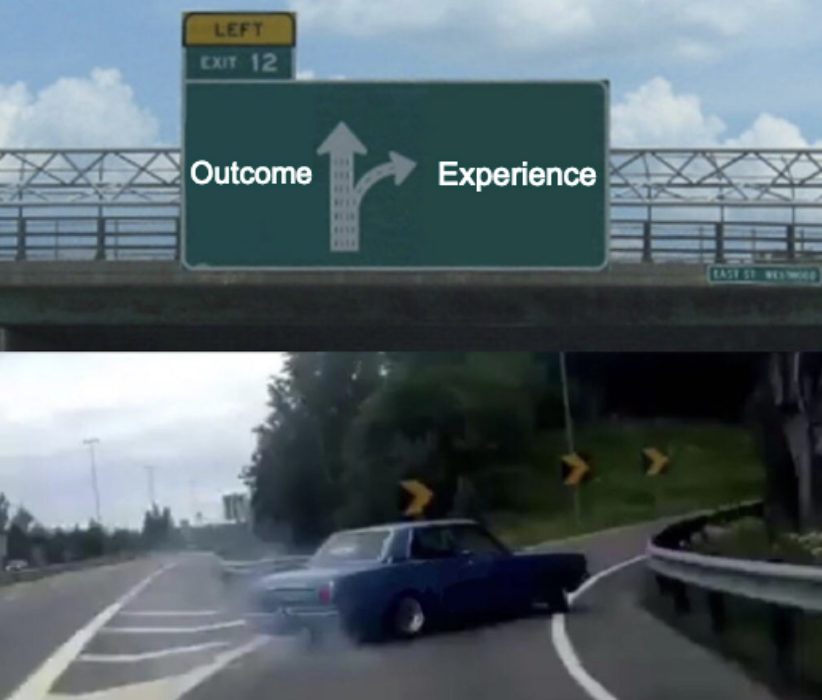 | | | White-knuckling outcomes has a devastating impact on an agent's ability to learn from their own actions and environment to optimize their policy functions. Ironically, optimizing for the experience makes it tremendously easier to achieve specific outcomes because they are a biproduct of correctly attributed desire. I was watching the USO the other day and Madison Keys is a monster on the tennis court, there's no doubt about that. She was up 5-0 in the final set, any sports book would've priced that as a 99%+ victory. But she lost. In the post-game she had the courage to sit in front of the mic and tell the world that she swung scared, that tennis felt really hard for her. But everything is performance driven, and everyone experiences it in real-time. I've experienced performance anxiety on test day during my academic studies, fighting in Brazilian Jiu-Jitsu competitions, and even writing these weekly letters. I was violently confused how sometimes during my fights I did not care at all and performed like a world class competitor, and other times I fought scared, similar to what Madison was relaying during her post-game, and got obliterated. Fundamentally, as someone obsessed with the mathematical structure of the problem at hand, I've been able to cure my performance related anxiety. I need not predict the outcome of a dice roll. I just have to roll the dice. How I Cured My Performance Anxiety I love creating YouTube videos. I love every second I spend with the literature, compiling animations and Jupyter notebook lessons, commanding order to the chaos of high level applied mathematics. It takes me hours, sometimes days, to produce a single video. I love every second of it. When I post a video YouTube gives me three little arrows that are either green or grey. If they are green my audience "approves". It is doing as well or better than my previous videos. If they are grey it says I suck to think about why my audience might not have liked that topic and to create other types of videos. Now I have to step up to the plate. I finish my lecture for the week. It's awesome. It's on path signatures, one of, if not my absolute favorite topic in the literature due to the intersection of so many different ideas from geometry to stochastic calculus to information theory. It took me days to put together. I am so excited with what I came up with. Yet I'm told a grey down, down, down. My audience hates it. They want to see me smash day trading gurus, that's sexy. YouTube wants higher watch time and more ad revenue. Now I'm gun-shy. Call it writers block, call it lecturers block? I'm afraid to get up to bat and swing at a pitch. This is nothing new, a tale as old as time. I was up 5-0 with my video smashing fake YouTube day traders, but I've lost the set. What if my next video does just as bad? What if they don't like my Weekly Guild Letter? What if this is my peak? What if this is the best it ever gets? Uncertainty drives every component of performance anxiety. It used to plague me, but I've found the antidote: certainty. I am not uncertain anymore. I exist to learn and create. I have no performance anxiety because showing up, learning, and creating is the metric for success. Everything that happens after that is noise. Because I don't fear my at bats I keep stepping up to the plate and I keep getting better. That's why I grow. It is a function of iteration that is a natural component of progress, not my desire for an outcome. In other words, if you run multiple times a week, shocker, you'll get faster. Most don't run. But Roman, you're growing, that's all you really care about, right? Not in the slightest. I get fucking looms from dozens of people every day: "Roman you should be at 300k subs by now" "Roman you should be making $100k/month" "Roman you should be [insert stupid thing I don't care about]" I have no team. It's Roman. I create a Jupyter notebook, I lecture with no script, I edit my videos, I create a thumbnail and hit post. Everything after that is noise. Everything. "Roman that's not scalable, your time is worth more than that." To who and in what currency? Because I am trading time for experience, not dollars. Dollars can't buy me the experience of the personal work product I alone can produce. I exist for myself, and in that, I benefit my community who would not receive my work product if this weren't the case. That is my master. | | | 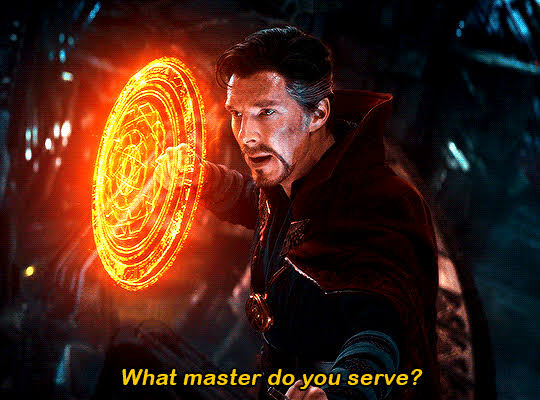 | | | We exist in an n-dimensional system of stochastic differential equations operating as independent agents with an environment nothing short of chaos. As biological agents, psychology and philosophy are inextricably tied to our perception of our path's history, our current state, and target states. I do not know who governs the dynamics of our system. I have my suspicions... I can't promise you that the environment and other agents don't want to kill you. I have no idea what guided your sample path to this current state. So much is out of our control. Miraculously, and functionally, however, the only thing that matters is in our control: our personal objective function. What we optimize for fundamentally changes our selected action, but more importantly, it dictates how you perceive your current and target states. In other words, what are you optimizing for? What drives your actions? Your personal objective function is the only thing that matters. Yet, ironically, many can't define it for themselves. This isn't conjecture, I'm one of the few people in a position that sees thousands of students and practitioners chasing... "Roman, how do I get into Quantitative Research / Development / Trading?" "Roman, how do I develop a profitable trading strategy?" "Roman, do I have a chance at breaking into Quant?" I am here to help, but remember from last week's letter, if someone can't stand basic criticism they are unlikely to stand on their own. So I ask simple questions. "Why?" "Do you know what they do?" "Why do you want to trade at all?" I am met with "I want to be free of the rat race, and leave the 9-5" Terrific, desire to work less always yields positive performance results... I am met with "I want to be challenged...also what's first year comp there?" Terrific, the money will be a nice band aid on your mortal gun shot wound... I follow up with questions pertaining to asymptotics. Assume you had all the money in the world, now what? Crickets. Only one of my students in my entire life so far has shown me his answers to these questions. We worked on research together, he'd send me articles, we'd get coffee, and he tried to understand with every fiber of his being. Rat race? Challenged? Total comp? Give me a break. His objective function was clear, and it's why he will be exorbitantly wealthy successful (those are two entirely different things). He doesn't care about the outcome, he lives for the experience. | | | Selecting your objective function is roughly equivalent to your meaning of life. It's not hard to select, it's math. But most people are really bad at math. I'll tell you mine, and even how and why I picked it. Wealth is your goal? Victory is your goal? An arbitrary binary outcome is your goal? So you get there, and now you're bored. Like the video games you've put down. The world loves to clown on the struggles of success but it's a real problem for these folks that don't understand the mathematical shit storm they've subjected their agent to. Drugs, women, anything to remedy a chaotic reward system. I've seen it first hand from the closest people in my life. In the context of TikTok fame and fortune blinding everything from their friendships to their family. They live for validation from the herd, I had trouble for years offerings structure as to why they were so miserable, but kept on going anyway, its obvious now. They live for everyone else. They live for the outcome of the dice roll. The outcome is at the expense of the experience. Peace is a lottery. They never had to get there in the first place. Allow me to illustrate. Few know this, but I worked as a high school teacher to get by while I built Quant Guild from scratch. I could not stand my colleagues and the administration. The relationships I built with the kids and their parents gave me hope for humanity. Where am I going with this? A teacher there I knew was a retired bond trader. He made millions over his career, and now he's single in his fifties, and flexes his wallet to his colleagues, and the kids? Hold on, what is our net experience? He and I were in the same place, at the same time from 7AM-4PM? He can go anywhere, do anything, and he chooses to be there? RomAn It'S nOt ThE SaME He IS RiCh. Then why is he there? We had the same contemporaneous experience. In fact I'd argue I was arbitrarily happier fulfilling the role as he demands external validation for his years of industrial experience and accumulation of resources. He optimized for the outcome at the expense of the experience. He had to retire. He wanted to. And now what should his experience be? The thought of retirement makes me sick. I live everyday for the experience. I've gotten "Roman you're so lucky" or "You just figured it out so young", what a wonderful way to trivialize my suffering, it wasn't luck, and unlike you, I reason. | | | What is My Objective Function? Here are a few things structurally you need to understand. First, expectations are time varying. Dean Lister says you can get used to anything. The guy is a BJJ competitor, not a philosopher or a mathematician, but he's correct on the latter fronts. You will get used to everything from living in a cardboard box to sitting on a golden throne. You don't remain in a state of surprise forever, this is exactly why volatility has to be mean reverting, if everything is a shock nothing is. If you optimize for outcome you will want to put the video game down. You will be at the mercy of the next arbitrary binary outcome you find to dictate success. What structure do I offer? At the highest level what is my objective function? What do I live for? Education and creation. Logic and reasoning. In a single word: freedom. I show up and learn, I am successful. I show up and create, I am successful. I show up and reason, I am successful. Everything downstream is a byproduct of these three truths. Is more money better than less money? Yes, but only so I can continue to show up and learn, create, and reason without the external noise and baseline requirements of life impeding that process. Someone drops $1M in my bank account? Great, now I can continue to learn, create and reason. Nothing changes. I have no interest in anything else. My objective function remains unconstrained, there is no boundary, no supremum, I am left to a video game that has no final boss. A game I actually enjoy playing rather thane one I have to play to achieve an arbitrary outcome. Everything else is noise. Sometimes there is a lot of it, sometimes it takes a tremendous effort to silence. Practice makes perfect, and I've got all the time in the world. | | | RoMan TheN whY wEre yOu a QuAnT aT aLl? Because I was 20 years old and nobody gave me the structure of the universe. I had to figure it out myself. Use it if it's useful, otherwise you are just noise. | | | With that I will leave you to the Weekly Guild Letter. I hope you enjoy, and I hope you learn something! - Roman | | |
|
|
|---|
|
📅 Quant Guild Week in Review |
| Rough Volatility and the Youngest Quant at Bloomberg |
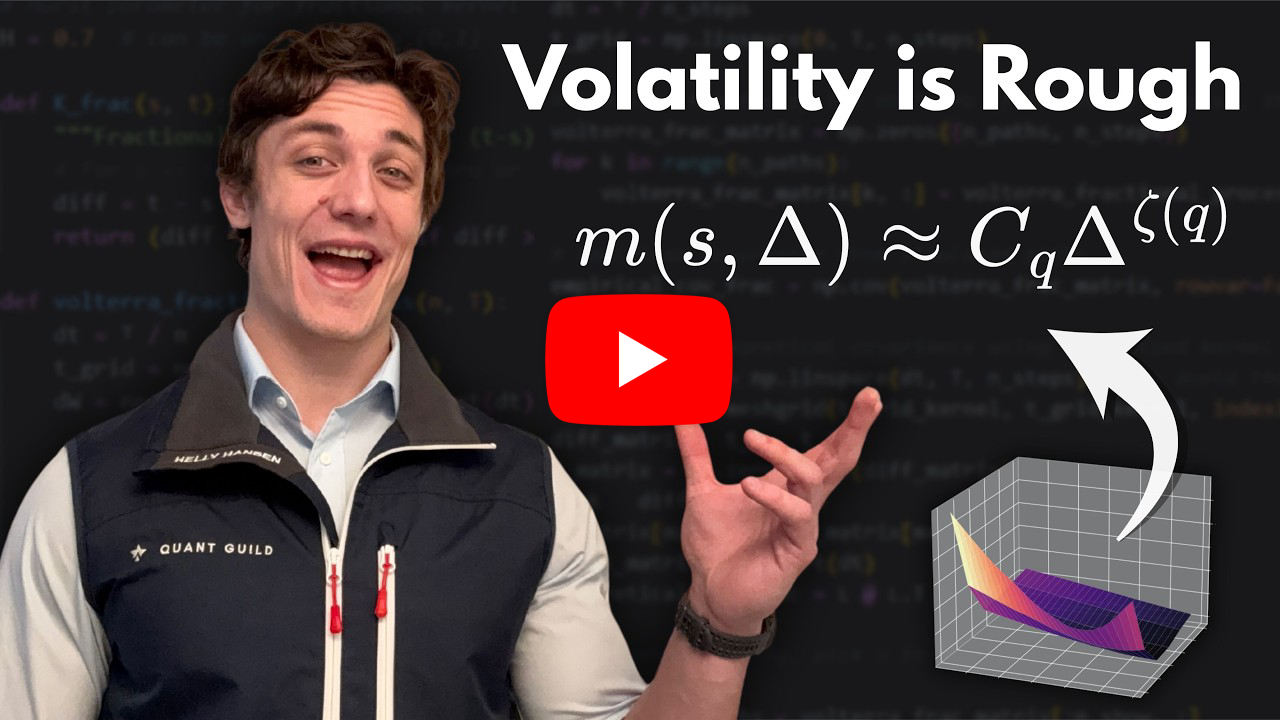
| | | 🎲 Rough Volatility for Quantitative Finance | In this video I introduce the rough volatility hypothesis and explain why empirical volatility behaves very differently from the Brownian motion assumed in classical models. By analyzing high frequency market data, I show that volatility exhibits power law scaling with a Hurst exponent near 0.1 rather than 0.5, producing much rougher paths than standard stochastic models predict. Here's a link to the full video 👇 | | | | | 📊 How I Became the Youngest Quant at Bloomberg LP | In this video I share the story of how I became the youngest quantitative researcher at Bloomberg while I was still an undergraduate student. Rather than following a traditional recruiting path, I explain how persistence, networking, and a genuine passion for quantitative finance ultimately opened doors that submitting résumés alone never could. Here's a link to the full video 👇 | | |
|
|
|---|
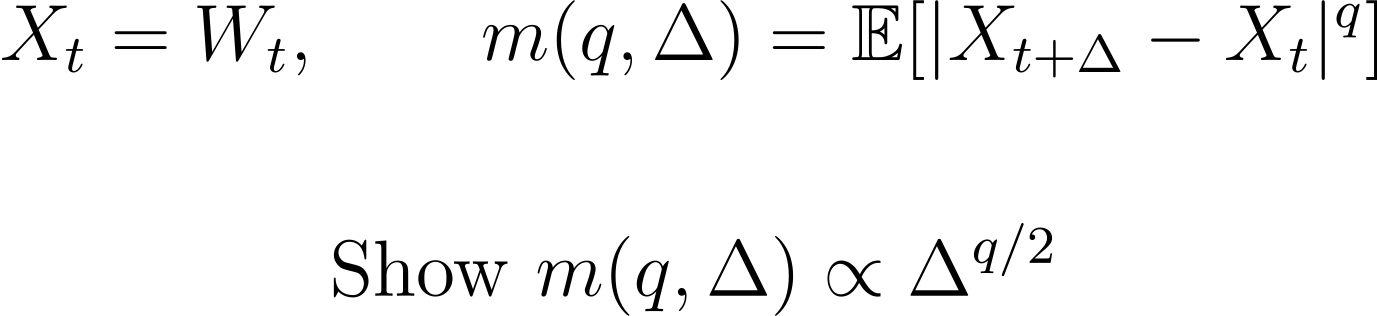
| | 🏆 Quant Question of the Week |
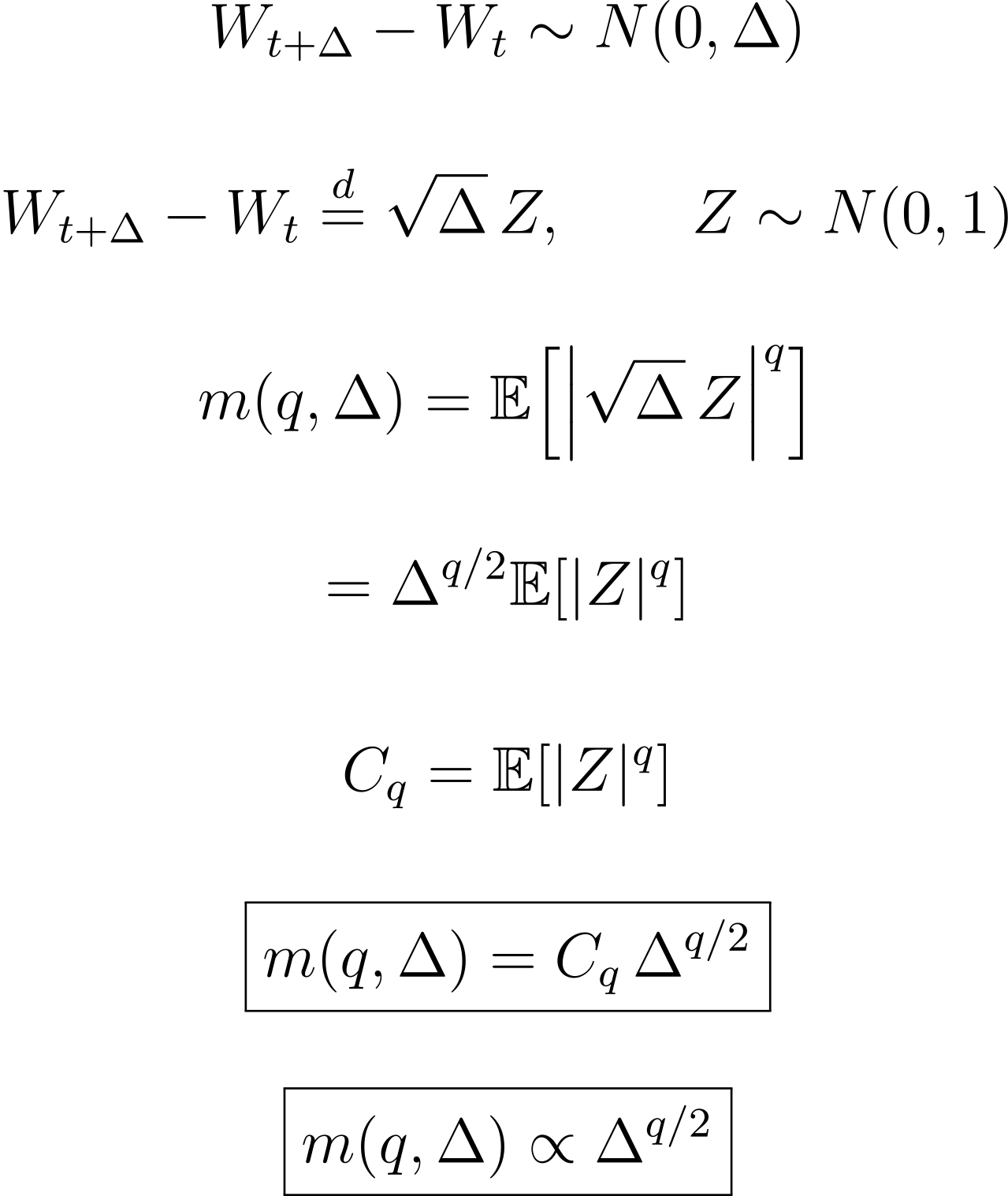
| Solution at the Bottom of this Email 👇 |
| | | | | Need to study up on topics in math, probability, and finance? 👉 Learn to solve problems like this on Quant Guild — the platform I wish I had when I was studying to become a quant. |
|
|
|---|
|
| | 🧮 Quant Model of the Week |
| q-th Order Structure Functions |
| | | Financial markets are not just random. They are rough, intermittent, and often exhibit scaling across different time horizons. Simple statistics like variance capture only a small part of that behavior. They tell us how large fluctuations are on average, but not how the distribution of those fluctuations changes across scales. Structure functions generalize this idea. Instead of measuring only second moments, they examine the q-th moments of increments across different time lags, revealing how fluctuations scale with time and exposing properties such as roughness, multifractality, and intermittency. | | | 📚 Model Definition | Let's observe the definition of a q-th order structure function... | | | At a high level, the q-th order structure function measures the average size of increments across a given time scale. The parameter Δ specifies the time lag over which changes are measured, while q determines which moment of those changes is being analyzed. Small values of q emphasize typical fluctuations, whereas larger values place increasing weight on extreme movements. By studying how this quantity changes as Δ varies, we can characterize the scaling behavior of the process and quantify properties such as roughness, intermittency, and multifractality. | | | 📈 Model Applications | In practice, structure functions are used to study how financial fluctuations behave across different time scales. They are particularly valuable for testing the rough volatility hypothesis. By measuring how the q-th moments of volatility increments scale as the observation horizon changes, researchers can estimate the Hurst parameter and determine whether volatility exhibits rough behavior. Empirical studies using high-frequency financial data consistently find Hurst exponents around 0.1, far below the value of 0.5 associated with classical Brownian motion. This provides some of the strongest statistical evidence that volatility is significantly rougher than traditional models assume. | | | 🎓 A Little Story | I remember staying at the Bloomberg office until almost 11 p.m. on a Friday night, reading The Volatility Surface by Jim Gatheral and digging through his papers. The office was basically empty. I had a notebook full of equations, coffee that had gone cold hours earlier, and absolutely no idea what I was reading. Every page introduced another concept I'd never seen before. Forward variance. Static arbitrage. Local volatility. Moment formulas. I would read a paragraph, stare at the ceiling for five minutes, and then read the same paragraph again. At the time, it felt completely hopeless. But I kept coming back. | | | 💡Takeaway | Structure functions are a reminder that markets reveal their secrets across scales. Looking only at variance tells us how much a process moves. Looking across multiple moments and time horizons tells us how it moves. That simple shift in perspective has provided some of the strongest empirical evidence for rough volatility. |
|
|
|---|
| | ✅ Quant Question of the Week |
| | | | | | | | |
|
|
|---|
|

 Roman Paolucci