 | | 📜 A Note from the Guild Leader |
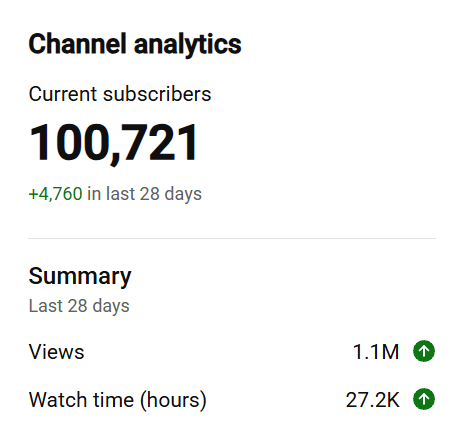
| | I have to express my gratitude, and in expressing my gratitude, tell you how we got here and where we are going. For no other reason than I hold you in the highest regard, and if you're reading this, it's only fair that you know how I see it. Last week Quant Guild surpassed 100,000 subscribers on YouTube. From the bottom of my heart, thank you.. This one's personal. I'll tell you exactly what I dream of and fear. | | | | Let's talk about how we got here... When I quit everything (the second time) to run Quant Guild I dedicated every day to making the best lectures that I possibly could. It would take me hours to build Jupyter notebooks, to research and lecture without a script, to edit videos, to make thumbnails, to build the Quant Guild Web App, to record lectures for classes, to teach live class sections, the list goes on... It took me roughly 5 years of posting sporadically to hit 5,000 subscribers. But 5 years in, dedicating my full time to Quant Guild, with at least 2 (sometimes 4 or more) video lectures every week, in roughly 2 years we've gained 95,000 subscribers and a rolling monthly audience of 220,000 students, practitioners, and enthusiasts of finance, math, probability and statistics, computer science, data science, machine learning; in a single topic: quantitative finance. We now sit above 100,000 subscribers and it still takes me hours to build Jupyter notebooks, to research and lecture without a script, to edit videos, to make thumbnails, to build the Quant Guild Web App, to record lectures for classes, to teach live class sections, the list goes on... I have no team, no editor, no thumbnail guy; it is all me. And I LOVE it. But something is different now from when I started, something I don't like. The signal quality was purer back then, I'm now bombarded with noise. I'm generating attention, I only wanted to teach, and in come the vultures. | | "Roman, you should be making $100k+/mo with high ticket sales" - Marketing Firms Sending Me Looms Everyday "Roman, why aren't you running a hedge fund under general solicitation?" - Aspiring Fund LPs "Roman, that's really all you make in a month?" - My (old and fired) Accountants Noise, it's loud, sometimes I confuse it with signal. I take meetings I know I shouldn't. I allocate time to problems I know I shouldn't be solving. I am ephemerally blinded by others that want my attention with what little I have to offer. The attention I should spend putting together the best quantitative finance lectures I possibly can. I know it's noise, but I've never received so much of it in my entire life, in so many different forms. I'm getting better at filtering out who to allocate my time to, which problems demand my attention to solve, and (most importantly) what to ignore, but it is not a trivial problem (at least for me). It upsets me. I feel I've let myself, my family, my community down when there is wasted time. I know that's not how Bayesian updating works, you have to lose hands of poker, but this is still reality, and I hold emotion regardless of if I would prefer to. This remains one of the greater challenges I face working alone. Nevertheless, at the end of the day I turn them down. All of them. I turn them down. "Roman, you are where ambition goes to die." "Roman, the fake trader managing no risk" "Roman, the poor version of a course selling guru" But here's the fun part... I can't be bought or silenced. I know exactly who I am and why I'm here. I hold that contract overtly with myself alone, and everyone should be made painfully aware of it. I'm not acting virtuously, this is not altruistic, this isn't even white-knuckling a business and refusing to scale. This behavior is optimizing my objective function. Optimization is not always computationally efficient, certainly not in reality. Hence the noise and why this has been draining for me. This behavior created Quant Guild, it's who I am, and they aren't why I'm here. I exist to research, understand, model, lecture: I exist to teach. | | What are my dreams? In optimizing for the experience, my success is not a lottery. My dream is to teach quantitative finance, to sufficiently protect and provide for family and friends in need. To become a better student, researcher, and practitioner. Everyday I will stand on my soapbox preaching the truth as I see it from my academic and industrial experience, my personal research and practice, my discussions with students and practitioners, and of course, my community. I will work until my fingers bleed to ensure that I never take for granted the ability to study, research, and practice my craft. I exist for myself and act for others. People will disagree and I'll be right. People will disagree and I'll be wrong. People will throw things at me. People will judge my appearance. People will judge my speech. People will judge my past. People will judge, period. And on my soapbox in an open forum I will remain, for any and all who want to hear from me or challenge me. Unless, of course, I am to be forcibly removed, in which case I hope you've brought a few strong men with you, because I'm quite physically able... This is what I want. I want to experience this as I do now and until the end of my days. And if you think my dream is stupid, just wait until you hear about my fears. | | What are my fears? - Planes (on and off, trying to go to Chicago this October) - Failing to Protect or Provide for my Family and Friends - Not Optimizing for the Experience I have failed at overcoming planes, I keep trying. I have failed at providing, you were there for me in my time of need and saved Java's life, I keep trying. The last is the most important and the most personally devastating (in the rhetorical sense). I don't want to trade the experience for the outcome. I try to optimize for the experience everyday, constrained by fears. I look up, I am not uncertain, but I am afraid. I hear tycoons of business like Alex Hormozi or Tony Robbins say the most terrifying things among the likes of failing to be happy, or normalizing the goodness that they're doing. I've heard Robbins say he's fed tons and tons of people, and it's amazing, but it doesn't do much for him anymore. Hormozi has classically called it a trade. If someone takes a business risk that you aren't willing to, you can't be jealous or judge their trade you weren't willing to make. That exact notion is what I'm talking about here, but I'm uncertain if he sees the irony in the mathematical shit storm of his personal reward function in the context of arbitrary happiness (or peace, whatever you want to call it). Life is Bayesian statistics, we update our priors and expectation functions way too quickly. In other words, it's a moving goal post, and we'll always move it too fast. Won the big game, now what? Hit $1m a year, now what? Got the big sponsorship, now what? I've long been shocked at new investment bankers thinking they've made it, and it's only a matter of time before they make that $1m/year salary as a partner, but I remind these students they not only have to survive, but once they get that big role, they still have to show up everyday. They have to take the train to the office, what if they hated the train all along? I don't celebrate 25k, 50k, or even 100k and get off the train. I love the train I'm on. I look out the window and see a milestone. A snapshot of where I was, where I am, and where we're going. Not a benchmark for success or even a goalpost. Success is loving the train, the seats, the people sitting with me, the people that join me for some time and eventually depart, the conductor, even the ticket guy (yes, even when they get annoying). This is not an argument for "coasting" which will propagate its own form of misery. You should work until your fingers bleed, on the appropriate train. Otherwise, happiness [peace] is a lottery. In all the noise I face one thing is certain. I never want to be like them in my entire life. I've seen it first hand. Members of my extended family sold out trying to make their daughter TikTok famous. It worked. And now what? They're estranged, they have to do this or that. They care only about the outcome not the experience. They fail at being and choosing happy every day, fail at choosing their family, much like Horomzi, maybe Robbins, and others that are arbitrarily successful. Maybe I'm wrong, I won't speak for them, but this is what I've gathered from podcast discussions with Hormozi, Robbins, Williamson, etc... It becomes a trade. Trade your family, friends, and community for dollars. The quality of your work product for scalability. The peace you have for an ever moving goalpost governed by people that don't care about you or your endeavors, just faces on pieces of paper that keep us from killing each other for food. As I write to you today, I don't fail at being happy, at peace, freedom. In the past I have failed spectacularly at happiness, peace, and freedom. I know what it feels like. I know what Hormozi is talking about. I felt that despair as a Quant, a Ph.D. student, a High School teacher studying at Columbia. I refuse to walk that path again. I am not in an indefinite resource accumulation game with myself or the world. I spend time, money, and my health to enjoy my experience. It's an art. Spend too much, you're in trouble. Spend too little, guess what? You're in trouble. I need to work hard everyday to survive. I'm not a rich man, and I refuse to sell out because now it's my train, and I really like my fucking train. Could I make more money? Sure, at what cost? Could I have more time? Sure, at what cost? Could I make a bigger impact? SURE, AT WHAT COST? At the cost of the quality of my work product. At the cost of my family, friends, and community. At the cost of everything that actually made the train enjoyable in the first place. At the cost of my peace. Then what? We're right back to where we started. | | "Roman, you should be optimizing for impact, wealth, legacy [insert something else I don't care about here]" This isn't a debate, this isn't even a discussion, it's my policy function. I exist for myself and I act for others. It's how Quant Guild came to be in the first place, and it's how Quant Guild will stay, and how it will continue to grow if the world so chooses to grow it. Helping students, professionals, and enthusiasts master their quantitative skills in the most dollar efficient way for them, NOT for me. "Roman, if you got that guy a job at a hedge fund through your online platform he should pay you much more than a few hundred dollars" Actually, that's exactly how much he should pay me. Any more and it's making a market on illiquidity and ignorance, that would keep me up at night. Call me naive, call me a romantic, call me stupid Those are just opinions. Call me a sellout, call me unoriginal, or claim that I don't care? Now you're wrong. The truth is at the cost of potential upside... - I can easily look at myself in the mirror
- I can easily have a wonderful time with friends and family
- I can speak honestly and freely to my community without selling to them
- I can easily work hard today, tomorrow, all of next week, whenever
- I can easily be at peace: free
I wasn't always here. It's because of you that I am. I must practice this gratitude every day, week, month, and year. I'm not going anywhere. You can catch me on this train at least twice a week, enjoying the seats, the company, and the wonderful views we get every now and again. Thank you, sincerely, for 100k subscribers. | | With that I will leave you to the Weekly Guild Letter. I hope you enjoy, and I hope you learn something! - Roman | |
|
|
|---|
|
📅 Quant Guild Week in Review |
| Quant Resumes and Making a Market on a 1 Mile Run |
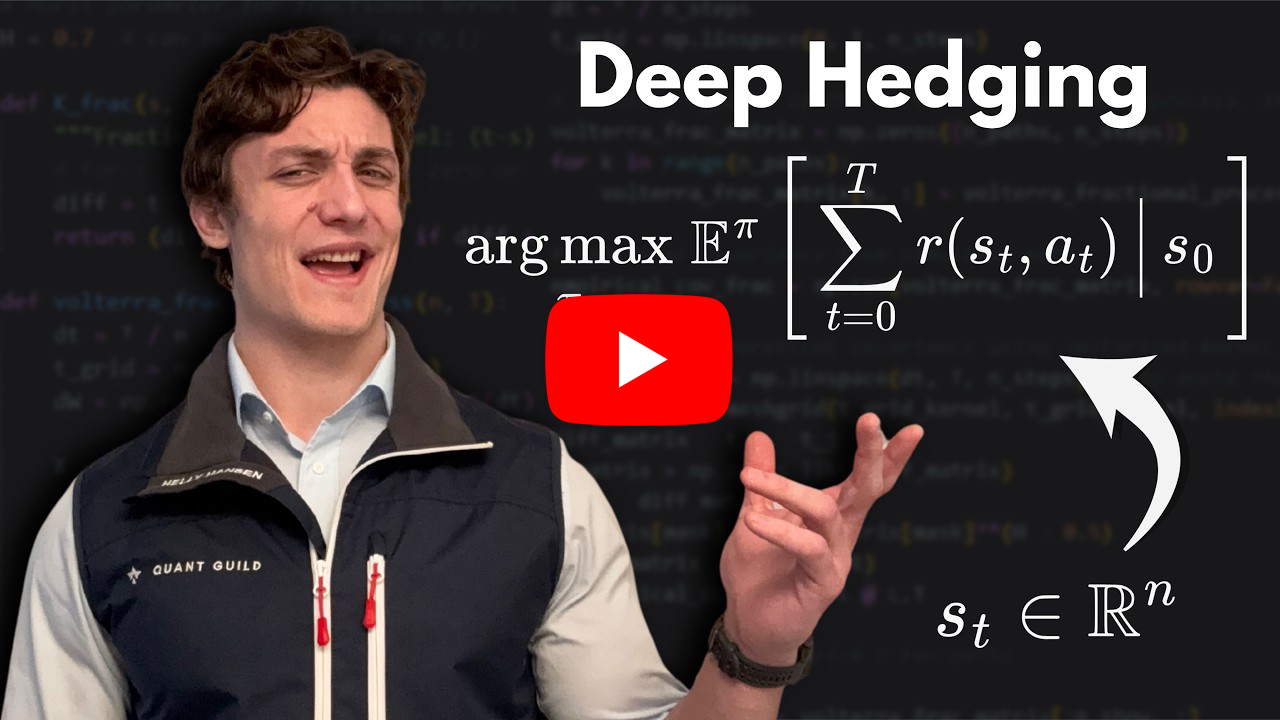
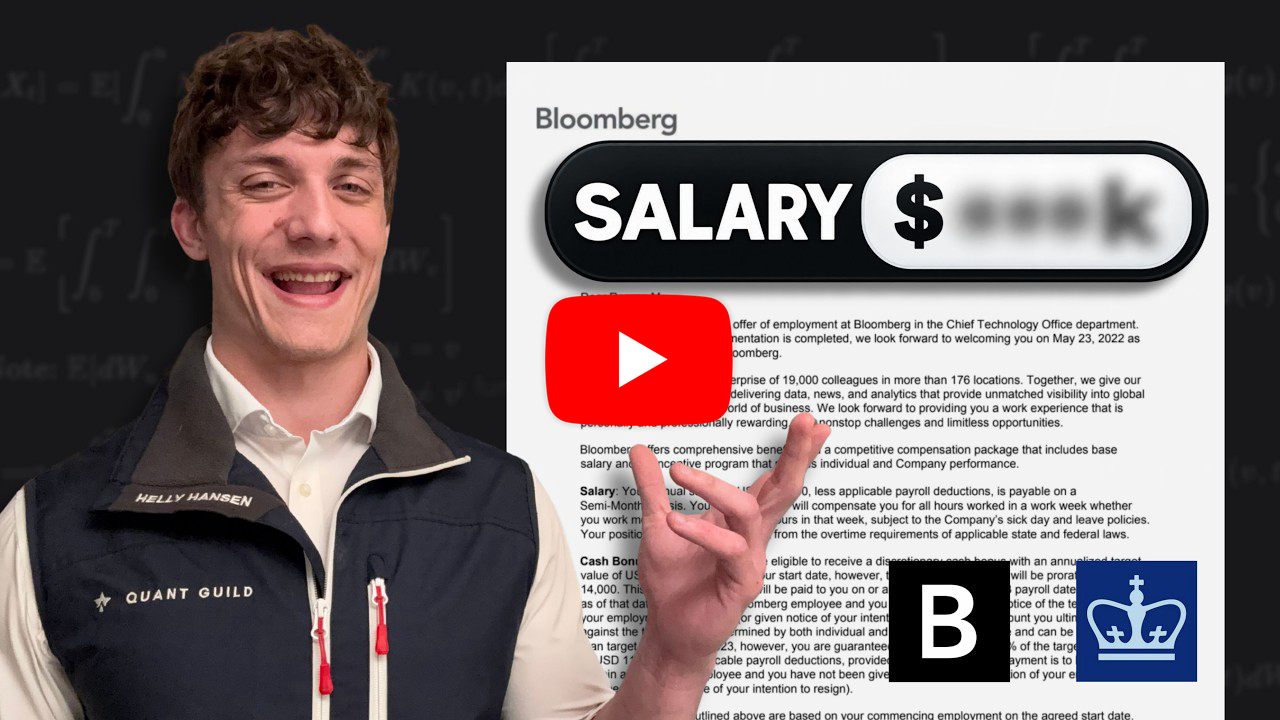
| | 🎲 Deep Hedging for Quantitative Finance | In this video I introduce deep hedging, a reinforcement learning framework for learning optimal hedging strategies under realistic market conditions. Starting from the foundations of risk neutral pricing and market making, I show why classical delta hedging is only theoretically optimal under idealized assumptions and how transaction costs, discrete hedging, and model risk create a much more challenging optimization problem in practice. Here's a link to the full video 👇 | | | 📊 My Offer Letter(s) As Bloomberg's Youngest Quant | In this video I walk through the internship and full time offer letters that launched my career as a quantitative researcher at Bloomberg, using them to demystify compensation, recruiting, and career progression in quantitative finance. I also discuss what it was like transitioning from an undergraduate student to a full time quant and the challenges of working while finishing my degree. Here's a link to the full video 👇 | | |
|
|
|---|
🧮 Quant Model of the Week |
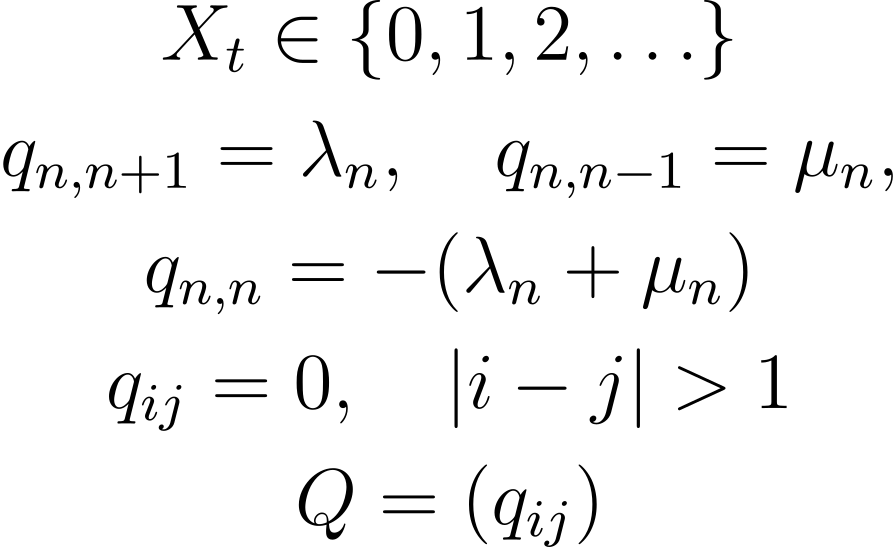
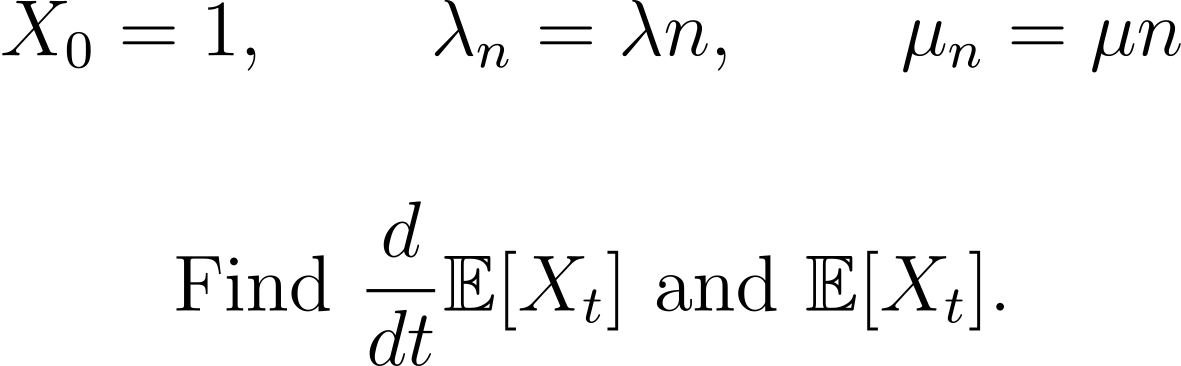
| | | A birth-death process is a continuous-time Markov chain where the state can move only one step up or one step down. A "birth" increases the state by one, while a "death" decreases it by one, with separate rates governing each transition. In quantitative finance, this simple structure appears naturally in areas such as limit order book modeling, queue dynamics, credit risk, and market microstructure. | | 📚 Model Definition | Let's observe the structure of a birth-death process... | | A birth-death process moves between nonnegative integer states, one step at a time. From state n, the process moves up to n+1 at rate λn, called the birth rate, or down to n−1 at rate μn, called the death rate. The diagonal term, −(λn+μn), represents the total rate of leaving state n. All other transitions are zero because the process cannot jump more than one state at a time. The matrix Q is the generator matrix, which completely describes the instantaneous transition dynamics of the birth-death process. | | 📈 Model Applications | In quantitative finance, birth-death processes are particularly useful for modeling systems driven by discrete arrivals and departures. One of the most natural applications is market microstructure. Limit order book queues can be modeled using births as new order arrivals and deaths as cancellations or executions, helping researchers study queue position, liquidity, and execution probabilities. They also appear in credit risk, where discrete changes in defaults or credit states can be represented through transition intensities, as well as in queueing problems involving transaction flows and financial networks. | | 🎓 A Little Story | The first time I read about birth-death processes, I immediately couldn't help but think of a million examples. World population. Monthly subscriptions. Employees joining and leaving a company. Customers entering and exiting a queue. Orders arriving and disappearing from a limit order book. The abstraction felt incredibly intuitive. A system grows, a system shrinks, and randomness determines when each event happens. That's one of my favorite things about probability. Sometimes you learn a mathematical framework and immediately start seeing it everywhere. Not too much of a shock there relative to the context of my previous letters... | | 💡Takeaway | Birth-death processes are a reminder that simple models can describe an enormous range of complex systems. Whenever something can arrive or leave, grow or shrink, enter or exit, the same basic probabilistic structure appears. | | 🏆 Quant Question of the Week |
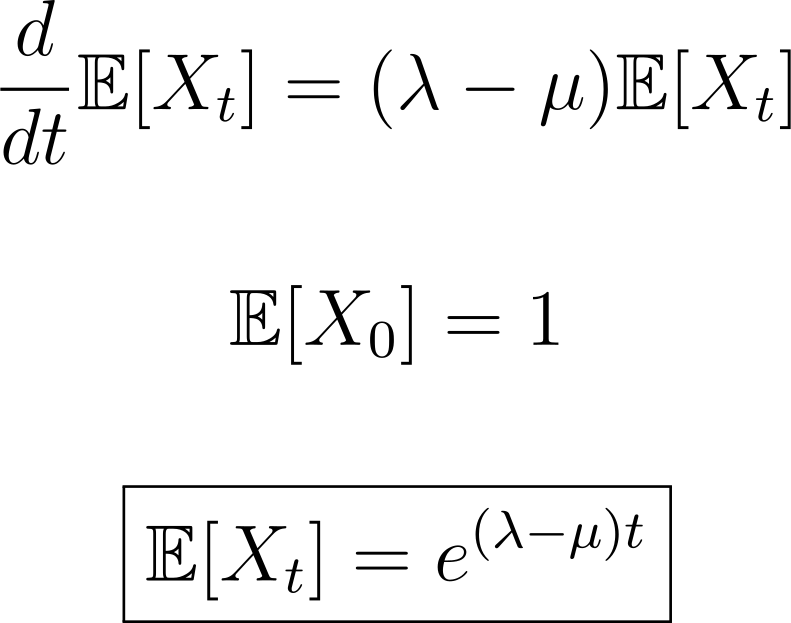
| Solution at the Bottom of this Email 👇 |
| | | Need to study up on topics in math, probability, and finance? 👉 Learn to solve problems like this on Quant Guild — the platform I wish I had when I was studying to become a quant. |
|
|
|---|
| ✅ Quant Question of the Week |
| | | | |
|
|
|---|
|

 Roman Paolucci