 | | 📜 A Note from the Guild Leader |
| | The greatest pioneers of this world, entrepreneurs, inventors, academics all share, at the highest level of abstraction, a fundamental appreciation for the particular beauty of discovery, action, in a word: creation. Regardless if your medium is business, writing, lecturing, singing, drawing, lifting, running, sparring, fishing, ..., anytime you engage in an activity that a combination of nature and nurture posits as an optimal experience for your policy function you are actively creating. Whether it's ephemeral and you are creating memories and an amazing contemporaneous experience, or an asset that is to live beyond the moment, that enjoyment, that flow state, that peace is precisely what makes the experience optimal and enables progress. In other words, we didn't get to the moon because a few smart men had to go to work tomorrow. Brilliant minds, curiosity, hard work, discipline, collaboration, but most importantly enjoyment is precisely why and how we make progress. |
| | 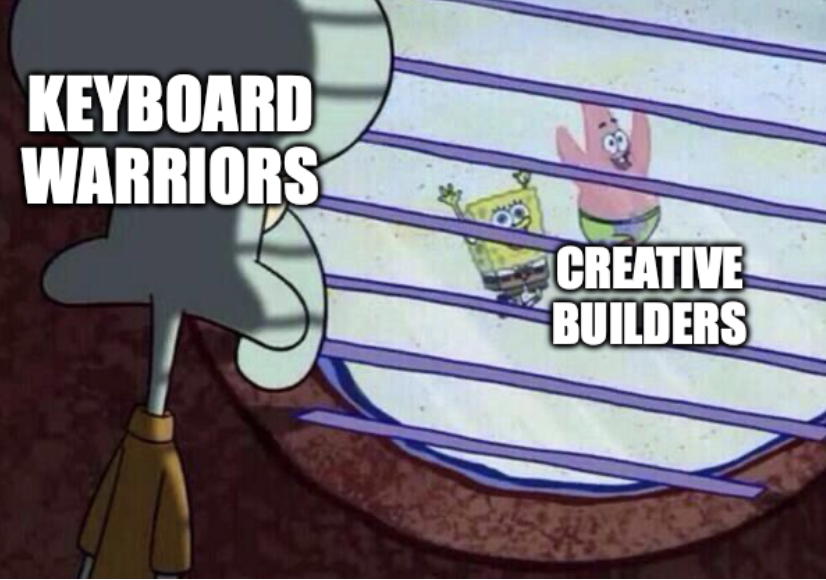 | | Our world is a closed arena in the epistemic sense. We can only learn, study, and reason about our experience within it. We can't reason about the outside of the arena, it's an extrapolation problem; if we can't tame the chaos of Apple's stock price tomorrow within the arena, how on earth can we possibly reason about the chaos outside of the arena? A system capable of locally reversing entropy, born from entropy itself? Already egregious, so I digress. So while we are operating in this closed arena what else is there to do but fight? Some will choose ranged weaponry, others prefer means of battle that are closer quarters, and others somewhere in between. We don't lie around the arena and do nothing (somehow), we have preferences (somehow), and create experience through action and our different weapons, tools, mediums. Creation is the perfect example of a non-stationary distribution. It's certainly more amorphous than a well defined stochastic process, nevertheless, the ideas from statistics translate quite well here. When we begin creating anything we are quite dreadful, even with a natural aptitude toward this or that, we lack experience. When I first started fishing I didn't know how to tie a polymer knot. But now I've been tying polymer knots for 15 years. It fundamentally changes the experience that I am capable of creating today, the distribution has shifted and what is possible now is fundamentally different than what was possible 15 years ago. When I first started conducting research, I didn't know how to conduct a literature review. I didn't know what to do if there was no literature to review. But now I've been conducting quantitative research for almost 10 years in a variety of professional and personal capacities. What is possible today is fundamentally different than what was possible 10 years ago. So it's just a function of time and discipline? If only it were that easy. The world is going to try to destroy you on your journey. In the literal sense, this is the furthest thing from a metaphor. You think locally reversing entropy is a free lunch? Things will come your way that will rock your world when you least expect it. You won't believe the negative events that can cluster together in a day, week, month, quarter, year that seem so violently far from what your net expectation was. How many have I seen destroyed by this world? You wouldn't believe it. It takes so many forms... "The sport isn't fun anymore." Instead of going pro he now complains about his day job. The pressure wasn't fun, but it certainly destroyed him. He stopped doing what he loved from the noise in the background. The arbitrary pressure of competition. You ever see Alyssa Liu skate recently? "They stole my idea, why bother try." Creatives don't run out of ideas, it's not even a question. If you think the idea is the hard part about shaping a work, business, and the likes return to your keyboard at once, the comment section needs your incapacity my keyboard warrior. And I have dozens more from armchair quarterbacks to keyboard warriors that let the world destroy them. Now, since misery loves company, they try to destroy others. They don't even know they're doing it. They try to do it to me. Not strangers on the internet, but these miserable folks that I've been peers, colleagues, even friends with. Anything to stop me from acting. To stop me from "creating those sad YouTube videos". Hahahahahaha, good luck with that. | | I've long said, and this is quite a Roman quote: "The time stick is not kind to those that don't do what they're supposed to do" Look around you, treat people kindly, exercise, eat reasonably, spend time with your family, work hard; all reasonable things that everyone on the planet should be doing. But it take work. There's no free lunch. There is a stunning relationship between folks that build people up and tear people down and it's the proportion of the above that they choose to dedicate their time to. The more of what is arbitrarily good that they sacrifice, the more miserable they will be, and the more it will be the fault of those that are men of action. You get to wake up everyday and decide what you want to be. A creative builder, a man of action. Or a keyboard warrior. | | With that I will leave you to the Weekly Guild Letter. I hope you enjoy, and I hope you learn something! - Roman | |
|
|
|---|
|
📅 Quant Guild Week in Review |
| Solving a Math Problems from EVERY Level, All of Statistics |
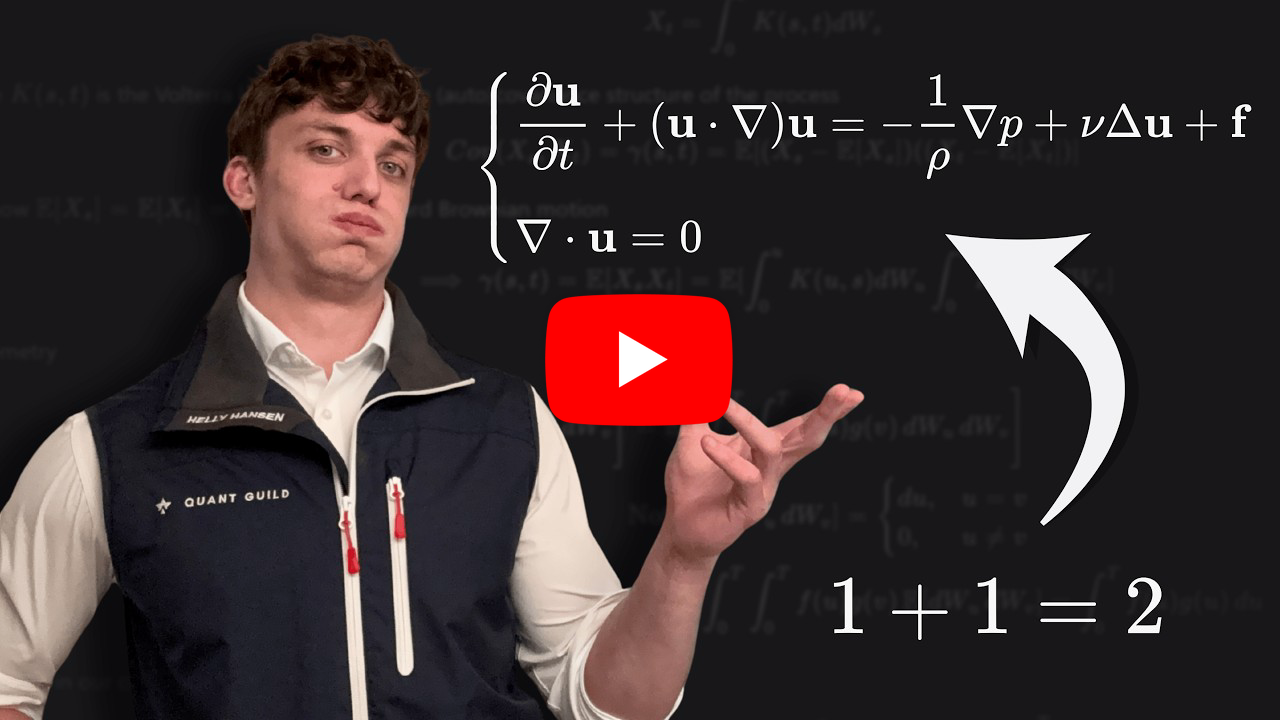
| | 🎲 Quant Solves a Problem from EVERY Level of Math | In this video I solve mathematical problems spanning every stage of a quantitative career, from elementary arithmetic and algebra through calculus, linear algebra, differential equations, abstract algebra, and ultimately unsolved research problems. Along the way, I emphasize not just how to solve each problem, but why each area of mathematics matters in practice and where it appears in quantitative finance, machine learning, and modern technology. Rather than treating mathematics as a collection of disconnected subjects, I show how each concept builds on the last, culminating in the types of open research questions that even today's best mathematicians cannot yet solve. Here's a link to the full video 👇 | | | 📊 Everything I Know About Statistics (After a Murph) | In this video I build probability and statistics from first principles, beginning with classical probability and random variables before connecting those ideas to parameter estimation, stochastic processes, Bayesian reasoning, and modern quantitative finance. Rather than treating statistics as a collection of formulas, I focus on the assumptions that make statistical models work and why those assumptions often fail in real markets. I explain why financial data rarely comes from a fixed data generating process, making model risk unavoidable. This motivates a Bayesian perspective, where models are continually updated as new information arrives and every investment decision is ultimately made under uncertainty. Here's a link to the full video 👇 | | |
|
|
|---|
🧮 Quant Model of the Week |
| Generational Adversarial Networks (GANs) |
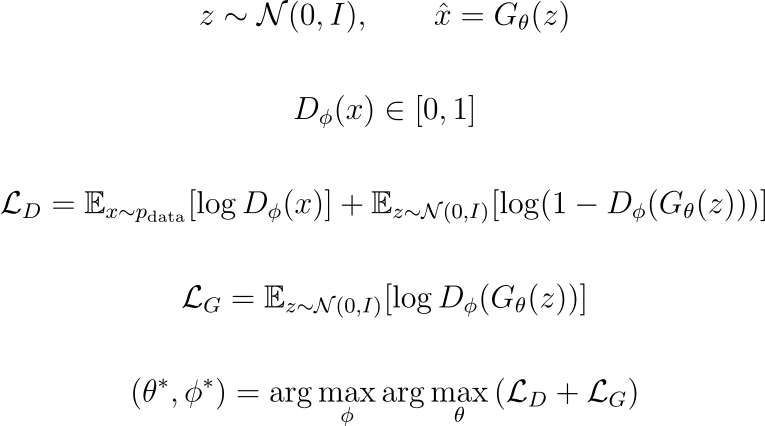
| | Generative Adversarial Networks are about learning to generate realistic data through competition. A GAN consists of two neural networks: a generator, which creates synthetic observations, and a discriminator, which tries to distinguish those observations from real data. As the two compete, the generator gradually learns to produce increasingly realistic samples. This makes GANs particularly interesting for synthetic market data, scenario generation, time-series simulation, volatility surfaces, and stress testing. | | 📚 Model Definition | Let's observe the structure of a GAN... | | A GAN learns through competition between two neural networks: the generator and the discriminator. The generator begins with random noise sampled from a simple distribution and transforms it into synthetic data. In finance, that synthetic observation might be a return series, volatility surface, or market scenario. The discriminator acts as the judge. It receives observations and assigns a score representing how likely they are to have come from the real dataset rather than the generator. The two networks then compete. The discriminator is trained to become better at distinguishing real from synthetic data, while the generator is trained to become better at fooling the discriminator. As training progresses, the generator ideally learns the underlying structure of the real data well enough that its synthetic observations become increasingly difficult to distinguish from reality. GAN training is essentially an adversarial game. One network learns to detect what is fake, while the other learns to become better at creating it. | | 📈 Model Applications | GANs can learn the distributional structure of returns, volatility, order flow, or other financial time series and generate new scenarios that preserve features such as fat tails, volatility clustering, nonlinear dependence, and extreme movements. This makes them useful for Monte Carlo simulation, stress testing, portfolio risk, derivative pricing, and data augmentation, particularly when historical observations are limited. GANs can also be applied to volatility surfaces and market microstructure, generating synthetic states that resemble real markets without simply replaying historical observations. The key advantage is flexibility. Rather than specifying a stochastic process beforehand, we allow the generator to learn complex market distributions directly from data. | | 🎓 A Little Story | I first learned about GANs in the context of John Hull's work on generating synthetic tail risk for volatility surface modeling. That sent me down a completely different rabbit hole. I learned about Ian Goodfellow, the original GAN paper, and eventually this entire world of machine learning and AI research that I had barely scratched the surface of before. What started as a quant problem about generating realistic market scenarios ended up becoming my introduction to a much broader field. Funny how that happens. Sometimes one paper doesn't just teach you a model. It opens an entirely new branch of research you did not even know you were interested in. | | 💡Takeaway | GANs are a reminder that we do not always need to explicitly specify the distribution we want to model. By learning through competition, GANs can reproduce complex structures that traditional parametric models may struggle to capture. The broader lesson is that generating realistic data is not about copying the past. It is about learning enough of its structure to create plausible futures. Missing out on the correct structure forward looking, now that's where you find real portfolio stress: economic crisis. | | 🏆 Quant Question of the Week |
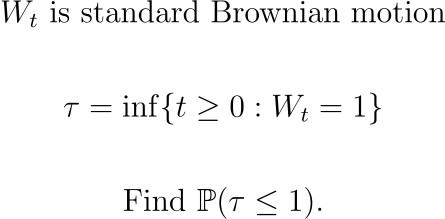
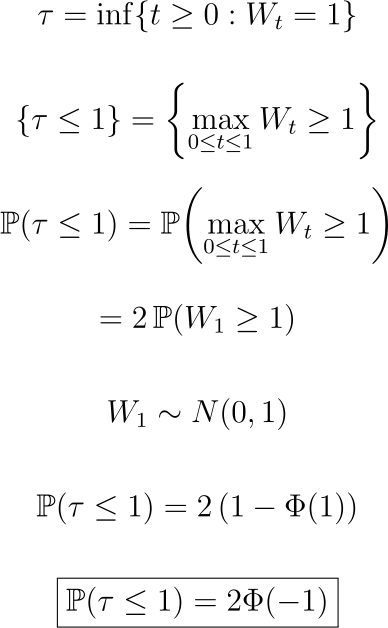
| Solution at the Bottom of this Email 👇 |
| | | Need to study up on topics in math, probability, and finance? 👉 Learn to solve problems like this on Quant Guild — the platform I wish I had when I was studying to become a quant. |
|
|
|---|
| I'm in QR preparing for interviews and your practice helped me brush up on probability, thanks | | |
| |
|
| | I learned more here in two days than an entire semester of college | | |
| - Guy on Discord Who DM'd Me |
|
|
|
|---|
|
| ✅ Quant Question of the Week |
| | | | |
|
|
|---|
|

 Roman Paolucci